
 3 min •
Juraj Ostertag
European Banks Launch Their Own Stablecoin – Market Overview
The cryptocurrency market experienced a slight decline over the past 14 days. Total market capitalization fell from €2.56 trillion to €2.48 trillion during this period. Bitcoin also declined in price, falling from €75,114 to €74,262.
The Fear & Greed Index dropped from 71 to 63 points over the past 14 days, although it remains in the “Greed” zone. The Altcoin Season Index also recorded a slight decline, falling from 59 to 55 points.
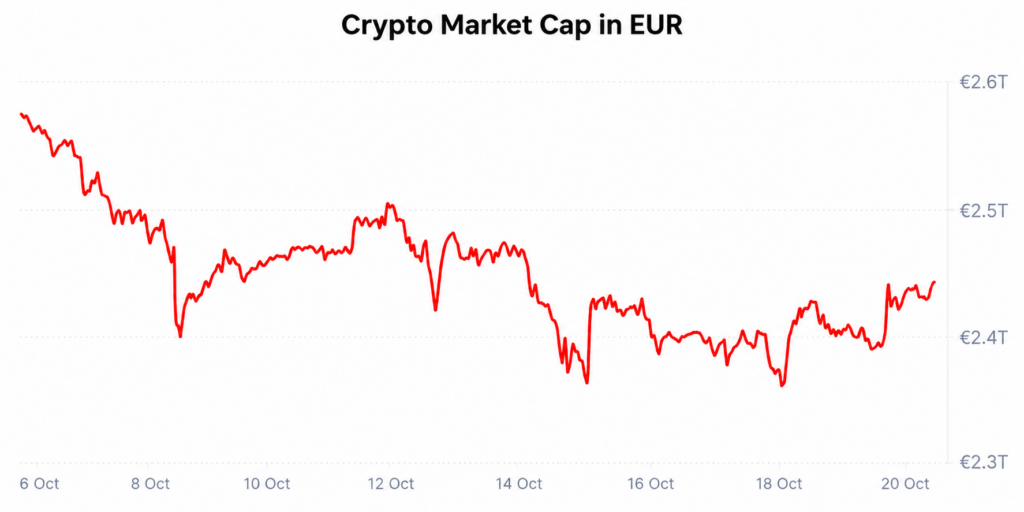
Source: CoinMarketCap
European Banks Launch Their Own Stablecoin
European banks are taking another significant step towards digital finance. Project Qivalis, backed by a consortium of 37 financial institutions from 15 European countries, has received an electronic money institution licence from the Dutch central bank, De Nederlandsche Bank (DNB). This represents an important milestone for the upcoming euro-pegged stablecoin, which aims to provide a European alternative to the digital currencies currently dominating the market. The participating banks include well-known names such as BNP Paribas, ING, UniCredit, BBVA and Erste Group. The licence also means that Qivalis will be subject to ongoing supervision by the Dutch regulator and has met one of the key requirements for issuing digital money.
Project Qivalis was established with the ambition of strengthening the euro’s position in the rapidly growing world of digital payments. The stablecoin will be pegged to the euro at a 1:1 ratio, with each issued unit backed by an equivalent value in euros. Users will therefore gain access to a digital form of the European currency that can be transferred via blockchain without the need to rely on traditional bank transfers for every transaction. Another major advantage will be its availability 24 hours a day, seven days a week. Qivalis plans to support not only everyday digital payments but also international transfers, corporate finance and the settlement of transactions involving tokenized assets.
However, obtaining the licence does not mean that the stablecoin is immediately available on the market. Before launching, Qivalis must fulfil the remaining regulatory requirements under the European Markets in Crypto-Assets Regulation (MiCA), particularly the publication of a mandatory disclosure document known as a white paper. The company plans to begin issuing the stablecoin in the coming months. Distribution is expected to take place through partner banks, cryptocurrency exchanges and payment service providers. Stablecoin holders will also have the right to request redemption in euros at face value at any time. Unlike some other digital products, however, these tokens will not be allowed to generate interest for their holders.
The initiative by European banks is also driven by the desire to reduce dependence on the US dollar. The stablecoin market has long been dominated by dollar-backed tokens, particularly USDT issued by Tether and USDC issued by Circle. Euro-backed stablecoins still account for only a negligible share of the overall market. This is also a concern from the perspective of European financial independence. An increasing proportion of digital payments and trading in tokenized assets takes place through infrastructure built around dollar-backed stablecoins. Qivalis aims to change this situation by creating a solution that combines the advantages of blockchain technology with the European banking sector.
The project represents an alternative to the European Central Bank’s digital euro. While the digital euro is intended to be a digital form of central bank money, Qivalis is developing a privately issued, euro-backed stablecoin subject to European regulation. Both initiatives demonstrate, however, that Europe does not want to be left behind in the transformation of the financial system. The involvement of 37 banks gives Qivalis substantial institutional backing and access to an extensive customer network. Its real test, however, will be user demand and its ability to compete with established dollar-backed stablecoins. Source
The NFT Market Loses a Major Player. Platform BLUR Is Shutting Down
The NFT sector is losing another well-known name. Blur, which became one of the most prominent marketplaces on the Ethereum network during the peak of the digital collectibles boom, is shutting down its main operations. The reason is a dramatic decline in trading activity. Trading volume has fallen by more than 99% compared with its all-time highs. Just a few years ago, Blur was among the fastest-growing projects in the entire NFT sector.
The platform gained popularity primarily thanks to its fast trading experience, advanced tools and zero fees. Unlike its competitors, it focused mainly on active traders who bought and sold NFTs in an attempt to generate profits. This approach helped it overtake the previous market leader, OpenSea. In March 2023, Blur recorded monthly trading volume of approximately $1.43 billion, accounting for more than 70% of NFT trading activity on Ethereum. Three years later, however, the situation was completely different. In March 2026, monthly trading volume fell below $7 million. The BLUR token also suffered a significant decline, with its price dropping by more than 20% following the announcement that the platform would cease operations.
Blur plans to shut down its website on 12 November 2026. On the same day, it will also stop facilitating new loans through its Blend service, which allows users to obtain cryptocurrency loans by using NFTs as collateral. Customers with active loans have been given until the specified deadline to repay them. Otherwise, they risk losing their pledged digital assets. However, shutting down the website does not mean that the project will disappear entirely. The smart contracts will remain functional, and the trading protocol will continue to exist. Users will, however, lose access to the official interface through which they have been trading NFTs.
Blur’s decline is also linked to a business model that proved unsustainable in the long term. The platform attracted users with zero trading fees and token rewards. Although this strategy succeeded in rapidly increasing trading volumes, high activity did not automatically translate into stable revenue. A significant proportion of trading was also driven by the desire to earn rewards rather than genuine interest in the NFTs themselves. This system created pressure across the entire market and negatively affected the rewards creators received when selling their NFTs.
Blur’s departure is another sign that the NFT market has still not recovered from the sharp downturn following the record-breaking period of 2021 and 2022. Digital collectibles have not disappeared from the cryptocurrency world, but interest among investors and traders is significantly weaker than in the past. Blur’s story demonstrates that even a dominant market position and millions in trading volume do not guarantee long-term success. In the cryptocurrency industry, attracting users quickly is not enough. Building a business model capable of surviving even when speculative interest fades is equally important. Source
Ledger Introduces a Smartphone with an Integrated Crypto Wallet
Ledger, best known for its hardware cryptocurrency wallets, has introduced a new product designed to take digital asset security to an entirely new level. Called Ledger Atom, the device looks like a smartphone, but its primary purpose is not making calls or taking photographs. It is designed to combine everyday mobile applications with a secure environment for managing cryptocurrencies, digital identity and sensitive information. Ledger Atom runs on the Android operating system, allowing users to access regular applications such as WhatsApp and Instagram.
Its key feature, however, is a separate security environment called Ledger OS, which operates on an independent security chip. Private keys are stored there, and cryptocurrency transactions are confirmed within this protected environment. Users can therefore browse the internet and use mobile applications without directly exposing their cryptocurrency assets to the regular operating system. When performing sensitive operations, the device switches to a secure mode in which each transaction is displayed separately and final approval requires the user’s physical confirmation.
The device features a 6.77-inch OLED display, a Qualcomm Dragonwing processor and a 4,000 mAh battery that users can replace themselves. Another interesting feature is a physical switch that can disconnect the camera and microphone at the hardware level. Ledger Atom will also support encrypted communication between users of the same device. The company is also addressing the growing importance of artificial intelligence. Thanks to the integration of AI agent tools, users will be able to assign various financial tasks to AI assistants without giving them direct access to their cryptocurrencies. The agent will prepare the requested operation, but final approval will remain in the hands of the device owner. The new device will also include the Seeker application from Solana Mobile, providing access to the Solana ecosystem and more than 1,500 decentralized applications.
The timing of the announcement is relatively sensitive for Ledger. The company recently confirmed a security incident in which unauthorized hardware modifications were found in some hardware wallets sold through an external distributor. These modifications were capable of capturing users’ recovery phrases and sending them to attackers. Estimates link the incident to losses exceeding $86 million, although Ledger has not officially confirmed the total amount of damage. The new Atom therefore also introduces improved protection against physical tampering. It can detect attempts to open the device or modify its security components, while the company also highlights protective features built into its packaging. Ledger plans to sell the new device exclusively through its official website.
Ledger Atom is expected to reach the market in summer 2027. Interested customers can already reserve the limited Founder’s Edition for $849, with a refundable deposit of $100 required. Following its official launch, the standard price is expected to be $899. This makes it considerably more expensive than traditional Ledger hardware wallets, which are available at a completely different price point. However, the company is not trying to compete with traditional smartphone manufacturers. Its goal is to attract people who prioritize cryptocurrency security, privacy and digital identity protection. Whether customers will be willing to pay almost $900 for a device that does not replace a fully fledged smartphone remains to be seen. Source
Financial Giant Charles Schwab Makes Bitcoin and Ethereum Available to Millions of Investors
American financial services company Charles Schwab is expanding its presence in the cryptocurrency market. Its Schwab Crypto service, which allows customers to buy and sell Bitcoin and Ethereum directly, is now available to all eligible retail clients in the United States. This marks the end of the gradual rollout of cryptocurrency services on the platform, which began in May 2026.
The development is particularly significant because of the company’s sheer size. Charles Schwab manages nearly $13 trillion in assets and serves tens of millions of clients. Cryptocurrencies are therefore gaining access to one of the world’s most prominent investment firms. Clients can also trade them in the same place where they manage stocks, funds and other investment products.
Chart: Client Assets Under Management (USD)

Source: YCharts
Schwab Crypto is linked to customers’ existing investment accounts and is available through the company’s website, mobile application and trading platform. At launch, it offers the two largest cryptocurrencies by market capitalization: Bitcoin (BTC) and Ethereum (ETH). However, the company announced plans in August to expand its offering to include Solana (SOL), Avalanche (AVAX) and Chainlink (LINK). These cryptocurrencies are expected to be added before the end of 2026. Charles Schwab charges a fee of 0.75% of the transaction value for each trade.
Another important development is the gradual introduction of the ability to transfer existing cryptocurrencies into Schwab Crypto accounts. When the platform first launched, clients could only buy and sell cryptocurrencies directly through the company. Charles Schwab is now gradually allowing Bitcoin and Ethereum deposits from external wallets as well. A 24-hour security waiting period applies when adding an address for asset withdrawals. However, the company has not yet announced whether customers will be able to transfer cryptocurrencies back to external wallets. Digital asset custody is provided through Charles Schwab Premier Bank, while the technological infrastructure, sub-custody and trade execution are handled by Paxos. It is also important to note that cryptocurrencies held on the platform are not bank deposits and are not covered by FDIC insurance or SIPC protection.
Charles Schwab’s entry into direct cryptocurrency trading represents another step towards the gradual integration of traditional finance and digital assets. Even before launching its own trading service, the company had already provided clients with exposure to cryptocurrencies through exchange-traded products, funds and futures contracts. Direct purchases of Bitcoin and Ethereum therefore expand its existing offering by allowing customers to own the digital assets themselves rather than simply investing in products that track their prices.
However, the service is not yet available to everyone. Schwab Crypto is intended for eligible clients in the United States and is currently unavailable to residents of New York and Louisiana, as well as customers outside the US. For the cryptocurrency market, however, the most important aspect is the sheer scale of this development. Charles Schwab is entering a segment that has so far been dominated by specialized cryptocurrency exchanges such as Coinbase and Binance. If the company manages to convince even a portion of its existing clients to invest in cryptocurrencies, digital assets will gain access to an enormous pool of traditional investors. It is also another indication that Bitcoin and Ethereum are gradually becoming a standard part of the investment services offered by major financial institutions. Source
Charles Hoskinson Is Developing a New Programming Language for Cardano
Cardano founder Charles Hoskinson is working on a new programming language designed to expand the capabilities of the blockchain platform. He is collaborating on the project with Lucas Rosa, a software engineer at Input Output Global (IOG), the company responsible for Cardano’s development. The new language is intended to combine so-called transaction intents, data accompanied by cryptographic proofs and advanced Groth16 technology. The goal is to simplify the execution of complex operations while ensuring that their correctness can be verified quickly and reliably. Hoskinson announced the initiative on 18 October through a post on the social media platform X. However, he has not yet revealed the name of the new language, its technical specifications or the expected completion date.
One of the main innovations will be transaction intents. This is an approach to submitting requests in which users specify the outcome they want to achieve without having to define every technical step required to execute it. For example, if someone wants to exchange one token for another, they simply specify the desired exchange and the conditions under which they want it to take place. The application then identifies an appropriate way to execute the transaction. Users therefore do not need to understand complex background processes or manually select individual steps. A similar approach could also simplify connections between different decentralized applications and services.
Another important component of the project is so-called proof-carrying data, meaning information accompanied by a cryptographic proof of its correctness. In practice, this means that information also contains proof that allows another system to verify whether it meets the specified requirements. The Groth16 technology, which belongs to a category of systems using zero-knowledge proofs, is expected to support this process. These proofs make it possible to confirm the validity of certain information without revealing all the underlying data. Their main advantages include faster verification and greater privacy. Combining these technologies could give developers the opportunity to build applications capable of processing complex requests while providing verifiable results without having to repeat all the calculations.
Cardano already has its own tools for developing smart contracts. The best-known examples include Plutus, which is based on the Haskell programming language, and Aiken, which was specifically designed to meet the needs of developers within the Cardano ecosystem. Lucas Rosa himself contributed to the creation and development of Aiken. The new programming language therefore represents a further expansion of the existing technological infrastructure. It is not yet clear, however, whether it will operate alongside the current tools or introduce an entirely new approach to building decentralized applications. A similar approach to data protection is also used by the Midnight project, developed within Input Output Global, which focuses on privacy and the use of zero-knowledge proofs.
Hoskinson’s project comes at a time when Cardano continues to expand its technological capabilities and aims to become more attractive to decentralized application developers. The new language is still under development, and its practical applications remain uncertain. If the announced vision becomes reality, developers will gain a tool for building applications that can process transactions more efficiently, verify their correctness and better protect sensitive information. For Cardano, this would represent another step in its technological development and an effort to compete with other blockchain ecosystems that are actively working to make decentralized services easier to use. Source
Zcash Is Preparing Protection Against Quantum Computers
Zcash is introducing another solution designed to protect users’ privacy against future quantum computers. Developers from the Zakura group have proposed an upgrade that will prevent individual private transactions from being linked through a public address. Their focus is on a specific vulnerability that occurs when exchanging cryptocurrencies through the NEAR Intents service. This service allows users to exchange digital assets across different blockchains, for example, private Zcash (ZEC) for the USDC stablecoin. However, during such a transaction, the system publishes a Zcash address on the blockchain to which unused funds are returned if the transaction fails. This address remains publicly accessible even when the transaction is completed successfully and no funds are returned. Developers consider this a security vulnerability that today’s conventional computers cannot exploit, but future quantum technologies potentially could.
Zcash is one of the cryptocurrencies whose main advantage is the protection of financial privacy. Its shielded transactions can conceal the sender, recipient and transferred amount. The problem is that individual addresses within the same wallet typically share the same viewing key. This key allows the wallet to recognize incoming transactions and display their details. Today’s computers cannot reverse-engineer this key from a public address. However, a sufficiently powerful quantum computer could potentially break the underlying mathematical security in the future using Shor’s algorithm. After obtaining one key, an attacker could therefore reveal the entire wallet’s incoming payment history, including transaction amounts and private messages attached to transactions.
The solution proposed by Zakura involves assigning each cryptocurrency exchange through NEAR Intents its own unique transaction viewing key. Instead of using one shared key, every operation would have a separate identity. If a quantum computer manages to break the security of one publicly accessible address in the future, an attacker would gain access only to information about that specific exchange. All other transactions would remain hidden. Importantly, the main key used to sign transactions and spend cryptocurrencies would remain exclusively under the user’s control. Developers are also addressing the practical aspects of the new system. After hundreds of exchanges, a wallet would have to manage hundreds of separate keys and search the entire blockchain when restoring funds from a backup. A technology called Private Information Retrieval (PIR) is expected to help. It allows users to search for the necessary transactions in a database without revealing to the database operator which addresses they control.
The advantage of the proposed upgrade is that it does not require any changes to the Zcash blockchain itself. It is an improvement at the software wallet level that developers can gradually implement. The Vizor wallet is expected to be among the first to adopt it, while support for hardware wallets will come later. Zakura aims to make the new solution available in the coming weeks, ahead of the January target date. This is not the first initiative of its kind. In July 2026, Zcash activated the Ironwood upgrade, which introduced a new private pool with a dedicated mechanism allowing funds to be recovered in the event that current cryptography is compromised. However, this upgrade alone does not mean that the network is fully resistant to quantum attacks. Zakura’s new proposal therefore addresses another important piece of the puzzle. Developers do not want to wait until quantum computers actually become a threat. Their goal is to eliminate potential vulnerabilities today and preserve users’ financial privacy. Source
Invest with Fumbi Today
Take advantage of the potential of cryptocurrencies easily, safely, and efficiently. Start investing with Fumbi with amounts starting from just €10. The Fumbi Algorithm in the Fumbi Index Portfolio tracks cryptocurrency market movements for you. If you want to create your own crypto portfolios, choose the Advanced Portfolios product, where you’ll have access to over 120 cryptocurrencies and templates created by our team, focusing on different areas of the crypto world.
REGISTEREncountered a term you don’t understand? No worries! All important crypto-related terms can be found in one place in our new Fumbi Dictionary.

Juraj Ostertag 
Fumbi


