
 3 min •
Juraj Ostertag
3 min •
Juraj Ostertag
Bitcoin surges above $87,000 as crypto market regains momentum – Market Info
The cryptocurrency market recorded another sharp increase over the past 14 days. Total market capitalization rose from €2.31 trillion to €2.58 trillion during this period. Bitcoin gained a significant 11.7%, rising from €67,647 to €75,580.
The Fear & Greed Index increased from 65 to 71 points over the past 14 days. This value falls within the “greed” range. As a result of the strong growth of the crypto market as a whole, the Altcoin Season Index increased from 43 to 53 points.
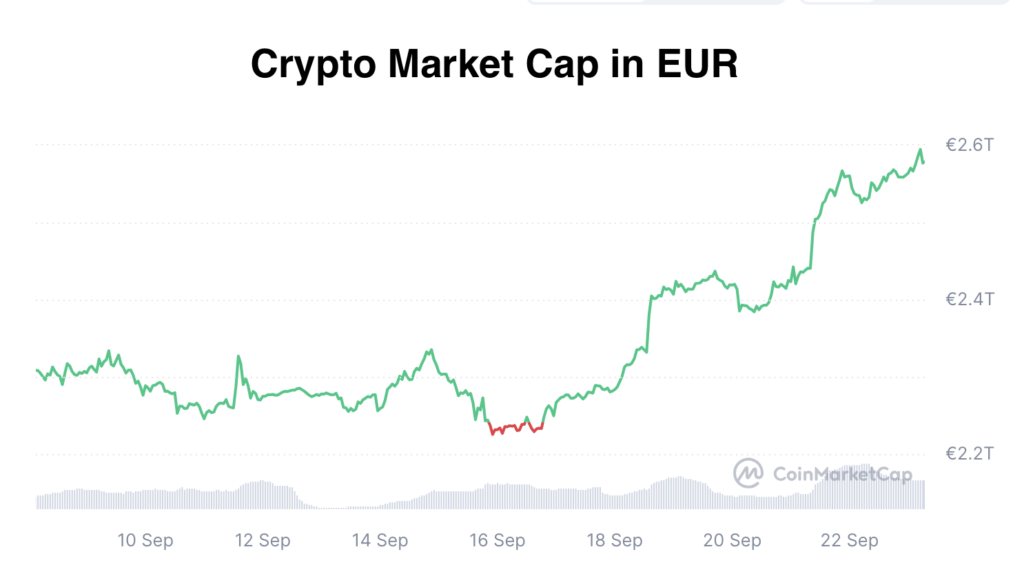
Source: CoinMarketCap
Bitcoin surges above $87,000 as crypto market regains momentum
The cryptocurrency market has experienced several exceptionally strong days. After weeks of uncertainty, Bitcoin rose sharply and broke above the $87,000 mark. Just a few days earlier, it had been trading around $76,000. The rest of the market is rising alongside Bitcoin, while investor sentiment is changing rapidly. All of this is happening despite the fact that the U.S. Federal Reserve took a step last week that would normally be considered unfavorable for cryptocurrencies.
On 16 September, the U.S. Federal Reserve raised its key interest rate by 0.25 percentage points to a range of 3.75% to 4%. It was the first rate hike in three years, and the central bank also indicated that the fight against inflation was not yet over. Higher interest rates usually create less favorable conditions for risk assets, as they make safer investments more attractive and increase the cost of capital. This time, however, the crypto market reacted in exactly the opposite way. Instead of falling further, Bitcoin gained momentum and has risen by thousands of dollars since the Fed’s decision. Positive sentiment also spread to U.S. equities, with the tech-heavy Nasdaq closing at an all-time high on Monday.
Altcoins also strengthened over the past few days. Sui, Avalanche and Dogecoin were among the assets that posted significant gains, while investor interest once again began spreading beyond the largest cryptocurrencies. Bitcoin has also risen by more than 40% since the beginning of the third quarter, bringing a completely different atmosphere to the market after a more difficult first half of the year. Buyers are returning and trading activity is increasing sharply. Strong momentum is also coming from U.S. investors. Spot Bitcoin ETFs recorded net inflows of $999 million on Monday, their best day in nearly eleven months. The return of capital to ETFs is an important signal because it shows that the rally is not being driven solely by short-term speculation among retail traders, but that investors using regulated exchange-traded products are also returning to the market in significant numbers.
Part of the sharp rise was also fueled by traders who had bet on a decline in the crypto market. As Bitcoin began breaking through its September highs, a wave of short-position liquidations swept through the market. Nearly $648 million worth of positions were liquidated within 24 hours, creating additional buying pressure on Bitcoin and helping push its price higher. After months of caution, stronger optimism and a greater appetite for risk are returning to the market. By breaking above $87,000, Bitcoin entered a price range the market had not seen for several months, with $90,000 now representing the next major psychological level. Rising ETF inflows, stronger demand and returning optimism are creating favorable conditions for further growth. At the same time, however, pressure to take profits is also increasing, meaning sharper moves in either direction cannot be ruled out. The end of September is therefore bringing noticeably better sentiment to the crypto market, with Bitcoin once again attracting investor attention after its strong rally. Source
CLARITY Act fails in the Senate, delaying U.S. crypto market rules
The United States came close to passing one of the most significant cryptocurrency laws of recent years. The CLARITY Act was designed to introduce clearer rules for digital assets and, in particular, determine which cryptocurrencies fall under the supervision of the Securities and Exchange Commission (SEC) and which are overseen by the Commodity Futures Trading Commission (CFTC). The bill had already passed the House of Representatives in July 2025 by a vote of 294 to 134. However, it failed in the Senate on 15 September 2026. This was not a final vote on the legislation itself, but rather a procedural step intended to open the way for further consideration. Sixty votes were required for it to pass, but the result was 49 in favor and 50 against. Republicans Susan Collins, Josh Hawley and Jerry Moran voted against it, as did Republican Thom Tillis. The CLARITY Act has not been definitively rejected, but its passage has been postponed indefinitely.
The proposal was intended to resolve an issue that has affected the U.S. crypto market for years – the unclear boundary between securities and commodities. This distinction determines which rules apply to a particular token or service and which regulator has authority over it. The CLARITY Act would have expanded the CFTC’s authority over the spot market for digital commodities while defining the SEC’s role more precisely. After more than a year of negotiations, the proposal had grown to hundreds of pages, with additional amendments incorporated shortly before the vote. These addressed areas such as DeFi protocols, anti-money laundering rules, the powers of state attorneys general and protections for banks against potential deposit outflows into stablecoin products. Even these changes were not enough to secure the necessary support. Some Democrats called for stricter ethics rules for senior public officials with financial interests in the crypto sector. The cryptocurrency activities of President Donald Trump’s family also became a major topic. Other concerns focused on combating illicit financial activity and the rules governing decentralized services. The banking lobby also raised objections, warning that some stablecoin products could draw deposits away from traditional banks. The bill’s authors, by contrast, argued that the final version already included extensive compromises, including new ethics provisions and greater protections for community banks.
The failed vote means that the U.S. crypto market will not yet receive the unified legal framework the industry had expected. Much of the work will therefore once again shift to the SEC and CFTC, which can develop rules within their existing authority. Such an approach, however, is less stable than legislation passed by Congress. Regulatory rules can be changed by a future administration and may also become the subject of legal challenges. SEC Chair Paul Atkins has also warned that long-term rules for the crypto market would remain more vulnerable without legislative backing. The Senate setback also stands in sharp contrast to 2025, when Congress managed to pass the GENIUS Act with bipartisan support, establishing federal rules for stablecoins.
The story of the CLARITY Act is not over yet. A group of Democrats, including Kirsten Gillibrand, said the day after the vote that they wanted negotiations to continue and that they still supported the creation of a common regulatory framework. The question is therefore no longer only whether the United States will adopt rules for the broader crypto market, but also whether lawmakers will be able to reach a compromise during the current Congress. Source
Strategy expands its Bitcoin holdings by 950 BTC
Strategy has returned to buying Bitcoin after a three-week pause. Between 14 and 20 September, the company acquired 950 BTC for $75.7 million, at an average purchase price of $79,670 per Bitcoin including fees. This was its first purchase since the end of August, when the company added 4,603 BTC to its reserves for $370 million. Following the latest transaction, Strategy now holds a total of 846,000 BTC, for which it has paid an extraordinary $63.8 billion to date. The average purchase price of its entire portfolio stands at $75,416 per BTC. The company therefore owns approximately 4% of Bitcoin’s maximum supply and remains one of the largest corporate holders of Bitcoin in the world.
Table of the last 20 BTC purchases and sales
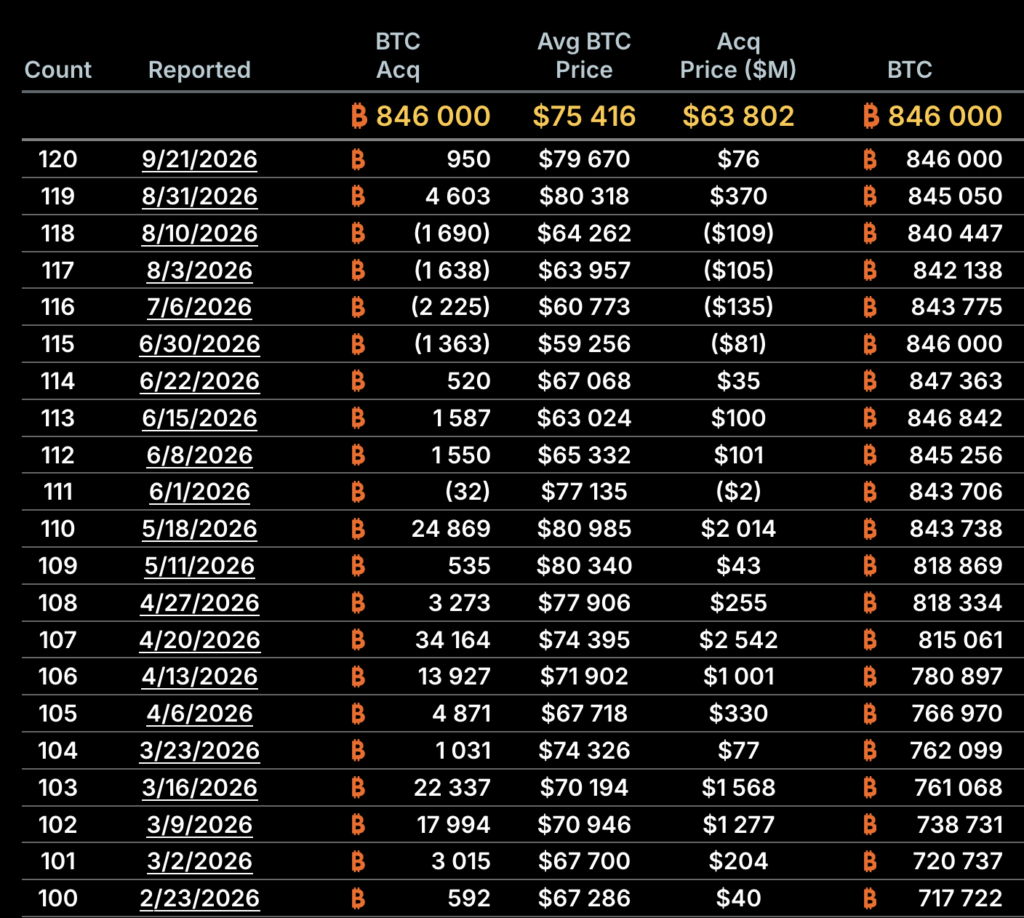
Source: Strategy
Another interesting aspect of the latest transaction is how Strategy financed it. This time, the company did not fund the purchase through the sale of newly issued shares, as it had done with several previous Bitcoin acquisitions. The entire $75.7 million was paid from the company’s cash reserves. Strategy also took additional steps related to financing its financial products. During September, it spent $174 million repurchasing 1.77 million STRC preferred shares. It therefore spent more than twice as much on the buyback as it invested in its latest Bitcoin purchase.
The latest Bitcoin purchase follows a period during which Strategy reduced part of its Bitcoin reserves. At the end of June, it held 846,000 BTC, but during July and August it sold part of its holdings, reducing its reserves to 840,447 BTC by mid-August. At the end of August, however, Strategy purchased another 4,603 BTC, and its latest acquisition of 950 BTC has brought its total reserves back to 846,000 Bitcoin. The announcement also came as the crypto market was recovering and Bitcoin broke above the $86,000 mark. Strategy, formerly known primarily as the software company MicroStrategy, now bases its corporate strategy largely around Bitcoin and describes itself as a “Bitcoin Treasury Company.” The latest purchase therefore confirms that Bitcoin remains a key part of its long-term strategy. Source
Google and Apple are looking for crypto experts
Stablecoins and tokenization are gradually moving from the world of cryptocurrencies into the center of attention of the world’s largest technology companies. The latest signal comes from job postings by Apple and Google, which are looking for professionals with experience in blockchain, stablecoins and tokenized bank deposits. Apple has opened a position for an Apple Pay Financial Product Strategy Lead, who will help shape the long-term strategy of Apple Pay, Apple Cash and Apple Card. Preferred qualifications explicitly include knowledge of stablecoins, tokenized deposits and blockchain technologies. This is therefore not simply a technical position somewhere on the edge of the company, but a role responsible for evaluating new products, business models, partnerships and opportunities for further growth directly within Apple’s payments ecosystem. Google is going even further. For Google Cloud, it is looking for an Industry Principal Architect for Web3 in Hong Kong who will work with financial institutions, crypto exchanges, digital asset custodians and blockchain projects across the Asia-Pacific region. Required experience includes the tokenization of real-world assets, stablecoin payment networks, tokenized deposits and digital asset custody infrastructure.
The job postings themselves do not mean that Apple is preparing its own stablecoin or that Google Pay will soon allow users to pay with cryptocurrencies. They do, however, show that technologies that only a few years ago belonged primarily to crypto exchanges and fintech startups are no longer viewed by Big Tech as a niche area. At Google, this shift is already visible today. The company has developed the Agent Payments Protocol (AP2), which enables secure payments performed by AI agents and supports various payment methods, including stablecoins and cryptocurrencies. Google Cloud also offers Universal Ledger, infrastructure that allows companies to create tokenized assets, digital payment services and financial products operating on a distributed database. The new hiring push therefore does not come out of nowhere, but fits into Google’s broader effort to build technologies for a world in which traditional payments, AI and blockchain are increasingly interconnected. Apple remains more cautious, but the very fact that it considers knowledge of stablecoins and tokenized bank deposits relevant for shaping Apple Pay’s strategy shows how quickly traditional technology companies’ view of digital assets is changing.
The growing interest is being driven primarily by the shift of stablecoins from cryptocurrency trading toward real-world payments. Their main advantage is the ability to transfer digital dollars virtually around the clock, quickly and in a programmable way, without requiring users to hold a volatile cryptocurrency. Traditional payment companies are therefore beginning to use this infrastructure much more actively. Visa says that more than 160 card programs connected to stablecoins are already operating on its network, while their payment volume has increased by nearly 200% year over year and stablecoin settlement volume has exceeded $20 billion. At the same time, the tokenization of bank deposits and traditional financial assets is also growing and could prove even more important to major banks and technology companies than cryptocurrencies themselves. All of this is creating a new environment in which the boundary between traditional money and blockchain is gradually beginning to disappear. Neither Apple nor Google has announced a new crypto product so far, but their hiring efforts clearly point to one thing: if stablecoins and tokenized money become the next generation of payment infrastructure, the largest technology companies will not want to be left behind. Source
Solana tests transaction finality of up to 150 milliseconds
Solana has begun testing one of the biggest upgrades in its history on a test network. The upgrade, called Alpenglow, is designed to dramatically reduce the time required for a transaction to be considered final – from the current approximately 12.8 seconds to around 150 milliseconds, or 0.15 seconds. This is not merely another improvement in transaction processing speed. The key concept in this case is so-called finality, meaning the point at which the network considers a block confirmed and no further changes are expected. This level of certainty is what crypto exchanges wait for before crediting deposits, blockchain bridges before releasing assets on another network, or merchants before accepting payments as final. If Alpenglow achieves its planned performance under real-world conditions, this process could become more than 80 times faster, with users waiting only a fraction of a second for final confirmation.
The dramatic increase in speed comes from a complete change in the way Solana validators agree on the final state of the blockchain. Today, the network uses a mechanism called TowerBFT, under which validators record their votes directly on the blockchain and a sufficient number of votes must be collected across 32 slots before finality is reached. Alpenglow replaces this with a new system called Votor. Under this system, validators send votes directly to one another, and under suitable conditions a block can receive final confirmation after just one round of voting. If the required majority is not reached immediately, a second round follows. The way people use Solana, however, will not change as a result. Transactions, smart contracts, fees and the Solana Virtual Machine will continue to work in the same way, and users will not need to change their wallets or the way they send cryptocurrencies. The change takes place primarily within the technical operation of the network. According to Solana’s documentation, the new system is also designed to cope with situations in which some validators are unavailable. The protocol is designed to tolerate 20% of stake being offline and another 20% potentially behaving maliciously.
Alpenglow has already been running for several months in a smaller experimental environment created specifically for its development. Moving it to the public testnet is therefore an important step: the new mechanism is entering an environment where existing infrastructure operators can test it and where it will become clear how it handles the migration of a larger number of validators at once. Solana itself expects the upgrade to be activated only after testing and stabilization have been completed. However, if approximately 150-millisecond finality can be safely implemented on the mainnet, it would represent a major change for Solana. The blockchain could offer users and financial applications not only fast transaction processing, but also near-instant certainty that the outcome of a transaction is final. Source
European central banks push to restrict stablecoin yields
European central banks want to tighten stablecoin rules and prevent crypto platforms from offering users yields through lending, staking or similar services. The European Central Bank, together with the national central banks of EU member states, submitted the proposal to the European Commission as part of the review of the MiCA regulation. MiCA already prohibits stablecoin issuers and crypto service providers from paying interest or other rewards directly for simply holding a stablecoin. According to central banks, however, there is room to circumvent this restriction, for example by allowing users to provide their stablecoins to a platform for lending or place them in a product described as staking in return for regular yield. This is the loophole central banks want to close. They argue that stablecoins should primarily serve as a means of payment under the European regulatory framework, rather than as an equivalent of a savings account. If stablecoin holders were able to earn a regular yield regardless of the type of product through which it is paid, stablecoins would increasingly resemble traditional interest-bearing bank deposits.
This issue is not merely theoretical. Several crypto platforms already offer yields on stablecoins, with the money used to pay these returns coming from a variety of sources. An analysis by the Bank for International Settlements shows that some centralized exchanges are able to reward stablecoin holders using returns generated by reserve assets, while others rely on trading revenue or other activities carried out by the platform. When interest rates are higher, a stablecoin combined with such a service can therefore begin to resemble a savings product from the user’s perspective. This is precisely what European central banks are concerned about from the perspective of the traditional banking system. If a large amount of money were to move from bank accounts into stablecoins offering comparable or higher yields, banks could lose part of the stable retail deposits they use to finance their operations. The ECB has previously warned that stablecoins have growing potential to compete with traditional financial products. Their global market capitalization stands at around $300 billion, with approximately 90% of the market accounted for by the two largest U.S. dollar stablecoins, USDT and USDC. Euro-denominated stablecoins remain significantly smaller.
Central banks are also proposing changes to the way stablecoin issuers are required to hold their reserves. MiCA currently requires at least one-third of reserves to be held in the form of bank deposits, while the proportion can reach 60% for stablecoins classified as significant. However, the ECB and national central banks point to the opposite problem: if a stablecoin issuer needed to redeem a large number of customers during a crisis, it could withdraw a significant amount of money from banks at once and place additional pressure on them. Instead of requiring a fixed proportion of bank deposits, they therefore propose placing greater emphasis on how quickly reserve assets can be converted into cash. Reuters reports that central banks support a model based on the liquidity of assets with maturities of between one and five business days. The proposal therefore aims on the one hand to impose stricter restrictions on stablecoin yields, while on the other hand it could also change the rules governing how stablecoins operate and how their reserves are managed. For now, this remains only a position submitted as part of the MiCA review. The European Commission’s next steps will determine whether these recommendations make it into proposed new rules and, if so, how they would apply to crypto exchanges, lending platforms and staking services in the EU. Source
Invest with Fumbi Today
Take advantage of the potential of cryptocurrencies easily, safely, and efficiently. Start investing with Fumbi with amounts starting from just €10. The Fumbi Algorithm in the Fumbi Index Portfolio tracks cryptocurrency market movements for you. If you want to create your own crypto portfolios, choose the Advanced Portfolios product, where you’ll have access to over 120 cryptocurrencies and templates created by our team, focusing on different areas of the crypto world.
OPEN PROFILEEncountered a term you don’t understand? No worries! All important crypto-related terms can be found in one place in our new Fumbi Dictionary.

Juraj Ostertag 
Fumbi


