
 3 min •
Juraj Ostertag
Binance Suffers the Largest Hack in Cryptocurrency History – Market Info
The cryptocurrency market declined over the past 14 days. Total market capitalization fell from €2.48 trillion to €2.31 trillion during this period. The price of Bitcoin also dropped from €74,262 to €68,695.
The Fear & Greed Index fell sharply over the past 14 days, dropping from 63 to 26 points as the market moved out of the “greed” zone and into the “fear” zone. The Altcoin Season Index also declined significantly, falling from 55 to 37 points.
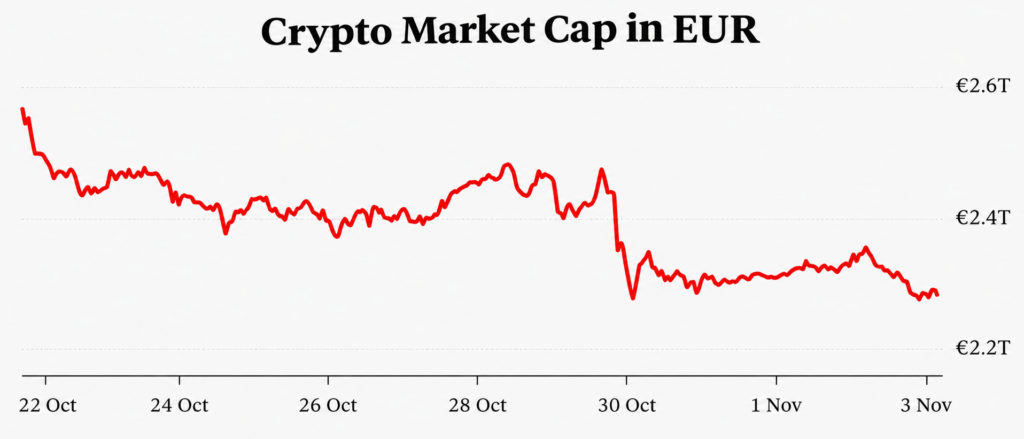
Source: CoinMarketCap
Binance Suffers the Largest Hack in Cryptocurrency History
The cryptocurrency market has experienced one of the most serious security incidents in its history. On October 29, 2026, Binance, the world’s largest cryptocurrency exchange, became the target of a massive cyberattack in which hackers stole approximately $6.3 billion worth of cryptocurrencies. It is the largest known theft of digital assets, significantly surpassing the attack on the Bybit exchange in February 2025. The incident affected multiple blockchain networks and forced Binance to temporarily suspend cryptocurrency withdrawals. Millions of users were left uncertain about whether their funds were safe and when they would regain access to them.
Initial findings from the investigation suggest that the attackers did not compromise the security of the blockchain itself. Instead, they exploited weaknesses in the exchange’s internal infrastructure, which manages enormous amounts of client assets. The incident has once again raised questions about the security of centralized cryptocurrency platforms and the risks associated with entrusting digital assets to third parties.
According to Binance’s preliminary findings, a compromised work laptop belonging to one of its technical employees played a significant role in the attack. The attackers subsequently managed to exploit internal permissions and withdrawal approval mechanisms. This allowed them to gain access to so-called hot wallets, which are internet-connected wallets used by exchanges for everyday transactions. From these wallets, they transferred cryptocurrencies to addresses under their control.
Binance stated that it had not yet found evidence of private keys being stolen directly. Nevertheless, the scale of the attack was extraordinary. According to blockchain analysts, approximately 18,270 bitcoins worth $1.4 billion, more than 200,000 ETH, and other cryptocurrencies, including XRP, SOL, and the stablecoins USDT and USDC, were stolen. The attack affected a total of ten blockchain networks. Security experts also reported the use of malicious software designed to erase some of the digital traces left behind after the attack. The case demonstrates that even extensive security measures may prove insufficient if attackers gain control over critical internal company processes.
Chart: The Largest Hacks in Cryptocurrency History

Source: Reuters
The investigation quickly took on an international dimension. On October 31, the US Federal Bureau of Investigation (FBI) confirmed that the North Korean hacking group TraderTraitor, linked to the well-known Lazarus Group, was responsible for the attack. The group has been associated with several major cyberattacks targeting cryptocurrency companies. The hackers immediately attempted to split the stolen assets and transfer them across different blockchain addresses. The stolen bitcoins were distributed among 19 wallets, 17 of which contained exactly 1,000 BTC each. Such distribution makes it more difficult to track subsequent movements and potentially recover the funds. The FBI therefore published hundreds of addresses associated with the attack and called on cryptocurrency exchanges, analytics companies, and decentralized service providers to cooperate. Investigators also warned that the attackers were converting some of the stolen assets into Ethereum and using various decentralized finance services to conceal their origin.
One particularly interesting aspect of the incident is the difference between individual cryptocurrencies. Although hackers stole assets worth billions of dollars, some of the funds were successfully blocked. Binance announced that, in cooperation with other companies, it had managed to freeze approximately $3 billion worth of assets. The issuers of the stablecoins Tether and Circle played a significant role in this effort. These companies have the technical ability to block transfers of their USDT and USDC tokens from specific addresses.
However, no comparable mechanism exists for Bitcoin or native Ethereum. If an attacker gains control of the relevant wallet, the blockchain network itself cannot unilaterally freeze the funds. Transactions can be publicly traced, but they cannot be reversed once confirmed. This highlights one of the greatest paradoxes of cryptocurrencies. Centralization creates security risks by concentrating large amounts of assets under the management of a single company. At the same time, it enables rapid intervention during security incidents. Freezing tokens, however, does not automatically mean that they will be returned to their original owners.
Immediately after the attack, Binance faced another serious challenge. The exchange had to reassure its clients that it held sufficient funds to cover the losses. The company announced that it would absorb the financial consequences of the incident and that clients would not bear the losses resulting from the stolen assets. To restore its reserves, Binance used its own corporate funds, insurance mechanisms, and the SAFU fund, which is designed to protect users during extraordinary events. By November 1, the company reported that it had replaced approximately 95% of the affected assets. The remaining portion consisted mainly of less liquid cryptocurrencies, which require more time to purchase in large volumes. Binance also began gradually restoring withdrawals, which had been suspended for approximately 45 hours. Bitcoin withdrawals were among the first to be enabled, followed by other widely used cryptocurrencies, including Ethereum, Solana, and XRP. Services were restored across individual networks gradually, depending on security checks. The exchange also published updated information about its reserves and declared that balances in major cryptocurrencies remained fully backed.
However, the restoration of withdrawals immediately triggered significant capital movements. According to data from the analytics platform DefiLlama, assets worth more than $6 billion left wallets associated with Binance within 24 hours. This represented approximately 3.6% of the value of assets held by the exchange before the attack. However, not all these transfers necessarily represented client withdrawals, as public blockchain data also includes movements between the exchange’s internal wallets. During the first nine and a half hours after services resumed, Binance reported withdrawals of $4.65 billion and deposits of approximately $1.01 billion. This resulted in a net outflow of $3.64 billion. Competing exchanges OKX and Bybit also recorded increased activity as new deposits flowed onto their platforms. Despite the substantial outflows, Binance remained one of the world’s largest cryptocurrency platforms, holding extensive reserves. Nevertheless, the situation demonstrated how quickly client confidence can change following a security incident and highlighted the importance of an exchange’s ability to maintain smooth withdrawals even during extraordinary events.
The largest hack in cryptocurrency history has also sparked a broader discussion about digital asset security. Unlike the traditional banking system, where mechanisms exist to stop or review suspicious transfers, confirmed blockchain transactions are generally irreversible. Stolen cryptocurrencies can therefore move through numerous wallets and decentralized services within minutes. Although public blockchains make it possible to track these movements, transparency alone does not guarantee the recovery of stolen funds. The incident therefore emphasizes the importance of multilayered security, strict access controls, secure private key management, and the separation of client assets from day-to-day operations.
Equally important is a company’s ability to manage a crisis without putting its customers’ assets at risk. The Binance case also serves as a reminder that cryptocurrency security depends not only on the blockchain itself but, above all, on how digital assets are managed. As the number of users and the amount of invested capital continue to grow, security and transparency are becoming increasingly important factors in maintaining trust across the entire cryptocurrency sector. Source
Wall Street Investment Legend Backs Hyperliquid
One of Wall Street’s most prominent investors, billionaire Stanley Druckenmiller, surprised the financial world with his first post on the social media platform X. Instead of commenting on stock markets or the US economy, he announced an investment in Trade[XYZ], a company operating within the ecosystem of the cryptocurrency platform Hyperliquid. The 73-year-old investor, known for successfully managing multibillion-dollar funds, has once again demonstrated his interest in blockchain technology. His decision comes as Trade[XYZ] announced a major partnership with Intercontinental Exchange (ICE), the owner of the New York Stock Exchange (NYSE). The collaboration aims to introduce new trading opportunities to the US financial market. The announcement immediately attracted investor attention, and HYPE, the cryptocurrency associated with the Hyperliquid ecosystem, responded with a significant price increase.
Hyperliquid is one of the fastest-growing decentralized trading platforms. Unlike traditional exchanges, it uses blockchain infrastructure that enables trading without the need for a central intermediary. Trade[XYZ] uses this technology to develop markets for so-called perpetual futures, derivative contracts without a fixed expiration date. Their value is derived from the prices of underlying assets, such as stocks, cryptocurrencies, or commodities. This gives traders exposure to price movements even outside regular exchange trading hours. The model is becoming increasingly popular. According to Trade[XYZ], trading volume exceeded $650 billion in just over a year. However, these are highly risky products, and the use of leverage significantly increases the risk of losses.
The partnership with ICE represents a major milestone for Hyperliquid. The company behind one of the world’s largest stock exchanges plans to establish a regulated US market offering round-the-clock derivatives trading. The new platform, called ICE[XYZ], is expected to include contracts linked to stocks, stock indices, commodities, currencies, and cryptocurrencies. ICE will be responsible for exchange operations and trade clearing, while Trade[XYZ] will contribute its technology and expertise in developing trading products. However, the project’s launch still requires approval from the US regulator, the CFTC. ICE also announced a strategic investment in Trade[XYZ], although the amount was not disclosed. The combination of traditional financial infrastructure and blockchain technology demonstrates the growing interest of major institutions in technologies originating from the cryptocurrency sector.
Druckenmiller’s interest is not entirely new. His investment firm, Duquesne Family Office, previously held nearly 2.94 million shares of Hyperliquid Strategies, valued at approximately $23.15 million. The company focuses on accumulating HYPE tokens, making it an indirect investment in the Hyperliquid ecosystem. Druckenmiller has also owned Bitcoin in the past and has repeatedly highlighted the potential of blockchain technology in financial services. At the same time, he has remained critical of several cryptocurrency projects lacking practical applications. His latest investment therefore suggests that his attention is shifting from cryptocurrencies themselves toward technologies capable of transforming financial markets. Hyperliquid’s cooperation with traditional exchange giants illustrates how the once separate worlds of cryptocurrencies and Wall Street are gradually becoming interconnected. Source
Anthropic Prepares for One of the Largest IPOs in History. What Does It Mean for Crypto?
Artificial intelligence is becoming one of the most significant investment themes of our time. Anthropic, the company behind the popular AI assistant Claude, has officially filed for a listing on the US Nasdaq stock exchange. According to investor estimates, its expected market valuation ranges between $1.5 trillion and $1.75 trillion. If these expectations are met, it would become one of the largest stock market debuts in history. Anthropic plans to go public as early as November under the ticker ANT. Meanwhile, the company is experiencing extraordinary growth. In the first half of 2026, it generated $16.3 billion in revenue but also reported a net loss of $80.7 billion, significantly affected by accounting adjustments. Investors will therefore assess not only the potential of artificial intelligence but also the enormous costs associated with its development and operation.
Although this is an event in the technology sector, its significance extends beyond stock markets. Artificial intelligence and cryptocurrencies have been among the most prominent technological trends in recent years, and their development is becoming increasingly interconnected. Investor interest in AI is also influencing the cryptocurrency market, where projects are emerging that focus on decentralized computing power, data infrastructure, and autonomous AI agents. In this environment, blockchain enables transparent transaction records and automated payments between digital services. Projects such as Bittensor and Render are already combining blockchain with artificial intelligence development and the provision of computing resources. The growth of the broader AI sector therefore creates new opportunities for cryptocurrency projects that offer practical applications for their technology.
Interestingly, Anthropic’s planned IPO has already generated activity in decentralized cryptocurrency markets. A derivative contract called ANTH is traded on the Hyperliquid platform, with its value reflecting traders’ expectations regarding Anthropic’s future share price. Immediately after the publication of the IPO documents, its price surged to approximately $1,980 before falling by six percent within minutes. Daily trading volume reached approximately $12 million. This illustrates how blockchain platforms are gradually expanding into traditional financial assets. Through these platforms, investors can gain exposure to price movements even before a company officially goes public.
Anthropic’s upcoming IPO also represents an important test of investor confidence in the broader technology sector. If the company successfully enters the stock market at its expected trillion-dollar valuation, it will confirm continued interest from major investors in artificial intelligence. Some of this attention could also extend to cryptocurrency projects that provide infrastructure for AI applications. The convergence of artificial intelligence, decentralized technologies, and traditional finance is therefore emerging as one of the directions shaping the financial sector in the coming years. Source
More Than Half of All Bitcoins Have Unknown Owners. Who Actually Holds Them?
Bitcoin has changed significantly over the past few years. Once a niche digital asset, it has become a major investment instrument purchased by large financial institutions, investment funds, and publicly traded companies. Despite growing interest from Wall Street, however, most bitcoins remain in the hands of unknown owners. According to the latest analysis by Galaxy Research, approximately 11.1 million BTC, representing as much as 55% of all bitcoins mined to date, are held at addresses that analysts cannot attribute to specific individuals or organizations. With approximately 20.1 million BTC mined in total, this represents an exceptionally large share. The findings raise questions about who actually owns the largest portion of Bitcoin and what role individual investors continue to play in the market.
Chart: Bitcoin Ownership Distribution
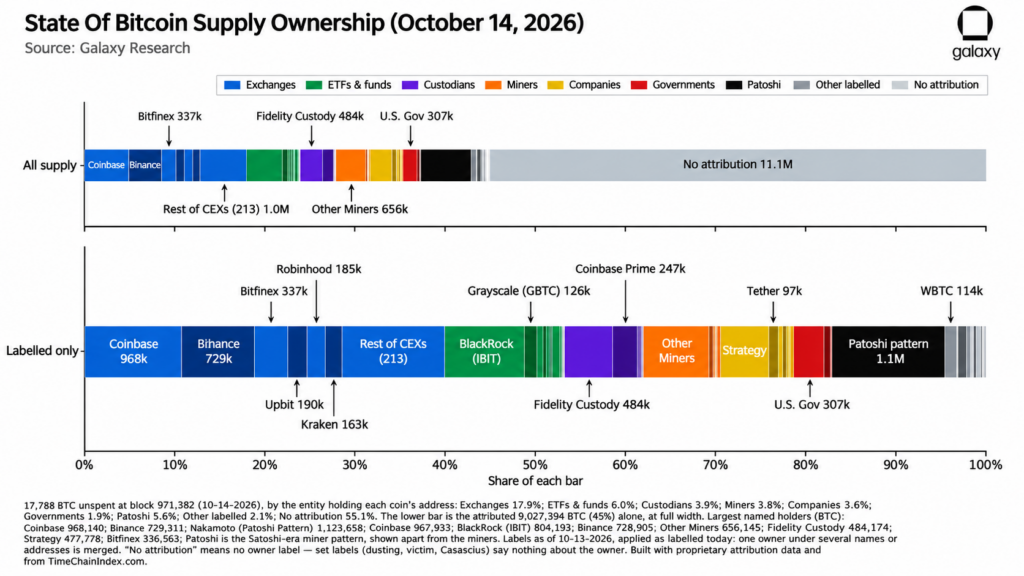
Source: Galaxy Research
One explanation lies in how Bitcoin itself works. Its blockchain is public, allowing anyone to verify the balances of individual addresses and their transaction histories. However, the identities of their owners remain unknown unless the addresses can be linked to a specific person or company. Analytics firms therefore monitor cryptocurrency movements and identify wallets belonging to exchanges, funds, and major investors. According to Alex Thorn, Head of Research at Galaxy Research, the findings suggest that individuals still hold a significant share of bitcoins in their own wallets. This is known as self-custody, where owners manage their private keys without relying on an exchange or another intermediary. This capability was one of Bitcoin’s fundamental principles when it was introduced in 2009.
However, an unknown owner does not automatically mean an individual investor. The 11.1 million BTC category likely also includes lost bitcoins that are no longer accessible to anyone. Another portion consists of cryptocurrencies mined during the network’s early years, as well as institutional holdings whose wallets have not yet been identified. On the other side are approximately 45% of bitcoins that analysts can attribute to specific entities. These include cryptocurrency exchanges, investment funds, including Bitcoin ETFs, government institutions, and major corporations. A separate category is also attributed to Bitcoin’s anonymous creator, Satoshi Nakamoto, whom Galaxy Research estimates to hold approximately 1.12 million BTC based on its analysis.
From the cryptocurrency market’s perspective, however, the most interesting aspect lies elsewhere. Despite the growing number of institutional investors, Bitcoin continues to retain its decentralized nature, with a large portion of its supply remaining outside identified financial institutions. This alone, however, does not prove that ownership is evenly distributed among millions of people. The analysis also highlights that Bitcoin differs from traditional financial assets not only in its technology but also in how it is held. While banks and asset managers play a central role in conventional investments, Bitcoin allows individuals to take direct control of their own assets. This remains one of its most distinctive characteristics compared with the traditional financial system. Source
KuCoin Exits Russia and Belarus Amid Regulatory and Sanctions Pressure
Cryptocurrency exchange KuCoin has announced the immediate termination of services for customers in Russia and Belarus. The decision, announced on October 29, 2026, applies to all its products, including cryptocurrency trading. The move comes amid growing regulatory requirements and international sanctions that significantly restrict the operations of financial companies in both countries. KuCoin did not specify which particular sanctions measure prompted the decision. Affected customers will receive individual notifications containing instructions and deadlines for closing their trading positions and withdrawing their assets. The exchange has not yet disclosed how many users will be affected by the restrictions. Nevertheless, this represents a significant step by one of the world’s largest cryptocurrency platforms, which reports serving approximately 45 million users globally.
KuCoin is not the only exchange to have taken a similar decision in recent weeks. During October, competing platforms MEXC and Bitget also announced restrictions on services for customers from Russia and Belarus. Both companies cited international regulatory requirements. A similar development began in 2023, when Binance, the world’s largest cryptocurrency exchange, announced its departure from the Russian market and the sale of its local operations to CommEX. However, CommEX ceased operations approximately six months later. Since the beginning of Russia’s invasion of Ukraine in February 2022, Western countries have progressively tightened sanctions against the Russian financial sector.
Regulatory pressure on cryptocurrency exchanges is not limited to Russia and Belarus. Regulators worldwide are gradually introducing stricter rules governing financial transactions, customer identification, and the prevention of money laundering. KuCoin itself has previously faced regulatory action in the United States. In January 2025, the company admitted to violating US regulations by operating an unlicensed money transmitting business and agreed to pay nearly $300 million. Such cases demonstrate that neither the size of a platform nor its international presence protects it from the consequences of regulatory violations. Compliance with local laws and sanctions regimes is therefore becoming increasingly important for cryptocurrency exchanges. In some cases, companies choose to exit certain markets rather than continue providing services while facing significant legal risks.
The withdrawal of major exchanges from Russia and Belarus also highlights an important distinction between cryptocurrencies themselves and the companies that provide related services. Bitcoin and other decentralized networks operate independently of individual exchanges, but access to centralized trading platforms is subject to laws and the business decisions of their operators. Users can therefore lose access to a particular exchange’s services even without a technical failure or security incident. These developments also confirm that the cryptocurrency sector is becoming increasingly integrated into the regulated financial environment. For users, a platform’s legal status, transparency, and approach to managing client assets are becoming just as important as its security. Cryptocurrencies remain a global technology, but companies facilitating their trading must comply with the rules of the countries in which they operate. Source
Invest with Fumbi Today
Take advantage of the potential of cryptocurrencies easily, safely, and efficiently. Start investing with Fumbi with amounts starting from just €10. The Fumbi Algorithm in the Fumbi Index Portfolio tracks cryptocurrency market movements for you. If you want to create your own crypto portfolios, choose the Advanced Portfolios product, where you’ll have access to over 120 cryptocurrencies and templates created by our team, focusing on different areas of the crypto world.
REGISTEREncountered a term you don’t understand? No worries! All important crypto-related terms can be found in one place in our new Fumbi Dictionary.

Juraj Ostertag 
Fumbi


