
 3 min •
Juraj Ostertag
SEC opens the door for ETF funds to simpler crypto custody – Market info
The crypto market moved sideways with a slight decline over the past 14 days. Total market capitalization fell from €2.58 trillion to €2.56 trillion during this period. The price of Bitcoin remained almost unchanged at €75,114.
The Fear & Greed Index remained unchanged at 71 points over the past 14 days. This value falls within the “greed” zone. The Altcoin Season Index rose again, this time from 53 to 59 points.

Source: CoinMarketCap
SEC opens the door for funds to simpler crypto custody
The U.S. Securities and Exchange Commission (SEC) has proposed new rules that could significantly change how investment advisers and regulated funds hold crypto assets on behalf of their clients. The regulator is addressing a problem that has persisted in the U.S. for years. Custody rules were created at a time when they were designed mainly for cash, stocks and bonds, not private keys and blockchain technology. SEC Chair Paul Atkins acknowledged that regulation has fallen behind market developments. The new proposal therefore creates a specific framework for how professional asset managers can hold crypto in compliance with federal rules. At the same time, it removes some of the obstacles that have made it harder for funds and advisers to offer investment strategies based on digital assets.
The biggest point of interest is so-called self-custody. In this case, however, it does not mean a regular personal crypto wallet where the investor holds their own private keys. The SEC uses the term to describe a situation where a client’s crypto is held directly by their investment adviser. The proposal would allow this only in limited cases, mainly when no suitable qualified custodian is available for a specific asset. The adviser would have to reassess the situation at least once every quarter. They would also need to demonstrate sufficient expertise to manage crypto securely, segregate individual clients’ assets, introduce rules for private key management and require approval from at least two people for transactions. The proposal also includes cybersecurity controls, regular reviews of security systems and independent internal control reports. If a suitable qualified custodian later becomes available, the assets would have to be transferred to it.
A second important change is that state-chartered trust companies could be allowed to serve as crypto custodians for advisory clients and regulated funds. The SEC is responding to the reality of a market where traditional financial institutions often do not support new tokens immediately after they are launched. That was one of the main problems with the previous approach. The rules required regulated custody, but in practice there was not always an institution capable of providing it. The new proposal seeks to resolve this contradiction without relaxing requirements for the protection of client assets. AIMA (Alternative Investment Management Association), which represents a large part of the global alternative investment industry, welcomed the SEC’s direction but noted that areas such as staking, DeFi and the exact boundaries of self-custody will require further discussion.
The rules are not final yet. The SEC has opened a 60-day comment period and the text may still change. Even so, the proposal already shows a broader shift in U.S. regulation. The debate is gradually moving away from whether crypto belongs in traditional finance at all and toward the conditions under which funds and professional asset managers can use it safely. For the institutional crypto market, clearly defined custody rules are one of the basic conditions for further growth. Without them, even an attractive digital asset remains practically unusable for a large part of the regulated financial sector. Source
Largest $TRUMP memecoin holders compete for dinner with the president
The $TRUMP cryptocurrency is once again relying on what it has never lacked from the beginning: the name of the U.S. president and the promise of exclusive access. The organizers of the memecoin have launched another competition for the token’s largest holders. The top 185 investors are set to receive an invitation to a gala dinner at Trump National near Washington on 22 November. The project is promoting it as “the most exclusive dinner in the world.” Donald Trump is expected to appear as the keynote speaker alongside three still-unannounced “legends.” The ranking will not be determined only by the number of tokens held on the final day. It will also take into account how much $TRUMP an investor held during the competition period. The final ranking will close on 12 November.
The highest positions come with additional benefits. The top 29 holders will gain access to a VIP reception and front-row seating, while the four highest-ranked holders are expected to receive 18-karat gold Trump-branded watches. This time, organizers are also emphasizing that a private meeting with the president will not be part of the program. That is a sensitive detail. Previous events drew criticism precisely because of the connection between large token purchases and the possibility of gaining access to the sitting president. The first major dinner for $TRUMP holders took place in May 2025, followed by another event this year at Mar-a-Lago. Critics among Democratic politicians and ethics experts have described the arrangement as a conflict of interest and an unusual blending of political power with a private crypto project. Organizers, however, present the events as an experience for the token-holder community.
The dinner comes at a time when $TRUMP is fighting for market attention. After the event was announced, its price briefly jumped by around 10% to $2.25 before giving back part of the gains. The token remains far below its all-time high of around $74. According to data cited by Crypto.news, nearly 989,000 wallets had accumulated combined losses of approximately $3.81 billion by June. That stands in sharp contrast to the enormous interest that accompanied the token’s launch shortly before Trump returned to the White House. This is where the unusual nature of the project becomes clear. $TRUMP is not built around a technological breakthrough or new blockchain infrastructure. Its strongest assets are its brand, its community and access to events that cannot be bought elsewhere. The memecoin is therefore shifting from an internet symbol into a ticket to the world of political celebrity. The line between investment, marketing and access to power is once again thinner than with a typical crypto project. Source
Robinhood introduces an AI agent that will trade for investors around the clock
Robinhood is taking automated trading a major step further. At the HOOD Summit 2026 in Houston, the company introduced Robinhood Agents, an AI tool built directly into the app that can analyze markets, prepare strategies and, with the user’s permission, place trades. The company presents the feature as a way to bring technology once reserved for hedge funds and professional traders to retail investors. Users will create a separate account for the AI agent, set rules and limits, and choose a language model. By default, every trade must be confirmed manually, although users will be able to disable this control. Robinhood is also preparing a feature called Loops, through which an agent can receive standing instructions and carry them out repeatedly, for example overnight. More than 150,000 customers activated an earlier version of agentic trading, and connected agents now use Robinhood’s tools nearly 30 million times per day. The new version is designed to move the entire process directly into the app without the need for external setup.
AI is not the only major change. Robinhood also plans to offer eligible U.S. customers crypto perpetual futures, derivative contracts with no expiration date. Trading is expected to include Bitcoin, Ethereum, Solana, XRP, Dogecoin, Cardano, Chainlink and Hyperliquid. Leverage will reach up to 10x for Bitcoin and Ethereum and 3x for the other assets. Such high leverage amplifies every market move, whether toward profit or loss, while significantly increasing the risk of rapid liquidation. The contracts will be offered through Robinhood Derivatives in cooperation with the Bitstamp exchange. The app is expected to display liquidation prices, warnings for risky positions and tools for automatically closing trades at predefined loss or profit levels. Robinhood also warns that responsibility for the outcome remains with the user when using AI trading. The agent may misunderstand an instruction, work with incomplete data or react differently from what the investor expected.
Robinhood is showing where it wants to take its business next. From an app that became famous for simple stock and crypto purchases, it is building a platform for increasingly active and automated trading. Alongside AI agents and crypto derivatives, it is also preparing weekend trading in selected U.S. stocks. Reuters notes that liquidity is usually weaker outside regular trading hours, which can lead to wider price spreads and worse conditions when buying or selling. Robinhood, however, is betting on a simple idea: news, crypto and global markets do not switch off at night, so it does not want its users’ tools to switch off either. The biggest change is therefore not 10x leverage or weekend trading itself. It is the fact that part of the trader’s work is being taken over by an AI agent that can monitor the market and act according to predefined rules even when no one is sitting in front of the screen. For retail investing, this is a significant shift and another sign that the line between a simple investment app and a full-scale trading platform is rapidly disappearing. Source
Crypto companies are hiring again. Job postings have tripled in the past two months
After months of caution, the crypto sector is hiring again. The number of new job postings on CryptoJobsList jumped from 382 in July to 886 in August and then to 1,241 in September. In just two months, the number more than tripled, making September the strongest month of the year for job listings. The number of companies looking for new employees also increased. There were 125 in September, compared with 107 in July. The recovery comes after a weaker first half of the year, when many crypto companies cut costs, eliminated positions or reassessed their plans. CryptoJobsList links the renewed hiring to growing institutional interest, closer ties between crypto companies and the traditional financial sector, and fresh capital flowing back into the industry. The figures also suggest that this is not simply a seasonal rebound after the summer holidays. Hiring accelerated significantly already in August, and a similar jump was not seen during the same period last year.
The other side of the labor market is even more interesting. While companies are adding new positions, applicant interest is moving in the opposite direction. CryptoJobsList recorded 26,728 job applications in July, 24,641 in August and just 19,605 in September. Over two months, the number of applications fell by roughly a quarter even as the number of available jobs rose sharply. For companies, this means tougher competition for people who already have experience with cryptocurrencies and blockchain infrastructure. The strongest demand in recent months has been in finance, development and trading. Stablecoins, artificial intelligence, security and compliance were also prominent areas. When companies listed knowledge of specific blockchains, Bitcoin appeared most often, followed by Ethereum and Solana. Crypto companies are therefore not looking only for developers capable of writing smart contracts. They need people who understand infrastructure, trading, regulation, security and products designed for increasingly large financial institutions.
This shows how the crypto industry is changing. After a period when a large part of the market focused on NFTs, consumer applications and rapidly launched projects, both capital and jobs are moving closer to infrastructure and professional financial services. CryptoJobsList had already recorded stronger hiring in blockchain infrastructure, institutional trading and technical teams during the summer. September’s figures reinforced that trend further. These are still data from one specialized jobs platform, not the entire global crypto market. Even so, the direction is clear: companies are reopening budgets for new teams while the pool of available talent is not growing at the same pace. After years of layoffs and cautious hiring, crypto is entering another phase in which the biggest challenge will no longer be only raising capital. Finding people who know how to turn it into working products, secure infrastructure and services for the financial world will become increasingly important. Source
Interest in Solana is growing. ETFs attracted a record $188 million in one week
U.S. ETFs linked to Solana recorded net inflows of approximately $188 million in the week from 21 to 25 September. The largest share of new capital went to the Bitwise Solana Staking ETF (BSOL), which attracted more than $128 million, or around 68% of the total. Friday, 25 September, was particularly strong, with $86.7 million flowing into the seven tracked funds. It was their strongest single trading day to date. Grayscale GSOL attracted approximately $28 million during the week, while Fidelity FSOL received nearly $18 million. Money flowed into all seven tracked products, so investor interest was not limited to a single fund. Even so, Bitwise’s dominance remains clear. Since launch, BSOL has attracted more than $1.2 billion in net inflows, while the entire group of U.S. Solana ETFs stands at around $1.6 billion.
Chart – ETF inflows
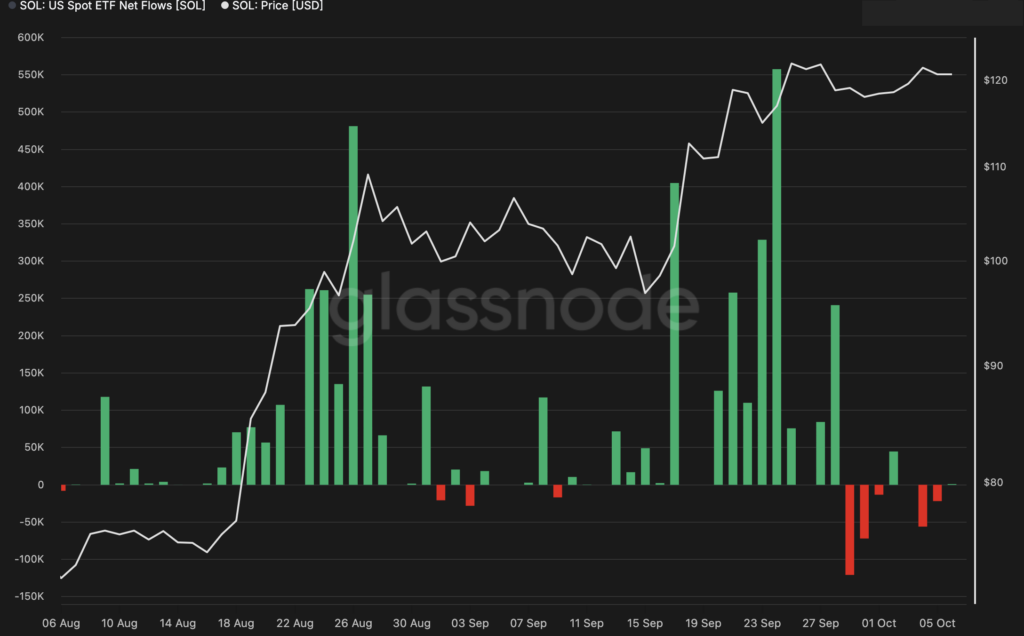
Source: Glassnode
For Solana, one of the most important factors is that ETFs give investors exposure without requiring them to buy SOL directly on a crypto exchange or manage their own wallet and private keys. They can buy shares in the fund through a standard brokerage account, just as they would stocks or traditional ETFs. This type of investment significantly broadened access to Bitcoin and later Ethereum. Solana is now joining the group of assets attracting larger amounts of capital through regulated investment products. BSOL also uses staking, where part of the SOL held by the fund is used to help secure the network and earn staking rewards. These rewards represent an additional source of return alongside changes in Solana’s price. The broader picture also shows that money was returning to crypto funds across the market during the same week. U.S. Bitcoin ETFs attracted around $2.4 billion, while Ether funds received nearly $690 million.
The strong inflows come at a time when attention is also focused on the network’s technical development. Solana is testing a major consensus upgrade called Alpenglow, which aims to reduce transaction finality from approximately 12.8 seconds to around 150 milliseconds. If the upgrade reaches mainnet in its planned form, it would represent a major improvement in transaction confirmation speed. Growing interest in ETFs is therefore being accompanied by efforts to push Solana’s underlying infrastructure further. ETF inflows do not automatically mean that the price of SOL will rise, but they do show that Solana is building a stronger position in the regulated investment space, which until recently was largely dominated by Bitcoin and Ethereum. The latest numbers therefore show that investors are no longer seeking crypto exposure only through the two largest assets, with some capital also finding its way into other major blockchain networks. Source
Cardano expands the possibilities for regulated tokens
Cardano is introducing a new token standard that significantly expands the options available to issuers. CIP-0113 allows the creation of so-called programmable tokens with rules built directly into how they operate. Issuers can determine who is allowed to receive a token, block its transfer or, in specific cases, freeze or remove assets from a holder’s wallet. The new standard is aimed mainly at regulated stablecoins, tokenized funds, bonds and other financial assets where companies must comply with anti-money-laundering rules, sanctions restrictions and customer identity verification requirements. This does not mean that Cardano has gained the ability to interfere arbitrarily with every token on its network. These powers apply only to assets created under the new standard, and the level of control is determined by the issuer itself.
Existing native tokens on Cardano move between addresses after issuance without allowing the issuer to check additional conditions on every transfer. This is precisely what creates a problem for banks or fund managers that want to bring traditional financial products onto the blockchain. If, for example, a fund is available only to verified investors, its token should not end up at an address belonging to someone who has not passed identity checks. Similarly, a stablecoin issuer needs to be able to block an address on a sanctions list or respond to a court order. CIP-0113 therefore allows compliance with specific rules to be checked whenever a token is transferred. If the transaction does not meet the conditions, the network will reject it. Issuers can choose individual rules according to their needs and later update them as regulations change. The entire solution uses Cardano’s existing capabilities, so its introduction did not require a fundamental change to the blockchain itself.
The new system also raises the question of where decentralization ends and issuer control begins. With some tokens, an authorized party can intervene without the holder’s consent and transfer or remove their assets. For users, it will therefore be important not only to know which token they are buying, but also what rules are attached to it and who has the power to activate them. Cardano’s technical documentation also highlights this distinction for DeFi protocols, for example when accepting such tokens as collateral. Cardano is moving closer to the market for tokenized real-world assets, where blockchain intersects with the rules of traditional finance. Similar mechanisms already exist on other networks. The main point of the new feature is therefore not greater control over Cardano as a whole, but the ability to create an asset on a public blockchain that follows the rules set by its issuer from the outset. Source
Invest with Fumbi Today
Take advantage of the potential of cryptocurrencies easily, safely, and efficiently. Start investing with Fumbi with amounts starting from just €10. The Fumbi Algorithm in the Fumbi Index Portfolio tracks cryptocurrency market movements for you. If you want to create your own crypto portfolios, choose the Advanced Portfolios product, where you’ll have access to over 120 cryptocurrencies and templates created by our team, focusing on different areas of the crypto world.
OPEN PROFILEEncountered a term you don’t understand? No worries! All important crypto-related terms can be found in one place in our new Fumbi Dictionary.

Juraj Ostertag 
Fumbi


