
 3 min •
Daniel Mitrovsky
3 min •
Daniel Mitrovsky
Bitcoin Enters the New Year on a Strong Note
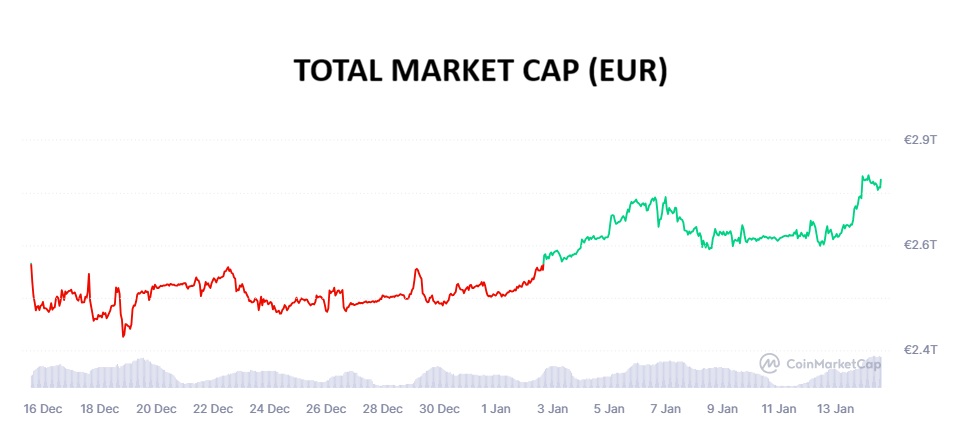
The cryptocurrency market has risen by more than 9% over the past 30 days, with total market capitalization increasing from approximately $2.55 trillion to $2.78 trillion during this period. Bitcoin itself has gained 7.5% over the last 30 days and is currently trading around €82,300.
The Fear & Greed Index is currently at 48 out of 100, which corresponds to a neutral zone. At the beginning of this week, the index was still hovering around 26–28 points. This shift signals a recovery in market sentiment, which has been accompanied by rising prices of Bitcoin and other cryptocurrencies.
Source: Coinmarketcap
Bitcoin Enters the New Year on a Strong Note
Bitcoin kicked off 2026 with a positive impulse that, after a weaker end to last year, once again attracted the attention of investors and the media. After closing 2025 with an approximate 6% decline, BTC entered a growth phase at the start of the new year and climbed above the $95,000 mark. Since the beginning of 2026, Bitcoin has gained more than 8.5%, all within the first two weeks of the year.
According to analysts, however, this move does not necessarily signal the start of a new long-term trend. The rally is largely attributed to portfolio rebalancing following the significant sell-off in 2025. Bitcoin was under strong pressure last year, and many investors now view it as an oversold asset worth re-entering. This return of capital is creating a natural price rebound as investors who had been waiting on the sidelines step back in at more attractive entry levels.
From a technical perspective, the key question is whether Bitcoin can convincingly break above the $95,500 resistance level. If successful, analysts believe this could open the door for a renewed push toward the psychological $100,000 level. Some experts also expect Bitcoin to reach a new all-time high at some point in 2026, although they caution that the pace of growth may not be as aggressive as the most optimistic scenarios suggest. At the same time, the risk of a return to a bearish trend remains on the table should macroeconomic conditions or overall market sentiment deteriorate.
On the other hand, more skeptical voices argue that current levels do not offer a sufficiently attractive risk-to-reward ratio. Critics point to opportunity cost, noting that Bitcoin has lagged behind other assets recently, particularly gold. While gold saw strong gains in 2025, Bitcoin ended the year in negative territory, which for some investors calls into question its role as a dominant store of value during periods of uncertainty.
The start of 2026 therefore places Bitcoin in an interesting yet still ambiguous position. Short-term gains may continue, supported by returning capital and improving sentiment, but the long-term direction will depend on BTC’s ability to break key price levels and compete with traditional assets. The coming weeks could provide important clues as to whether this move is merely a temporary rebound or the beginning of a stronger trend. Source
Bitcoin Is Just One Step Away From Adulthood
At the beginning of this year, Bitcoin celebrated its 17th anniversary, and its story ranks among the most significant financial transformations of modern history. It all began on January 3, 2009, when an anonymous creator known as Satoshi Nakamoto mined the Bitcoin genesis block. Embedded in its code was a message referencing the ongoing banking crisis, symbolically pointing to the weaknesses of the traditional financial system. At the time, however, Bitcoin went largely unnoticed — it was merely an experiment among a small group of cryptographers and technology enthusiasts, with no clear price, infrastructure, or widespread use.
The early years were marked by skepticism and ridicule. Bitcoin had no exchanges, no liquidity, and no clear economic significance. The first real transaction — now famously known as Bitcoin Pizza Day — took place in May 2010, when 10,000 BTC were used to purchase two pizzas. For years, Bitcoin was dismissed as a “toy for geeks” or “magic internet money.” Its reputation suffered further due to its association with darknet marketplaces, where it was used as a means of payment. Media outlets and regulators portrayed it as a tool for criminals, despite later data showing that illicit transactions accounted for only a small fraction of its usage.
With the introduction of exchange trading, it became clear that volatility would be an inseparable part of Bitcoin’s nature. Sharp rallies and crashes, often exceeding tens of percent, repeated themselves year after year. Since 2010, Bitcoin has been declared “dead” hundreds of times, compared to the tulip mania, and labeled a worthless experiment. Yet it never disappeared. Its narrative gradually evolved, particularly after 2017 and the massive monetary expansion during the COVID-19 pandemic. Bitcoin’s fixed supply of 21 million coins began to matter more, and it increasingly came to be viewed as digital gold or a hedge against currency debasement.
A major milestone arrived in 2024 with the launch of spot Bitcoin ETFs in the United States, firmly integrating BTC into the traditional financial system. Discussions around strategic Bitcoin reserves and its role in political debates further highlight how far Bitcoin has come in 17 years. What began as a valueless experiment has evolved into a global financial phenomenon and an asset with a multi-trillion-dollar market capitalization. Source
SEC Chair: A Big Week for Crypto in the US
The US crypto market may be on the verge of a significant shift. Securities and Exchange Commission (SEC) Chair Paul Atkins described the current week as a “big week for crypto,” as Congress prepares to vote on landmark legislation governing digital asset market structure. According to Atkins, the United States stands at the threshold of modernizing its financial markets for the 21st century, and clear rules could finally bring long-awaited certainty for investors and the broader industry.
The proposed market structure bill aligns with the administration’s vision of making the US a global hub for the crypto industry. Atkins emphasized that clearly defining jurisdictional boundaries between the SEC and the Commodity Futures Trading Commission (CFTC) is critical to eliminating the regulatory uncertainty that has plagued crypto markets for years. This regulatory “gray zone,” he said, has been one of the biggest obstacles to market development and a major source of tension between regulators and crypto companies. Passing the bill could resolve these issues while also preventing arbitrary actions by future regulators.
Known as the CLARITY Act, the legislation has drawn significant attention from investors. Bitwise CIO Matt Hougan suggested that its approval could determine the next direction of the entire crypto market. If the bill fails, market stagnation may continue; if it passes and is signed into law, it could pave the way for new all-time highs. Investor Michaël van de Poppe shares this view, calling the CLARITY Act the most important event of early 2026, with the potential to shape the ecosystem for months to come.
The US Senate is scheduled to take up the bill on January 15. The outcome of the vote could have a meaningful impact on market sentiment and the future price trajectory of digital assets. Source
Trump Pushes for Rate Cuts: How Is Bitcoin Reacting?
The latest US inflation data has once again fueled debate over the future direction of US monetary policy — and increased volatility in crypto markets. On Tuesday, the US Bureau of Labor Statistics (BLS) released Consumer Price Index (CPI) data showing a modest monthly increase of 0.3% and an annual rise of 2.7%.
Even more encouraging was the core CPI, which excludes volatile items such as food and energy. Core inflation rose just 0.2% month over month and 2.6% year over year. Both readings came in 0.1 percentage points below market expectations, strengthening speculation about potential interest rate cuts.
President Donald Trump reacted quickly. For more than a year, he has repeatedly urged Federal Reserve Chair Jerome Powell to lower interest rates, and the latest CPI figures provided fresh ammunition. Trump once again labeled Powell as “too late” and publicly stated that the Fed should cut rates “meaningfully.” This continued pressure follows recent actions by the US Department of Justice involving the Fed, which Powell believes were politically motivated.
Bitcoin responded swiftly to the CPI release, jumping from below $92,000 to above $92,500 before giving back some of its gains. Following Trump’s remarks, BTC attempted another upward move. The market remains highly unpredictable, and analysts expect elevated volatility in the coming days, even though Bitcoin has shown relative stability amid ongoing global geopolitical tensions. Source
Tokenized Gold Dominated the RWA Sector
Tokenized gold products added billions of dollars in new value last year and grew faster than physical gold and most gold-focused ETFs, according to recent data from analyses of tokenized asset protocols.
The market capitalization of tokenized gold surged by 177% over the past year, while the number of holders nearly tripled, with more than 115,000 new wallets added. This growth outpaced most other real-world asset (RWA) categories. According to data compiled from public blockchains and market sources, tokenized gold accounted for nearly 25% of all net inflows into the RWA sector, surpassing the combined growth of tokenized equities, corporate bonds, and non-US government bonds.
In 2025, tokenized gold recorded approximately $178 billion in trading volume, with fourth-quarter volumes peaking above $126 billion. Based on trading volume, tokenized gold became the second-largest gold investment product globally, behind only SPDR Gold Shares. Much of the late-year surge was driven by Tether Gold (XAUT), which accounted for 75% of total Q4 volume, up from 27% in Q3. XAUT has a market capitalization of $2.42 billion and is backed by 1,329 gold bars, equivalent to roughly 16,239 kilograms of physical gold.
The growth of tokenized gold highlights a structural shift, with liquidity and trading activity increasingly moving onto blockchain rails and away from traditional products. Overall, the tokenized commodities sector surpassed $4.3 billion in market capitalization and grew by 18% over the past month, led by Tether Gold at $1.9 billion and Paxos Gold at $1.7 billion.
Gold’s strong performance in 2025 was also supported by geopolitical and macroeconomic developments. Investors sought safe-haven assets amid reports of investigations involving Fed Chair Jerome Powell and escalating trade tensions between the US and China. Lower yields and uncertainty surrounding monetary policy further fueled the gold rally and contributed to the rise of tokenized gold. Source
MicroStrategy Opens 2026 With a Massive Bitcoin Purchase
Bitcoin’s price climbed back above $95,000 on Wednesday after Strategy announced the purchase of additional Bitcoin worth approximately $1.3 billion. This marked the company’s largest single acquisition since July 2025 and immediately boosted market sentiment. Strategy’s shares rose by around 7%, as the firm is widely viewed by investors as a leveraged proxy for Bitcoin price exposure. In total, the company now holds roughly $66 billion worth of Bitcoin, with an average purchase price near $75,000. As a result, Strategy is currently sitting on unrealized profits amounting to tens of billions of dollars, further strengthening its market position.
Notably, the massive purchase was not funded from existing cash reserves but through the sale of newly issued shares directly to investors on the open market. This deliberate strategy allows the company to increase its Bitcoin exposure without reducing balance sheet liquidity. Bitcoin’s price was also supported by strong inflows into spot Bitcoin ETFs, which recorded their highest single-day inflows since October, signaling renewed interest from institutional investors after a weaker period.
Despite the fact that many companies pursuing Bitcoin treasury strategies have faced pressure in recent months due to price declines and are trading at a discount, Strategy’s leadership remains firmly optimistic. Michael Saylor continues to champion Bitcoin as a strategic reserve asset, while the company has built a substantial cash buffer to manage heightened volatility. Management also expects 2026 to bring growing interest in Bitcoin from banks and even nation-states seeking to diversify their foreign exchange reserves. This narrative is increasingly echoed by major asset managers and could become one of the key drivers of the next crypto market cycle. Source
Invest With Fumbi Today
Harness the potential of cryptocurrencies simply, securely and efficiently. Start investing with Fumbi with amounts starting from €50. The Fumbi Algorithm in the Fumbi Index Portfolio tracks price movements in the cryptocurrency market for you. If you want to build your own crypto portfolios, choose the Advanced Portfolios product, where you will have access to over 120 cryptocurrencies and templates created by our team that focus on different areas within the crypto universe.
TAKE ADVANTAGE OF CRYPTO’S POTENTIAL
Have you come across a term in the text that you don’t understand? Never mind, you can find all the important terms related to cryptocurrencies in one place in our new Fumbi Dictionary.

Daniel Mitrovsky 
Head of Crypto, Fumbi


Biography
Specializes in cryptocurrency market analysis, investment strategies, and technological trends in the blockchain space. With over 5 years of experience in financial markets, he has been actively involved in cryptocurrencies for more than 8 years. On the Fumbi blog, he brings you the latest news from the world of cryptocurrencies, comments on market developments, and clearly explains various investment approaches – from basics to advanced strategies.