
 3 min •
Daniel Mitrovsky
3 min •
Daniel Mitrovsky
Strategy Holds 700,000 BTC – Market Info
The cryptocurrency market has been slightly down over the past 14 days, with the total market capitalization of cryptocurrencies falling by approximately -2.35% during this period, currently standing at around €2.49 trillion. Bitcoin itself has declined over the last 14 days and is currently trading at €73,500.
The Fear & Greed Index stands at 26 out of 100 (fear zone), having been at 61 points in mid-January. The drop in BTC price due to geopolitical uncertainty has significantly increased fear in the market.
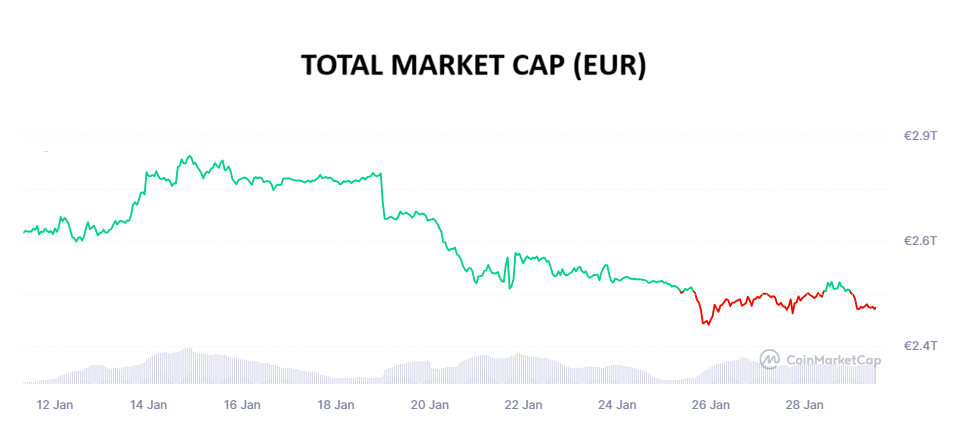
Source: Coinmarketcap
Strategy Holds 700,000 BTC
The company Strategy, led by Michael Saylor, has recently further strengthened its position as the largest publicly traded holder of Bitcoin. After the latest purchase of 22,305 BTC worth approximately $2.13 billion, its total holdings rose to 709,715 bitcoins. The average purchase price of the latest tranche was around $95,284 per BTC, with the price of Bitcoin briefly surpassing $97,000 shortly after the announcement of the purchase on January 20.
Strategy’s total Bitcoin portfolio was acquired for approximately $53.9 billion at an average price of just under $76,000 per BTC. This means the company currently controls more than 3.3% of the maximum supply of 21 million bitcoins and roughly 3.5% of the currently circulating supply. This represents a historically unprecedented concentration of BTC on the balance sheet of a single publicly traded company.
The latest purchase marks Strategy’s largest acquisition since February 2025 and is a clear signal that the company has again significantly accelerated its accumulation pace. Earlier in January, it announced the purchase of additional bitcoins worth approximately $1.3 billion, indicating growing management confidence in further market development. Shares of the company also reacted positively, rising along with the price of Bitcoin and benefiting from the decision of index provider MSCI to keep the company’s digital treasury in its indices.
Strategy’s increased activity comes at a time when the market is again evaluating the sustainability of corporate Bitcoin reserve models. After the strong rally in 2025, several companies came under pressure and are trading at a discount. Analysts, however, suggest that only companies that combine a disciplined approach to capital management with realistic expectations about the role of digital assets on corporate balance sheets will succeed in the long term. Strategy’s aggressive yet consistent approach clearly aims to place it in this group. Source
Africa Turns to Stablecoins: Remittances Become Essential
Stablecoins are increasingly being adopted in Africa as a cheaper and faster alternative for cross-border money transfers, with remittances becoming more important than development aid for the continent, according to economist Vera Songwe. Songwe, former UN Under-Secretary-General, highlighted this during a discussion at the World Economic Forum in Davos, Switzerland. Traditional money transfer services in Africa are often slow and costly, with fees around $6 for every $100 sent. According to her, stablecoins significantly reduce these costs while shortening settlement times from days to minutes, which is crucial for individuals and small to medium-sized enterprises.
The growing use of stablecoins is closely linked to high inflation in many African countries. Songwe noted that since the COVID-19 pandemic, inflation has exceeded 20% in roughly 12 to 15 African countries. Stablecoins provide residents with a way to store value in currencies not exposed to sharp inflation swings, acting as a financial safety net in an unstable economic environment. Approximately 650 million people in Africa do not have access to a bank account but do have access to a mobile phone, which greatly facilitates the adoption of digital currencies.
According to Songwe, the highest usage of stablecoins is in countries such as Egypt, Nigeria, Ethiopia, and South Africa, where high inflation, capital controls, and advanced mobile payment systems intersect. Most transactions are conducted by small and medium-sized enterprises, indicating that stablecoins are becoming a practical tool for financial inclusion and everyday economic functioning in Africa. Source
Tesla Sold No BTC
Tesla did not change the size of its Bitcoin holdings in Q4 2025, which remained at 11,509 BTC. Despite the stable number of coins held, the company recorded a significant drop in their accounting value due to Bitcoin’s sharp price decline at the end of the year. Over the last three months of 2025, Bitcoin’s price fell from around $114,000 to roughly $88,000, directly affecting the company’s financial results.
The drop in the market value of the digital asset forced Tesla to record an after-tax impairment loss of approximately $239 million. This follows accounting rules requiring companies holding cryptocurrencies to report impairment in case of significant price declines, while unrealized gains are not included in earnings. Tesla’s Bitcoin portfolio therefore remains a volatile balance sheet item, closely tied to cryptocurrency market developments.
Tesla entered the Bitcoin market in early 2021 under Elon Musk, announcing a purchase of 43,200 BTC worth approximately $1.7 billion. The company later tested market liquidity by selling a small portion of its holdings, but in 2022 decided to sell about 75% of its bitcoins near the bear market bottom. Since then, Tesla’s Bitcoin holdings have remained relatively stable without significant new purchases or sales.
For overall financial results, Tesla reported Q4 revenue of $24.9 billion, slightly below market expectations. Adjusted earnings per share, however, exceeded forecasts, positively affecting the company’s after-hours stock performance. Bitcoin thus continues to be a long-term strategic bet for Tesla rather than an actively traded asset. Source
What If You Had Invested in BTC 10 Years Ago?
In 2016, Bitcoin was still considered an experimental technology gradually finding its way into the broader financial world. Trading at around $400, many investors viewed it as a speculative toy rather than a serious alternative to traditional currencies. Ten years later, the situation is dramatically different. Bitcoin is now part of institutional investors’ portfolios, appears in model investment strategies of financial advisors, and its accessibility has been greatly enhanced by the approval of exchange-traded funds. It has also opened the door for other cryptocurrencies like Ethereum, Solana, and XRP, which now form a solid foundation of the crypto market.
Although Bitcoin remains highly volatile and is currently about 30% below its all-time highs, long-term investors have reason to be satisfied. Over the past decade, its value has increased by roughly 21,900%. Practically, a $100 investment made ten years ago would now be worth approximately $21,900. This illustrates the significant long-term potential Bitcoin has offered, despite repeated cycles of sharp rises and corrections.
For many investors, Bitcoin remains primarily a growth asset that makes sense to hold as part of a diversified portfolio. Historically, it has also served as a relatively effective diversifier against the US dollar and the S&P 500 index. Its true potential, however, is still seen as an alternative to fiat currencies, especially in a changing global financial system and ongoing technological transformation. Even after ten years of growth, Bitcoin’s story is far from over. Source
Gold and Silver Reach New Highs: Will Bitcoin Follow?
Gold and silver have surged in recent weeks, hitting historical highs and confirming increased investor interest in “safe-haven” assets. Gold prices have reached new records and have gained significantly since the start of the year, with silver even outperforming. This growth extends beyond these two metals, as copper and aluminum also reach record highs, signaling a broader shift of capital into real assets amid macroeconomic uncertainty, inflation, and geopolitical risks.
Interestingly, volatility is also rising in traditionally stable markets. Sharp intraday swings in gold prices are beginning to resemble cryptocurrency behavior, challenging the long-standing perception of gold as a calm safe haven. This fact reopens the discussion on when some capital might rotate back into digital assets, which remain under pressure and lag behind precious metals’ performance.
Historically, there is an interesting relationship between gold and Bitcoin. In past cycles, Bitcoin often followed gold’s movements with a delay of several months. While gold acted as the first response to deteriorating economic conditions, Bitcoin later assumed the role of a riskier but potentially higher-yielding asset. If this pattern repeats, the crypto market could currently be in an accumulation phase ahead of significant growth in the coming months.
From a long-term perspective, the current dominance of precious metals could be temporary. As the macroeconomic environment stabilizes and investors seek higher returns again, cryptocurrencies could benefit from returning capital. Bitcoin, often called “digital gold,” could regain attractiveness as an alternative store of value. Source
Fed Holds Interest Rates, Waiting for Clearer Economic Signals
The U.S. central bank (Fed) left interest rates unchanged at its January meeting, definitively putting an end to expectations of early rate cuts at the beginning of 2026. Just a few months ago, markets had anticipated that the first rate cut could occur in January, but these hopes gradually faded due to persistent inflation and a stabilizing U.S. labor market.
The Fed’s decision immediately affected the cryptocurrency market. Following the announcement, Bitcoin remained below $89,000 and showed no significant movement, while stocks and cryptocurrencies reacted rather mutedly. A stronger dollar and rising gold prices indicate that investors are currently favoring a more conservative “risk-off” approach, moving capital into traditional safe assets.
Liquidity remains a key factor for cryptocurrencies. Higher interest rates over a longer period mean more expensive financing and less room for speculative investments, which is reflected in weaker performance for both Bitcoin and altcoins. The market also considers that the Fed will likely maintain a restrictive monetary policy at least through the first quarter, with the probability of a rate cut in March remaining low.
Nevertheless, this is not necessarily a negative signal for cryptocurrencies in the long term. While higher rates may create short-term pressure on digital asset prices, the fact that further rate hikes are off the table provides a measure of stability. Investors will closely watch Fed Chair Jerome Powell’s statements and new macroeconomic data in the coming weeks for clues on when monetary policy might begin to ease.
Bitcoin is currently in a waiting mode. Its next significant move will likely depend on inflation developments, expectations regarding interest rates, and investors’ willingness to take on higher risk again. Source
Invest With Fumbi Today
Harness the potential of cryptocurrencies simply, securely and efficiently. Start investing with Fumbi with amounts starting from €50. The Fumbi Algorithm in the Fumbi Index Portfolio tracks price movements in the cryptocurrency market for you. If you want to build your own crypto portfolios, choose the Advanced Portfolios product, where you will have access to over 120 cryptocurrencies and templates created by our team that focus on different areas within the crypto universe.
TAKE ADVANTAGE OF CRYPTO’S POTENTIAL
Have you come across a term in the text that you don’t understand? Never mind, you can find all the important terms related to cryptocurrencies in one place in our new Fumbi Dictionary.

Daniel Mitrovsky 
Head of Crypto, Fumbi


Biography
Specializes in cryptocurrency market analysis, investment strategies, and technological trends in the blockchain space. With over 5 years of experience in financial markets, he has been actively involved in cryptocurrencies for more than 8 years. On the Fumbi blog, he brings you the latest news from the world of cryptocurrencies, comments on market developments, and clearly explains various investment approaches – from basics to advanced strategies.