
 3 min •
Daniel Mitrovsky
3 min •
Daniel Mitrovsky
FBI Warns About Fake Cryptocurrency Tokens – Market Info
The cryptocurrency market has traded sideways over the past 14 days with relatively high volatility. The total market capitalization increased by approximately 1% during this period and currently stands at €2.10 trillion. Bitcoin itself remained almost unchanged, with minimal growth of 0.04%, trading around €61,200.
The Fear & Greed Index fell over the two weeks from 18 points to 14 points, placing it in the “extreme fear” category, so the index remains within the same range. Meanwhile, the Altcoin Season Index rose slightly from 41 points to 49 points.
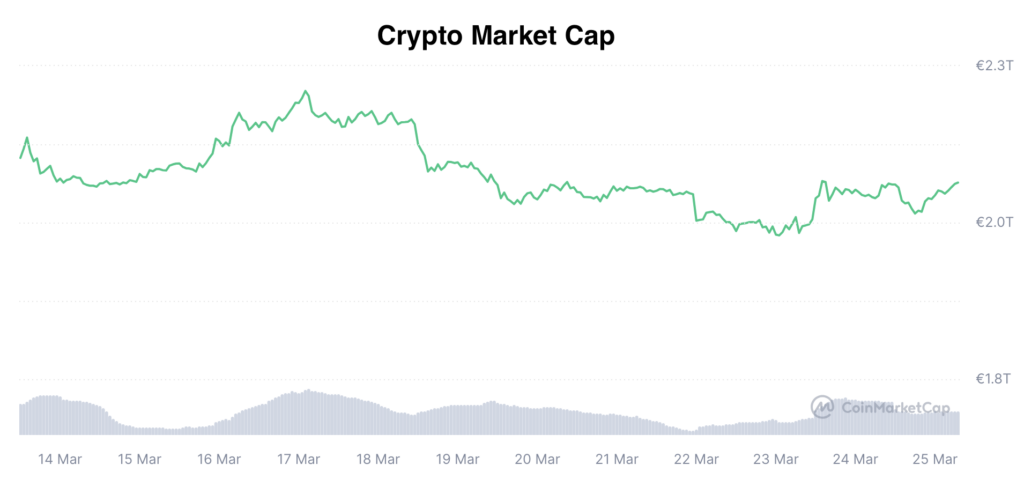
Source: Coinmarketcap
The Federal Reserve’s interest rate decision on March 18, 2025 shook Bitcoin
Large Bitcoin holders, often referred to as “OGs,” have begun selling after the Federal Reserve disrupted expectations of lower interest rates. Blockchain data tracked by Lookonchain shows that at least two long-term holders sold more than 1,650 BTC combined—worth over $117.87 million—on Thursday morning (March 19). One veteran, who had previously sold a stash of 11,000 BTC, added another 650 BTC to his sales, while another early adopter with a 5,000 BTC portfolio liquidated 1,000 BTC.
Bitcoin’s price dropped by approximately 1% to $70,600, extending Wednesday’s 3.5% decline from $74,500, according to CoinDesk data. Similar losses were recorded by Ether (ETH), XRP (XRP), Solana (SOL), and DOGE.
The decline followed a clear signal from the Fed, which kept its key interest rate unchanged in the 3.5%–3.75% range and indicated a slower pace of rate cuts, disappointing risk assets investors.
The central bank remains cautious about inflation, triggering a sharp shift in expectations regarding rate cuts. Prognostics on decentralized platforms like Polymarket and CME shows that there is roughly an 80% probability of only one rate cut this year, compared to a 62% probability of two to three cuts just a month ago. This outlook of limited liquidity is reducing investors’ willingness to take on risk in financial markets. Source
BlackRock sees AI driving crypto’s next bull phase
The asset management giant Robbie Mitchnick said that clients are primarily focused on bitcoin, ether, and only a few other tokens, with little interest in broad exposure. Instead, they see opportunity for cryptocurrencies in the field of artificial intelligence.
BlackRock’s head of digital assets, Robbie Mitchnick, signaled a shift in how large investors view crypto, pointing to artificial intelligence (AI) as a more significant driver than the expansion of new tokens. Describing client behavior, he noted that the market has moved away from broad exposure of smaller assets. Turnover among leading tokens has been “fairly ferocious,” with only bitcoin—and later ether—maintaining consistent positions. Many newer tokens, he suggested, fail to remain relevant over the long term.
This trend has also shaped investor demand. “Most of it is nonsense,” Mitchnick said at the Digital Asset Summit in New York on Tuesday, referring to the vast number of existing tokens. As a result, clients are now concentrating on a narrow set of assets rather than building broad portfolios. Bitcoin and Ethereum dominate allocations, with limited interest beyond them.
In this context, Mitchnick highlighted AI as a more powerful force shaping the future role of crypto. He emphasized that AI is a broader theme than digital assets, but that the two intersect in meaningful ways. “AI agents are very unlikely to use Fedwire and SWIFT,” he said. “What is crypto? Crypto is computer-native money… AI is computer-native data and intelligence. And so there’s a natural symbiosis there.”
This perspective frames cryptocurrencies more as foundational infrastructure than purely speculative assets. An increasing number of bitcoin miners are therefore shifting their capacity toward artificial intelligence, attracted by more stable revenues and rising demand for computing power. Several publicly traded firms, such as Hut 8, Core Scientific, and Iren, are already adapting their data centers or signing agreements focused on AI and high-performance computing. Others are considering similar moves, even though mining remains their primary source of revenue.
Mitchnick also pointed out that AI-driven technological change could enhance bitcoin’s appeal. In times of innovation and uncertainty, bitcoin may serve as a stabilizing component in portfolios and a tool for diversification. “There are intersection points that are relevant… there’s clearly an advantage and an opportunity to play a role in the AI economy,” he said. Source
MicroStrategy returns to “smaller” Bitcoin purchases, adding $76.6 million in BTC last week
MicroStrategy (ticker MSTR) is a U.S.-based company founded in 1989 that originally focused on developing business intelligence software. Since 2020, however, it has significantly shifted its strategy and become best known for heavily investing in Bitcoin as its primary corporate asset. It finances this approach through a combination of equity issuance and debt. As a result, it is now widely viewed as a “Bitcoin proxy”—its stock often mirrors Bitcoin’s price movements, but with higher volatility and risk.
Led by Michael Saylor, MicroStrategy continued to systematically expand its Bitcoin reserves last week, though at a significantly slower pace compared to previous periods. This development suggests a potential shift in the dynamics of the company’s accumulation strategy, which in recent months had been characterized by more aggressive buying.
The company purchased 1,031 bitcoins with a total value of approximately $76.6 million (€66.42 million), representing an average price of around €64,500 per bitcoin. Although this is still a substantial investment, the volume of the transaction is relatively smaller in the context of the company’s previous activity.
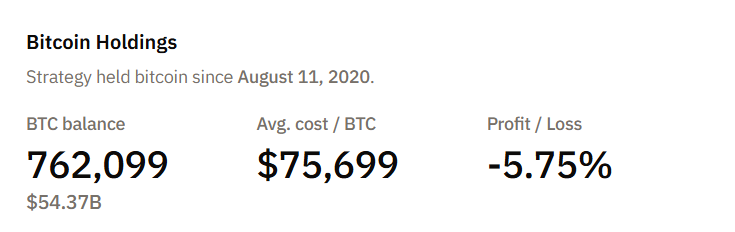
Source: BitcoinTreasuries.net
The latest acquisition was carried out on a much smaller scale than the purchases made over the previous two weeks, during which the company invested more than €1 billion in Bitcoin. Those large-scale purchases were primarily financed through the issuance of STRC preferred shares, highlighting the company’s active use of capital markets to support its Bitcoin accumulation strategy.
The slowdown in buying may indicate short-term caution in response to current market conditions or a tactical approach to capital management following earlier large-scale investments. Nevertheless, the company continues to reaffirm its long-term commitment to Bitcoin as a strategic reserve asset and systematically takes advantage of market opportunities to gradually increase its holdings. Source
Morgan Stanley Prepares Bitcoin ETF
Investment banking powerhouse Morgan Stanley has revised its Bitcoin ETF application, adding Fidelity as a custodian and confirming that the fund will trade on NYSE Arca under the ticker MSBT upon launch. In a Wednesday amendment to its S-1 filing with the SEC, the firm stated that the Morgan Stanley Bitcoin Trust will offer a fee waiver on the first $5 billion invested for a period of six months.
Morgan Stanley initially registered the Bitcoin fund alongside a Morgan Stanley Solana Trust in January. According to SEC filings, the BTC fund appears likely to be listed before its SOL counterpart, as the Solana filing has not been updated since its original submission.
At the time of registration, both funds were described as passive investment vehicles designed to track the price performance of their respective cryptocurrencies. The initial filings did not identify custodians, crypto counterparties, or fee structures—a common feature of S-1 filings, which are typically updated prior to a fund’s official listing.
Earlier this month, Morgan Stanley disclosed that The Bank of New York Mellon and Coinbase Custody Trust Company would serve as custodians for the fund’s assets, with Fidelity now joining the list. The updated application reflects Morgan Stanley’s broader strategic push into the cryptocurrency space.
In February, the firm’s newly appointed head of digital asset strategy, Amy Oldenburg, announced plans to develop in-house Bitcoin custody and trading services, while also exploring yield-generation and lending offerings. “We need to develop this infrastructure in-house. Relying primarily on rented technology isn’t sufficient,” she stated at a Bitcoin conference in Las Vegas.
Morgan Stanley, which manages nearly $9 trillion in client assets, confirmed in September that it would enable trading of Bitcoin, Ethereum, and Solana through its E*Trade platform. In January, the bank also filed to introduce an Ethereum ETF as part of its planned crypto offerings, one day after submitting filings for Bitcoin and Solana ETFs. That Ethereum filing has not yet been updated since its initial submission. Source
FBI warns of fake crypto tokens impersonating officials on the Tron network
The Federal Bureau of Investigation (FBI) has issued a warning about a new type of cryptocurrency scam targeting users of the Tron network. Attackers are sending fake tokens to crypto wallets that impersonate official notices of asset freezes due to alleged violations of anti-money laundering (AML) rules. The goal is to create panic and trick users into interactions that could reveal sensitive information or private keys.
This is not a typical phishing attack but a targeted social engineering scheme, primarily aimed at wallets with higher balances. Thanks to the low transaction fees on the Tron network, attackers can distribute thousands of these tokens at minimal cost, effectively reaching a large number of users.
The attack relies on psychological pressure. Upon receiving the token, the user sees a message about a supposed asset freeze, which may prompt hasty actions. They are then redirected to fraudulent websites or exposed to “address poisoning,” a technique where attackers create addresses resembling legitimate contacts to increase the likelihood of mistaken transfers.
This development reflects a broader trend in the crypto space, where attackers are increasingly focused on manipulating user behavior rather than exploiting technical vulnerabilities. For crypto companies, this represents growing security and regulatory risks, increasing the pressure to implement stricter controls and user protection measures. Source
SEC Declares Bitcoin, Ether, Solana and 13 Other Cryptos as Digital Commodities, Not Securities
For the past decade, the cryptocurrency industry has operated in a murky and often uncertain regulatory environment. Market participants have long struggled to determine whether the digital assets they use would be legally classified as securities, commodities, or something else entirely. That uncertainty is now beginning to lift.
On March 17, the Securities and Exchange Commission (SEC) and the Commodity Futures Trading Commission (CFTC) released interpretive guidance designating 16 cryptocurrencies as “digital commodities” and providing a clearer taxonomy for most other assets in the sector. Among the listed assets are Ethereum (ETH), Solana (SOL), XRP, Cardano, Chainlink, Bitcoin, and Dogecoin. This clarification could act as a significant catalyst for certain coins, potentially driving their values higher.
A key element of the new guidance addresses the regulatory treatment of staking. Staking is the process by which holders lock up their coins to help validate transactions on a proof-of-stake (PoS) blockchain, earning rewards in return. It is a major factor in attracting capital to chains like Ethereum and Solana.
Previously, whether staking rewards constituted a securities offering was a legally ambiguous question, which discouraged substantial institutional participation. Securities offerings require extensive documentation, and the SEC is known for strict enforcement when filings are incomplete. Moreover, once a security is issued, it becomes subject to a comprehensive regulatory framework.
The SEC now clarifies that most staking activities do not involve the offer or sale of a security, as the tokens being staked are classified as digital commodities rather than securities. This distinction is particularly significant for Ethereum and Solana, as it provides regulatory certainty and enhances the credibility of their staking ecosystems.
Capitalizing on this major new catalyst could potentially drive these assets to double over the next three years, particularly given that each already had a solid investment case even before this recent regulatory clarification. Source
Invest with Fumbi Today
Take advantage of the potential of cryptocurrencies easily, safely, and efficiently. Start investing with Fumbi with amounts starting from just €50. The Fumbi Algorithm in the Fumbi Index Portfolio tracks cryptocurrency market movements for you. If you want to create your own crypto portfolios, choose the Advanced Portfolios product, where you’ll have access to over 120 cryptocurrencies and templates created by our team, focusing on different areas of the crypto world.
TAKE ADVANTAGE OF CRYPTO’S POTENTIAL
Encountered a term you don’t understand? No worries! All important crypto-related terms can be found in one place in our new Fumbi Dictionary.

Daniel Mitrovsky 
Head of Crypto, Fumbi


Biography
Specializes in cryptocurrency market analysis, investment strategies, and technological trends in the blockchain space. With over 5 years of experience in financial markets, he has been actively involved in cryptocurrencies for more than 8 years. On the Fumbi blog, he brings you the latest news from the world of cryptocurrencies, comments on market developments, and clearly explains various investment approaches – from basics to advanced strategies.