
 3 min •
Juraj Ostertag
3 min •
Juraj Ostertag
DTCC Unites 50+ Firms to Drive Tokenization and Digital Asset Adoption – Market info
Over the past 14 days, the cryptocurrency market continued to grow moderately. Total market capitalization increased by 4.5% during this period and currently stands at €2.32 trillion. Bitcoin also rose by around 4.6%, with its price hovering around €69,460.
The Fear & Greed Index increased over the two weeks from 32 points to 46 points, which falls under the “fear” classification, meaning the index currently remains in the same range. The Altcoin Season Index slightly declined from 39 points to 31 points.
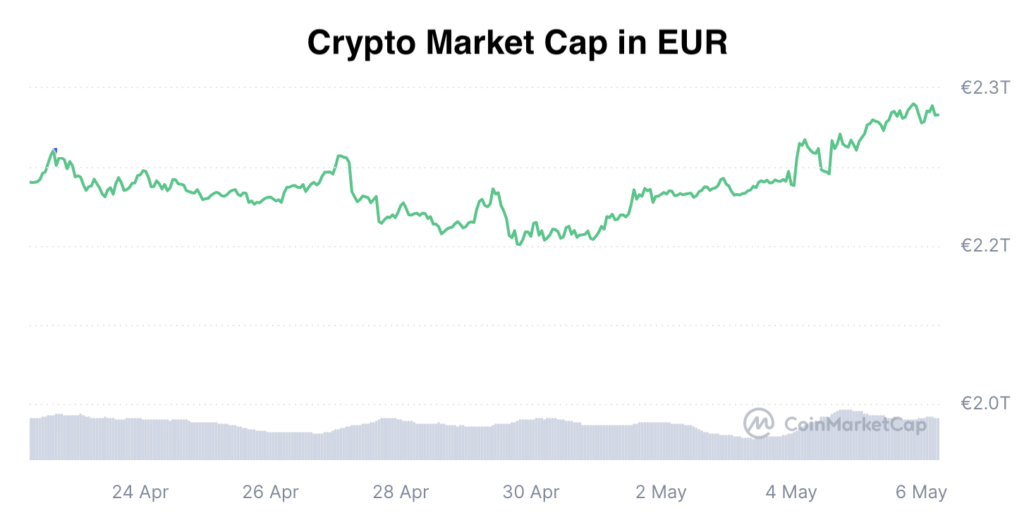
Source: Coinmarketcap
Meta Starts Paying Select Creators in Stablecoins With Stripe’s Support
Meta (META), the social media company behind Facebook and Instagram, has begun offering stablecoin payouts to creators, marking a renewed push into crypto-based payments years after it abandoned its Libra project. According to Meta’s website, the feature is currently available to a limited number of creators in Colombia and the Philippines. Eligible creators can connect a crypto wallet and receive payouts in Circle’s USDC stablecoin through the Solana or Polygon blockchain networks. The payout service is supported by payments company Stripe, which will also provide users with crypto-related reporting. Creators may receive tax documents from both Meta and Stripe related to their earnings and digital asset transactions. Stripe confirmed its role in the initiative to CoinDesk.
“Businesses can now send stablecoin payouts directly to customers using Link,” said Jay Shah, head of Link at Stripe, referring to Stripe’s customer checkout service. “We’re already partnering with Meta so their creators can receive stablecoins in their Link wallets in countries like the Philippines and Colombia.” The launch follows earlier reports from CoinDesk in February that Meta was working with third-party providers to manage stablecoin payments across its platforms, with Stripe seen as one of the main candidates for the integration.
With more than 3 billion users worldwide across its social platforms, Meta is now among the largest technology companies testing stablecoins for practical payment use cases. The company is using blockchain-based payment rails to send money globally without relying solely on traditional banking infrastructure. Stablecoins, which are cryptocurrencies pegged to fiat currencies, are increasingly seen as a faster and more cost-efficient payment option. Visa, for instance, said its stablecoin settlement network reached $7 billion in annualized transaction volume, rising 50% in one quarter. The initiative also represents Meta’s return to the stablecoin space after its earlier attempt to launch Libra, later renamed Diem. That project was ultimately shut down in 2022 following regulatory pressure. Source
Crypto Leaders Unite in $303M Aave Rescue Effort
Aave, one of the biggest lending platforms in decentralized finance, is helping lead a major recovery effort after losses linked to the Kelp DAO exploit. The incident affected rsETH markets and created risks for users who had lending positions on Aave. In response, several major DeFi companies and crypto projects have joined forces under an informal initiative called “DeFi United.”
So far, the initiative has received around $303 million in promised support, although much of it still needs approval from project communities and governance votes. Aave plans to contribute up to 250,000 ETH through a governance proposal. Its founder, Stani Kulechov, also said he would personally donate 5,000 ETH. Other people and teams connected to Aave have pledged smaller amounts. The recovery effort has also attracted support from outside Aave. Consensys and its founder Joseph Lubin agreed to provide up to 30,000 ETH to help protect users and support the market. Other projects, including Lido, EtherFi, Mantle, Compound, Renzo, Babylon Foundation, Circle Ventures, Avalanche Foundation, Solana Foundation, and Justin Sun, have also joined in different ways.
pic.
Source: Coindesk
Some are offering direct funds, others are making deposits into Aave, and some are providing loans or credit lines. This shows that the industry is trying to support affected users while also managing risk. Aave Labs has also asked Arbitrum governance to release around 30,765 ETH that was frozen by the network’s Security Council. The goal is to help compensate affected rsETH holders and restore confidence in the market. Many of these contributions still need final approval, but the response shows an unusually high level of cooperation across DeFi. Instead of acting separately, many major crypto projects are working together to protect users and help the market recover. Source
Dubious Bitcoin Fork Plan Faces Backlash Over Satoshi Coin Reassignment
Long-time Bitcoin developer Paul Sztorc is pushing for a major change to Bitcoin through a new hard fork called eCash. A hard fork happens when developers copy Bitcoin’s existing blockchain and create a separate network with its own rules and token. Bitcoin holders usually receive the same amount of the new token as the bitcoin they already own. A similar split happened in 2017, when Bitcoin Cash was created.
Sztorc’s proposed eCash fork is planned for August 2026 at Bitcoin block 964,000. Under the plan, anyone holding BTC at the time of the fork would receive the same amount in eCash tokens. For example, someone with 4.19 BTC would receive 4.19 eCash. The new network would be very similar to Bitcoin but would add Drivechains, a scaling idea Sztorc first proposed in 2015. Drivechains allow separate sidechains to connect to Bitcoin, making it possible to test new features without changing Bitcoin’s main network.
The most controversial part of the proposal involves coins linked to Bitcoin’s creator, Satoshi Nakamoto. Because the new chain would copy Bitcoin’s history, Satoshi’s untouched wallets would also receive equivalent eCash tokens. Sztorc wants to use part of these Satoshi-linked eCash coins to attract early investors and fund the project. He argues this would help the project gain support and avoid becoming unfinished or controlled by only a small group of developers. However, many in the Bitcoin community strongly disagree. Critics say using Satoshi-linked coins is unfair and sets a dangerous precedent. Some have called it theft, warning that if one group can reassign Satoshi’s coins today, other users’ coins could be at risk in the future. The proposal has therefore sparked a wider debate about Bitcoin forks, funding, and who has the right to decide what happens to coins on a new chain. Source
DTCC Unites 50+ Firms to Drive Tokenization and Digital Asset Adoption
On May 4, 2026, the Depository Trust & Clearing Corporation (DTCC) announced significant progress on a new tokenization platform developed through its subsidiary, The Depository Trust Company (DTC). More than 50 financial institutions from traditional markets and emerging digital sectors have joined the DTCC Industry Working Group to help shape the service. The platform is designed to tokenize traditional assets held in DTC custody—currently valued at over $114 trillion—while preserving existing investor entitlements, legal protections, and ownership rights. Its initial focus includes highly liquid assets such as the 1,000 largest U.S. public companies in the Russell 1000 index, leading exchange-traded funds, and U.S. Treasury bills, bonds, and notes.
The service aims to deliver institutional-scale liquidity, support interoperability across multiple blockchain networks, and create a secure, risk-managed environment for Web3 innovation. By enabling atomic settlement of collateral and programmable securities that can move across chains without losing legal standing, the initiative seeks to reduce settlement delays, lower over-collateralization needs, and unlock new liquidity and operational efficiencies. Two notable participants, Alpaca and Talos, confirmed their roles in the working group on the same day. Alpaca brings experience from its Instant Tokenization Network, while Talos emphasized that the service could help institutions access blockchain efficiencies within established regulatory frameworks.
Limited production trading of tokenized securities is expected to begin in July 2026, with a full commercial launch planned for October 2026. During this period, the working group will define best-practice standards, validate operational flows, and test real-world interoperability. DTCC President and CEO Frank La Salla described the initiative as a key step toward broader digital-asset adoption, highlighting tokenization’s potential to improve liquidity, transparency, and investor value. With DTCC’s post-trade expertise and scale, the service is positioned to connect traditional finance with decentralized ecosystems while maintaining the safety and resilience global markets require. Source
Bitcoin’s Inflation Shift: From Risk Asset to Hedge
Bitcoin continues to climb, challenging the usual inflation-driven market logic and raising a key question: has it quietly evolved from a risk asset into an inflation hedge? The world’s largest cryptocurrency has gained 19% in just over a month, rising above $80,000 on Monday for the first time since January. The move comes as oil remains above $100, Bloomberg’s commodity futures index reaches a decade high, and U.S. consumer inflation expectations continue to rise.
Under the traditional macro playbook, this environment should be negative for bitcoin. Higher inflation usually means the Federal Reserve may keep interest rates elevated for longer, making safer yield-bearing assets such as U.S. Treasury notes more attractive than non-yielding assets like bitcoin. This pattern was visible in 2022, when aggressive Fed rate hikes contributed to a sharp bitcoin sell-off.
This time, however, bitcoin is moving in the opposite direction. Some analysts see a disconnect between macro signals and asset prices, questioning whether the rally can last. Others argue that a deeper shift is underway. “Macro signals remain divided, with commodities pricing supply-side stress while risk assets continue to trade higher,” Bitfinex analysts said, noting that the divergence raises questions about the durability of the current risk-on environment.
Another view is gaining momentum: bitcoin is increasingly being treated not only as a speculative asset, but also as an inflation hedge. Renewed inflows into spot bitcoin ETFs support this shift. Ryan Lee, chief analyst at Bitget Research, said continued ETF inflows point to a broader change in how institutions approach hedging, with digital assets increasingly considered alongside gold.
The idea is also gaining traction beyond crypto circles. Veteran macro trader Paul Tudor Jones recently called bitcoin “the best inflation hedge there is,” even more compelling than gold. His reasoning is based on supply. Unlike gold, whose supply grows each year, bitcoin has a fixed maximum supply. In a world where central banks can expand money supply, investors may increasingly value an asset that cannot be printed. Source
Institutional Bitcoin Adoption Is Coming, But Slowly
Morgan Stanley’s entry into U.S. spot bitcoin ETFs has been described by some as a potential turning point for the crypto market, mainly because of the reach of its $8 trillion wealth management network. However, Blockstream CEO Adam Back believes the impact will not be immediate, as institutional adoption usually takes much longer than many investors expect.
Back argues that bitcoin ETFs may be one of the most important positive signals for the market, possibly even more significant than a pro-crypto U.S. administration. Still, he says large investors and fund managers do not adjust their portfolios overnight. Even if firms such as BlackRock recommend a 2% to 4% bitcoin allocation, it could take a year or even 18 months before those recommendations are fully reflected in institutional portfolios.
According to Back, this process is only starting, but it could create a meaningful long-term tailwind for bitcoin. He also noted that the current U.S. administration has helped improve the regulatory environment for crypto, making the country more open to digital-asset businesses. This has also encouraged other jurisdictions, including the U.K., to move in a similar direction.
At the same time, Back believes bitcoin ETFs may have an impact that extends beyond any single political administration. Major financial firms such as BlackRock, Morgan Stanley, and Fidelity now have a direct business interest in bitcoin ETF products. As a result, they may become important defenders of the sector and help keep institutional access to bitcoin open in the future.
Another important factor is bitcoin’s historical four-year cycle, which is shaped by the halving event that cuts the supply of new bitcoin in half. Even if this cycle is becoming less predictable, expectations can still influence the market. If enough investors believe a downturn is coming, they may sell in advance and help create the very price drop they expect.
Back believes this dynamic could change as stronger institutional demand becomes more visible. ETF inflows, sovereign investments, bitcoin treasury companies, and recurring buyers such as Strategy could gradually absorb selling pressure. Over time, these new sources of demand may outweigh sellers and provide lasting support for bitcoin’s price. Source
Invest with Fumbi Today
Take advantage of the potential of cryptocurrencies easily, safely, and efficiently. Start investing with Fumbi with amounts starting from just €50. The Fumbi Algorithm in the Fumbi Index Portfolio tracks cryptocurrency market movements for you. If you want to create your own crypto portfolios, choose the Advanced Portfolios product, where you’ll have access to over 120 cryptocurrencies and templates created by our team, focusing on different areas of the crypto world.
OPEN PROFILEEncountered a term you don’t understand? No worries! All important crypto-related terms can be found in one place in our new Fumbi Dictionary.

Juraj Ostertag 
Fumbi


