
 3 min •
Juraj Ostertag
3 min •
Juraj Ostertag
Ethereum Prepares for Its Biggest Change Since the Transition to Proof of Stake – Market Info
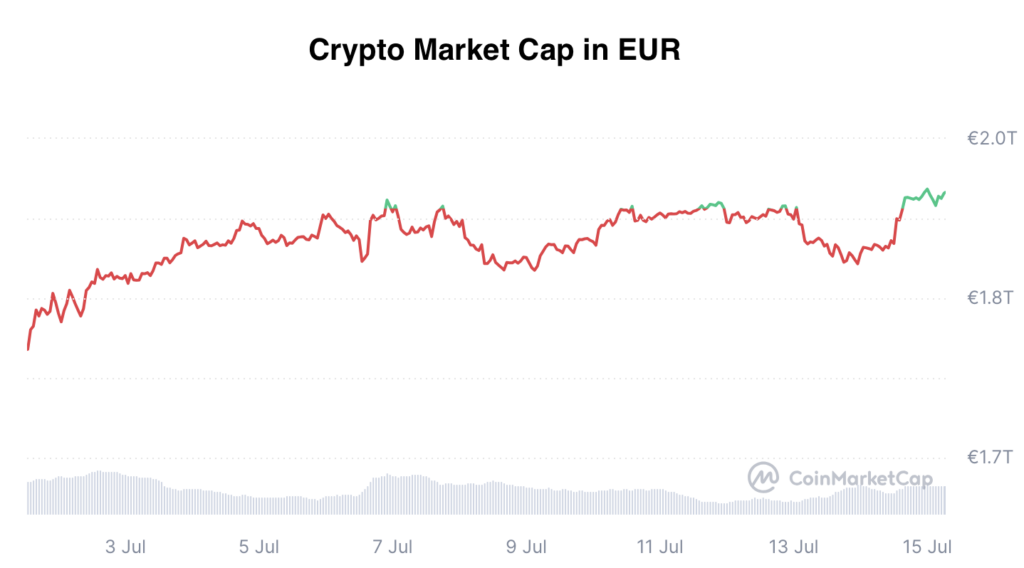
The cryptocurrency market recorded significant growth over the past 14 days. During this period, the total market capitalization increased from €1.79 trillion to €1.95 trillion. The price of bitcoin rose by approximately 10.5% and is currently trading at around €56,700.
Over the past 14 days, the Fear & Greed Index increased from 11 to 25 points. This value still falls within the “extreme fear” category. The Altcoin Season Index remained unchanged at 51 points.
Source: CoinMarketCap
Ethereum Prepares for Its Biggest Change Since the Transition to Proof of Stake
Ethereum co-founder Vitalik Buterin has introduced the Lean Ethereum plan, which aims to significantly transform the operation of the entire Ethereum network over the coming years.
According to Buterin, this will represent the third major stage in Ethereum’s development following its launch and transition to the Proof of Stake mechanism in 2022. Over the next three to four years, nearly all major parts of the protocol are expected to change gradually, while existing applications should continue to operate without significant disruption.
One of the main priorities is protection against quantum computers. In the future, they could potentially break the cryptographic security used by blockchains. Ethereum therefore plans to replace vulnerable technologies with quantum-resistant solutions, including the data-storage system used by layer-2 blockchains.
Privacy protection is also gaining greater importance. New network features are expected to be designed in a way that naturally supports private transactions. The method of transaction verification is also set to change. Instead of checking every individual operation, devices participating in the network would verify only a short cryptographic proof confirming that everything had been processed correctly. This could allow the network to operate faster and with lower technical requirements.
The biggest change, however, concerns the so-called network state, which is the record of all accounts, balances, tokens and data stored in smart contracts. The volume of this data continues to grow, making the network increasingly demanding to operate. Lean Ethereum proposes retaining the current flexible model while limiting its growth and supplementing it with less expensive forms of data storage. As a result, the network’s capacity could increase from approximately two terabytes today to more than 100 terabytes by 2030, without requiring all data to be stored with every transaction.
Ethereum may also eventually replace its current Ethereum Virtual Machine, or EVM, which is responsible for executing smart contracts. The open RISC-V architecture has been mentioned as one possible successor. According to Buterin, the EVM could remain a simpler layer for developers, while the protocol itself would operate on a new technical foundation.
However, this is a long-term vision, and most of the proposed changes will be introduced gradually over the coming years. Through this plan, Ethereum is preparing for further network growth, stronger protection of user privacy and new security threats that may become more significant in the future. Source
Robinhood Bet on Tokenized Stocks, but Memecoins Stole the Spotlight
Robinhood launched its own blockchain with the aim of connecting traditional financial assets with decentralized finance. During its first few weeks, however, trading in speculative memecoins dominated the network instead of tokenized stocks.
CASHCAT, named after the company’s former mascot, attracted the most attention. Its price increased by more than 2,100% in seven days, while its market capitalization reached approximately $156 million. This is significantly higher than the value of all tokenized real-world assets on the network, which stands at approximately $13 million. Most of these assets consist of tokenized stocks, while the remainder includes commodities, ETFs and US Treasury bonds.
Robinhood Chain also recorded a rapid start. Since its launch on 1 July, the total value of assets on the network has increased from $17 million to approximately $135 million. Over a single week, decentralized exchange trading volume on the network also reached approximately $3.1 billion.
The new network even surpassed Base in terms of daily activity. It processed approximately 10.4 million transactions in a single day, compared with 6.4 million recorded by Base. Robinhood Chain is a layer-2 blockchain built using Arbitrum Orbit technology. Transactions are settled on Ethereum, and fees are paid in ether.
Robinhood Chain Versus Leading Blockchains by Trading Volume

Source: DefiLlama
Its main products are Stock Tokens, which track the value of shares in companies such as Apple and Nvidia and enable continuous trading. However, they are not available to US investors and are legally structured as tokenized debt instruments.
Projects including Uniswap, Chainlink and Morpho also joined the network at launch. Robinhood plans to gradually integrate tokenized assets into trading, lending and other DeFi services. However, real-world assets currently represent only a small share of activity on the network. Most of the network’s value consists of assets under management, lending, trading and stablecoins, whose market capitalization is approaching $300 million.
The success of CASHCAT also encouraged the creation of additional tokens associated with the Robinhood brand. Memecoins therefore brought the network its first significant wave of users, liquidity and transactions. Base experienced a similar development after its launch. Speculative tokens initially dominated the network, while more stable applications developed only later.
Robinhood must now demonstrate whether it can convert traders’ short-term interest into the long-term use of tokenized stocks. If the value of real-world assets continues to increase after memecoin activity declines, the network may move closer to its original objective. However, if speculators leave, Robinhood Chain could remain just another network whose initial success was driven by memecoins. Source
Prediction Markets Eclipsed Traditional Sportsbooks During the World Cup
The 2026 FIFA World Cup broke betting records in the United States. The biggest surprise, however, was the rapid growth of Kalshi and Polymarket, which began taking a significant share of the market from traditional sportsbooks.
Kalshi recorded total trading volume of $31 billion in June, with sports markets accounting for approximately 85% of that amount. Contracts related to the World Cup alone generated more than $22 billion in volume. Polymarket set a monthly record on its international platform with trading volume of $10.8 billion. Its regulated US platform separately processed another $3.5 billion.
Prediction markets differ from traditional sportsbooks because they do not offer only sports betting. Users can also trade contracts related to election results, economic indicators and television programmes.
The popularity of Kalshi’s mobile application also grew significantly during the tournament. By the end of June, its number of daily active users had increased by 36%. By contrast, the DraftKings, FanDuel, BetMGM and Caesars applications recorded a significant decline in activity after an initial increase. Kalshi and Polymarket together accounted for almost 79% of all downloads among the six betting and prediction-market applications being tracked. A year earlier, their combined share stood at only approximately 6%.
Kalshi also attracted people who had previously made little use of betting products. The number of female users increased by more than 100% during the tournament, with women accounting for approximately one-third of its user base. Intensive advertising during football broadcasts and partnerships connected with the tournament contributed to this growth. Kalshi even ranked among the brands that recorded the strongest increase in consumer interest during the World Cup.
A new platform called Rothera, a joint project between Robinhood and Susquehanna International Group, also launched in June. During its first month alone, it processed approximately $2 billion worth of trades and captured 7% of the US market. The growth of prediction platforms is also attracting professional traders. Large financial companies are beginning to take advantage of pricing differences between Kalshi, Polymarket and traditional sportsbooks.
The World Cup demonstrated that traditional sportsbooks are no longer the only major players in the market. Prediction platforms attracted high liquidity, large numbers of new users and an increasingly strong reputation. The most important signal is that users of traditional betting applications increasingly began trying Kalshi, while Kalshi users were less likely to move to traditional sportsbooks. Prediction markets built on blockchain technology are therefore increasingly establishing themselves as full-fledged competitors to traditional sportsbooks. Source
USDC Surpasses Tether in Transaction Volume, Visa Data Shows
Circle’s USDC stablecoin significantly strengthened its position during the first half of 2026 and extended its lead over rival USDT, issued by Tether, in terms of transaction volume. This is according to the latest data from Visa’s analytical tool, which tracks stablecoin usage.
Stablecoin transaction volume reached a record $1.79 trillion in June. Compared with May, when it stood at approximately $1.1 trillion, it increased by 63%. On a year-on-year basis, the increase reached as much as 125%, as the figure stood at approximately $795 billion in June 2025.
During the first six months of the year, total stablecoin transaction volume reached $8.82 trillion. In just half a year, it therefore exceeded the $5.8 trillion recorded during the whole of 2024. It also moved closer to the record level of $10.8 trillion recorded in 2025, with a difference of approximately $2 trillion remaining.
Visa does not include every transaction recorded on a blockchain in its calculations. It removes bot activity, transfers between cryptocurrency exchanges and other operations that do not represent genuine economic activity. The resulting data should therefore provide a more accurate picture of stablecoin usage for payments, transfers and other financial operations.
The growth in stablecoin transaction volume comes at a time when stablecoins are increasingly being used by banks, payment companies and other financial institutions. They are primarily being adopted for cross-border payments, faster transaction settlement and corporate liquidity management.
British banking company Standard Chartered and BNY, also known as Bank of New York Mellon, recently introduced services based on USDC instead of developing their own stablecoin infrastructure. This suggests that financial companies increasingly prefer established digital currencies pegged to traditional currencies. Using an existing network may allow them to introduce new services more quickly and with lower technical costs.
USDC accounted for approximately 70% of total stablecoin transaction volume during the first half of 2026, while USDT represented around 25%. The balance of power has changed significantly in recent years. In 2020, USDT accounted for almost 90% of adjusted stablecoin transaction volume, while USDC’s share was below 10%. By 2022, however, USDC had already increased its share to approximately 45%.
USDT remains the largest stablecoin by market capitalization, but transaction data suggests that USDC is gaining a stronger position, particularly in payments and institutional use. At the same time, stablecoins are gradually moving beyond cryptocurrency trading towards broader adoption in traditional financial services. Source
Why Is Strategy Selling Hundreds of Millions of Dollars’ Worth of Bitcoin?
Strategy sold approximately $216 million worth of bitcoin and reported an unrealized loss of $8.31 billion on its bitcoin positions for the second quarter of 2026. The price of bitcoin fell from approximately $68,000 at the beginning of April to around $60,000 at the end of June. The company also recorded a realized loss of approximately $900,000.
Strategy’s accounting losses were primarily caused by the decline in bitcoin’s price. During this period, the company alternated between buying and selling bitcoin. At the end of May, it sold 32 BTC, subsequently purchased 3,657 BTC at higher prices and sold another 3,558 BTC on Monday.
Following these transactions, Strategy’s bitcoin reserves increased by only 69 BTC, despite the company deploying approximately $20 million in additional capital. Because it sold part of its bitcoin at a lower price than it had paid shortly beforehand, the estimated average cost of these additional 69 BTC exceeded $289,000 per bitcoin.
Strategy currently holds 843,775 BTC purchased at an average price of $75,476, maintaining its position as the largest publicly traded corporate holder of bitcoin. The latest sale may indicate that the company is prioritizing the payment of dividends on its high-yield Stretch preferred stock (STRC). Its dividend yield reached 12% following a recent increase of 50 basis points.
The recent alternation between bitcoin purchases and sales makes it more difficult for investors to assess the company’s short-term capital-allocation strategy. Assuming that the prices of BTC, MSTR and STRC remain relatively stable, further bitcoin purchases may be unlikely in the near future.
Such a development would represent a significant shift for Michael Saylor and his team, who have long advocated buying bitcoin regardless of its price and rejected the idea of selling it. Strategy currently has enough cash to cover dividend payments for more than 17 months. Among preferred-stock investors, dividend coverage for a period of at least 18 months is generally considered a strong position.
Further bitcoin sales remain possible, but they are likely to be limited unless markets decline significantly or the company’s financial requirements change.
For bitcoin, this could mean that Strategy will no longer create demand through regular purchases, which significantly supported its growth during the previous bull market. At the same time, the latest sale may reduce the need for further substantial bitcoin sales if it provided the company with sufficient cash to pay dividends. However, according to the latest information published at the beginning of this week, Strategy currently holds enough cash to cover dividend payments for the next 20 months without having to sell BTC. Source
ECB Selects Revolut and Deutsche Bank to Test the Digital Euro
The European Central Bank (ECB) has selected 36 banks and payment companies to participate in a pilot test of the digital euro. The project will begin in the second half of 2027 and is part of preparations for the potential issuance of a central bank digital currency (CBDC) in 2029.
The selected companies include Adyen, Deutsche Bank, Revolut, SumUp, UniCredit and Worldline. The ECB selected them from a total of 50 applicants.
Although the legislation required to introduce the digital euro has not yet been definitively approved, the central bank is continuing with the project. It considers the growing use of private stablecoins pegged to the US dollar, such as USDT and USDC, to be a threat to Europe’s monetary autonomy. The 12-month pilot project will test a trial version of the digital euro with the participation of the ECB and 19 national central banks in the euro area. Testing will include online and offline transfers between individuals, payments in physical stores and online purchases.
During the pilot phase, the digital euro will not have legal-tender status, but its design will closely resemble the model described in the European Union’s proposed legislation. Employees of the ECB and national central banks will act as consumers. Payments will be accepted by selected restaurants, cafés and online retailers.
However, central bank digital currencies have also faced criticism. Privacy advocates have warned about the risk of transaction monitoring and the possibility that a central bank could restrict users’ access to a digital currency. In the United States, a law entered into force last month prohibiting the Federal Reserve System from creating or issuing a digital dollar until 31 December 2030.
By contrast, the European project is moving into the practical testing phase while EU lawmakers work on the legislation required for its introduction. Last month, a European Parliament committee advanced the proposed legal framework to the next stage of the legislative process.
The final decision on issuing the digital euro will depend on the approval of the legislation and a separate decision by the ECB’s Governing Council. The central bank has stated that it could be ready for its potential introduction in 2029. Source
Invest with Fumbi Today
Take advantage of the potential of cryptocurrencies easily, safely, and efficiently. Start investing with Fumbi with amounts starting from just €10. The Fumbi Algorithm in the Fumbi Index Portfolio tracks cryptocurrency market movements for you. If you want to create your own crypto portfolios, choose the Advanced Portfolios product, where you’ll have access to over 120 cryptocurrencies and templates created by our team, focusing on different areas of the crypto world.
OPEN PROFILEEncountered a term you don’t understand? No worries! All important crypto-related terms can be found in one place in our new Fumbi Dictionary.

Juraj Ostertag 
Fumbi


