
 3 min •
Daniel Mitrovsky
3 min •
Daniel Mitrovsky
The Crypto Industry Enters the Infrastructure Era – Market Info
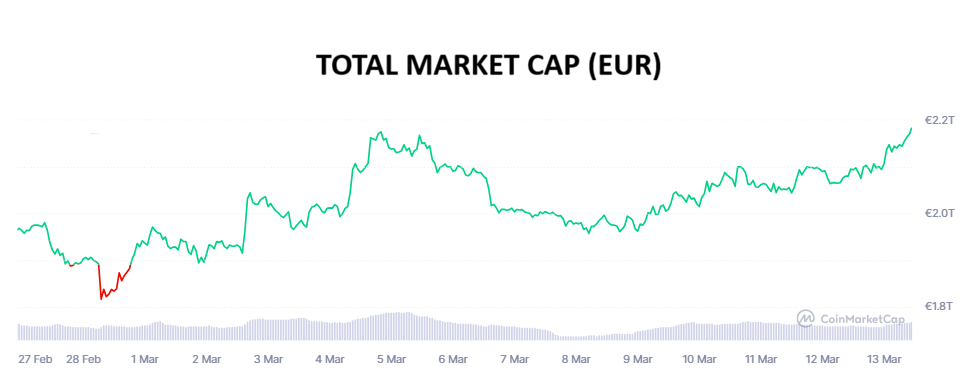
The cryptocurrency market has seen a slight increase over the past 14 days. The total market capitalization rose by approximately 4.5 % during this period and currently stands at around €2.08 trillion. Bitcoin itself increased only by 5.7 % over the same period, with its price hovering around €60,900.
The Fear & Greed Index rose from 11 to 18 points over the two weeks, but it still remains in the extreme fear zone. Meanwhile, However, the Altcoin Season Index worsened, dropping from 47 points to 41 points.
The Crypto Industry Enters the Infrastructure Era
According to several industry leaders, the crypto industry is entering a new phase of development, referred to as the “infrastructure era.” The discussion surrounding cryptocurrencies is gradually shifting from volatile speculation to building the technological foundation for a new global financial system. This shift is becoming increasingly visible, especially in 2026, as infrastructure enabling more efficient and faster financial transactions takes the spotlight.
One of the key differences between the traditional financial system and the cryptocurrency ecosystem is the way transactions are processed. According to Yaroslav Patsir from CEX.IO, applications in the traditional financial world are mostly just user interfaces, while the actual transaction processing is handled by a whole chain of banks, clearinghouses, and other intermediaries. In contrast, crypto platforms use blockchain to manage the entire transaction lifecycle within a single digital ecosystem.
This architecture allows for “atomic settlement” of transactions. While in traditional stock markets settlement can take up to two days (T+2), on crypto platforms, both the trade and its settlement happen virtually instantly. A major advantage is the 24/7 operation—while traditional exchanges are open only during business hours, crypto markets are available 24 hours a day, 7 days a week.
A key role in this system is played by stablecoins, which act as a bridge between different monetary systems. According to Kevin Lehtiniitty from Borderless, the so-called “stablecoin sandwich” allows a user to convert local currency into a stablecoin, send it abroad instantly, and then convert it back into another national currency.
This model could significantly simplify international payments, which today often face barriers between different banking systems. Blockchain also brings greater transparency, as all transactions are recorded in a public ledger. Industry representatives argue that crypto technologies are gradually creating the foundation for a new financial infrastructure that could operate faster, more openly, and be globally accessible. Source
Wells Fargo Hints at Entering the Stablecoin World
One of the largest American banks, Wells Fargo, has filed a trademark application for “WFUSD,” indicating its plan to enter the rapidly growing stablecoin market. The filing was submitted on March 10 to the U.S. Patent and Trademark Office (USPTO) and suggests the potential development of a stablecoin pegged to the U.S. dollar.
According to the documentation, the trademark covers a wide range of digital services, including software, blockchain platforms, and financial tools for digital payments. It also includes areas like cryptocurrency trading, staking, digital wallets, asset tokenization, and the use of smart contracts. This move suggests that the bank is preparing for a more comprehensive integration of blockchain technologies into its financial services.
For Wells Fargo, this is not a completely new experiment with digital currencies. The bank has previously tested its own solution called Wells Fargo Digital Cash, which functioned as an internal stablecoin used for international transaction settlements within the bank’s network. The goal of the project was to speed up the transfer of funds between branches, extend transactional hours, and reduce reliance on external intermediaries.
The new WFUSD registration comes at a time when several large U.S. banks are becoming more focused on stablecoins. As early as 2025, reports emerged that institutions such as JPMorgan Chase, Bank of America, Citigroup, and Wells Fargo were considering a joint initiative to create a stablecoin solution that could compete with rapidly growing crypto platforms.
Some banks have already launched similar projects. JPMorgan, for example, introduced the JPMD token, which represents a digital deposit token pegged to the U.S. dollar. This token allows institutional clients to settle transactions on the blockchain continuously, 24 hours a day. It also represents bank deposits, can generate interest, and supports on-chain payments, although its use is currently limited to approved financial institutions.
If Wells Fargo were to launch the WFUSD stablecoin, it would mark another significant step for traditional financial institutions toward integrating blockchain technologies into the global financial system. Source
BlackRock Launches Ethereum ETF with Staking
The world’s largest asset manager, BlackRock, is expanding its cryptocurrency investment product offerings with a new fund. The company has introduced the iShares Staked Ethereum Trust ETF (ETHB), which will be traded on the Nasdaq and allow investors not only to invest in Ethereum but also to earn staking rewards.
This is BlackRock’s first cryptocurrency ETF to integrate staking directly into its investment strategy. The fund will hold spot Ethereum, with a portion of these assets used for staking on the Ethereum network. This offers investors a combination of potential ETH price growth and additional returns from staking rewards.
The new fund also expands BlackRock’s existing cryptocurrency offerings. The company already manages two major cryptocurrency funds—iShares Bitcoin Trust (IBIT) and iShares Ethereum Trust (ETHA). The Bitcoin fund, IBIT, currently manages more than $55 billion, while ETHA holds approximately $6.5 billion in assets. According to Jay Jacobs, who leads ETF products at BlackRock in the U.S., the goal of the new fund is to broaden investment options. While the existing ETHA fund provides direct exposure to Ethereum’s price, some investors are interested in maximizing overall returns by combining price growth with staking rewards.
Ethereum operates on a proof-of-stake mechanism, where token holders lock their coins to secure the network and validate transactions. In return, they earn rewards, which many investors view as a form of regular income similar to interest.
Until now, most Ethereum-focused ETFs have not offered staking, which discouraged some investors who already held ETH directly and actively engaged in staking. The new fund could therefore attract crypto-native investors who want to maintain staking while taking advantage of the ETF structure’s benefits—such as easy trading through traditional brokerage accounts and institutional custody of assets.
The fund’s fee is set at 0.25%, with a reduced rate of 0.12% for the first $2.5 billion in assets under management during its first year. BlackRock expects interest from individual investors, financial advisors, and institutional players like hedge funds and family investment offices. Source
SEC and CFTC Settle Cryptocurrency Regulation Dispute
The U.S. Securities and Exchange Commission (SEC) and the Commodity Futures Trading Commission (CFTC) have signed a memorandum of cooperation aimed at coordinating oversight of digital assets. The agreement is designed to resolve long-standing jurisdictional disputes between the two regulators, which often created confusion for cryptocurrency companies and forced them to address parallel or even conflicting regulatory requirements.
The memorandum outlines several areas of collaboration, including joint classification of cryptocurrency assets, coordinated audits, and alignment of regulatory policies. The regulators have also launched the Joint Harmonization Initiative, which focuses on unifying approaches to product assessments, reporting, market oversight, and regulatory processes for firms operating in the digital asset market.
For crypto companies, this means greater regulatory clarity, especially regarding whether a specific token is considered a security or a commodity. A key benefit will also be a more streamlined process for communicating with regulators for exchanges, token issuers, and asset custodians. This move suggests that the U.S. may soon be closer to adopting comprehensive cryptocurrency legislation. Source
U.S. Inflation Matches Expectations, Fed Rate Cuts Not Expected Yet
The latest inflation data from the United States confirmed market expectations and suggest that the U.S. central bank is unlikely to lower interest rates in the near future. The Consumer Price Index (CPI) for February increased by 0.3% month-over-month, exactly in line with economists’ forecasts. Year-over-year, inflation reached 2.4%, the same as in January and precisely matching market expectations.
Core inflation, which excludes volatile food and energy prices, also developed as expected. It rose by 0.2% month-over-month in February, while year-over-year it reached 2.5%. These figures indicate inflation stabilization but do not provide sufficient grounds for a rapid easing of monetary policy. As a result, markets expect the Federal Reserve to keep interest rates unchanged not only at the March meeting but likely also in April.
On the financial markets, the data caused slight tension. Bitcoin briefly traded around $69,500, representing a decline of approximately 1.2%. U.S. stock futures saw a slight drop, and the yield on 10-year U.S. Treasury bonds rose to around 4.18%. Crude oil also saw significant movement, with WTI prices rising by more than 4% to about $87 per barrel. Markets are also closely monitoring geopolitical factors and energy prices, which could influence future Fed decisions on monetary policy. Source
Meta Strengthens AI Agent Development with Moltbook Acquisition
Meta is expanding its artificial intelligence efforts through the acquisition of the Moltbook platform, a social network designed for autonomous AI agents. The platform was founded by entrepreneurs Matt Schlicht and Ben Parr, who will join Meta’s research team at Superintelligence Labs following the completion of the transaction. The financial terms of the acquisition were not disclosed, and the deal is expected to close in mid-March. Moltbook was created as an experimental space where AI agents independently publish posts, communicate with each other, and coordinate tasks on behalf of their human operators. The platform functions as a social network resembling a discussion forum, where people mostly observe the agents’ interactions and do not actively participate in the communication.
At the core of Moltbook is the open-source framework OpenClaw, which enables the creation of autonomous agents connected to AI models like ChatGPT, Claude, or Gemini. These agents can communicate with each other via platforms like Slack, Discord, or WhatsApp and perform various tasks on behalf of their users. The platform quickly gained attention in the tech sector, attracting hundreds of thousands of active agents. OpenClaw, as an open-source system, also drew other tech companies interested in the potential of autonomous agents for communication, task coordination, and automating business processes.
Meta expects that acquiring Moltbook will significantly expand the capabilities of AI agents, allowing them to communicate not only with each other but also with users and businesses. The platform includes an agent identity verification system, enabling agents to securely connect and act on behalf of human owners. This move further supports Meta’s vision of creating superintelligent systems that can autonomously collaborate, improve productivity, and deliver innovative solutions for the digital environment. Moltbook thus represents another major step for Meta towards the broader integration of autonomous AI agents into everyday digital interactions. Source
Invest With Fumbi Today
Harness the potential of cryptocurrencies simply, securely and efficiently. Start investing with Fumbi with amounts starting from €50. The Fumbi Algorithm in the Fumbi Index Portfolio tracks price movements in the cryptocurrency market for you. If you want to build your own crypto portfolios, choose the Advanced Portfolios product, where you will have access to over 120 cryptocurrencies and templates created by our team that focus on different areas within the crypto universe.
TAKE ADVANTAGE OF CRYPTO’S POTENTIAL
Have you come across a term in the text that you don’t understand? Never mind, you can find all the important terms related to cryptocurrencies in one place in our new Fumbi Dictionary.


Daniel Mitrovsky 
Head of Crypto, Fumbi


Biography
Specializes in cryptocurrency market analysis, investment strategies, and technological trends in the blockchain space. With over 5 years of experience in financial markets, he has been actively involved in cryptocurrencies for more than 8 years. On the Fumbi blog, he brings you the latest news from the world of cryptocurrencies, comments on market developments, and clearly explains various investment approaches – from basics to advanced strategies.