
 3 min •
Juraj Ostertag
3 min •
Juraj Ostertag
U.S. and Iran to Sign Peace Deal on June 19 – Market info
The cryptocurrency market has moved sideways over the past 14 days, with slight growth in recent days. Total market capitalization remained almost unchanged during this period and currently stands at €1.96 trillion. Bitcoin recorded a minimal decline of 0.01%, with its price currently around €57,400.
The Fear & Greed Index rose over the past 14 days from 11 points to 23 points. However, this range still falls under the classification of “extreme fear.” The Altcoin Season Index remained unchanged at 49 points.
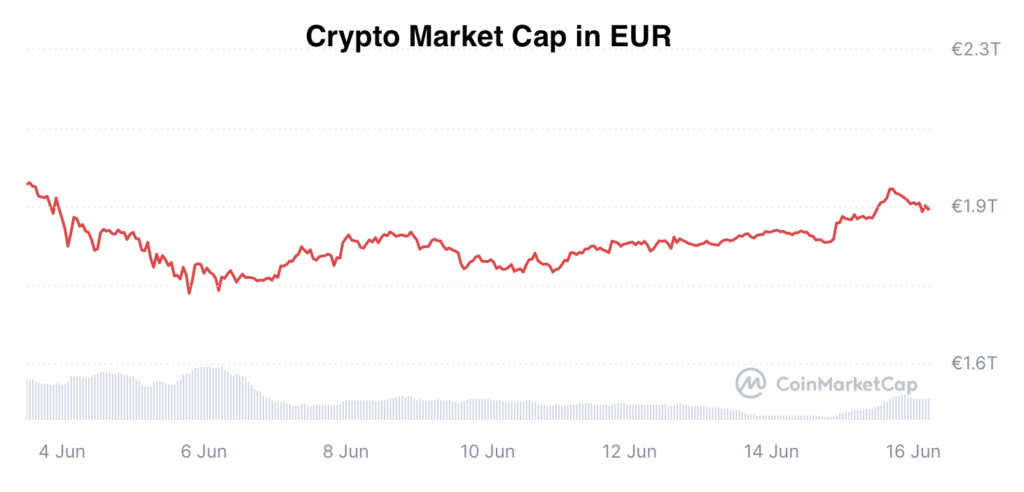
Source: Coinmarketcap
U.S. and Iran to Sign Peace Deal on June 19, Trump Says
Over the weekend, President Donald Trump announced that the United States and Iran had agreed to a peace framework, with the formal signing expected on June 19.
As part of the agreement, the U.S. naval blockade is set to be lifted, while the Strait of Hormuz is expected to reopen. The announcement immediately affected energy markets, with crude oil dropping by 5% to approximately $80 per barrel. Oil prices are now about 33% below their early March peak of $120.
Global equity markets responded positively to the news. Major stock indexes moved higher across regions, while U.S. equities gained in pre-market trading. The Invesco QQQ ETF, which follows the Nasdaq 100, rose by 2% before the market opened. Bitcoin, however, reacted more cautiously than stocks and oil. Although the cryptocurrency briefly moved above $67,000, it later slipped back below $66,000.
The ceasefire memorandum was signed electronically by Trump and Vice President Vance, with the Strait of Hormuz expected to fully reopen on Friday. Despite the positive market reaction, Bitcoin’s upside has remained limited. Bitcoin ETFs have recently stopped recording outflows after four consecutive weeks of withdrawals totaling $5.4 billion.
Market participants remain cautious. Axis co-founder Jimmy Xue noted that investors have not yet fully committed to the recovery, while institutional demand has not returned in a meaningful way. Chris Perkins from Franklin Templeton suggested that improving macroeconomic conditions could help bring retail capital back into the market.
Looking ahead, investors are watching several potential short-term catalysts, including the possible passage of the Clarity Act and the upcoming Federal Reserve decision. Source
SpaceX reveals $1.3 billion Bitcoin reserve
SpaceX’s Nasdaq debut drew attention for its massive fundraising, but another detail may be just as important for the crypto industry: the company is bringing a major bitcoin reserve into the public market.
In its filing, SpaceX disclosed that it holds 18,712 bitcoin, acquired for about $661 million and valued at roughly $1.29 billion as of March 31. The company described the position as part of its strategy for managing excess cash, not as the core of its business.
That distinction matters. SpaceX is focused on rockets, satellites and advanced technology, yet it has chosen to treat bitcoin as a treasury asset alongside traditional cash reserves. This gives investors a different example of corporate bitcoin ownership than companies built mainly around accumulating crypto.
Until now, most large public-market bitcoin exposure has come from firms whose identity is closely tied to digital assets. Strategy, for example, is widely viewed as a leveraged bitcoin proxy, while other treasury-focused companies raise capital specifically to buy crypto.
SpaceX represents another model: a major operating company that holds bitcoin without making it central to its business. That could make its approach more relevant for traditional finance teams watching how digital assets fit into corporate balance sheets.
The filing also revealed that SpaceX’s bitcoin position was more than double the roughly 8,300 bitcoin previously estimated by onchain analysts. As a public company, SpaceX will now have to mark the value of its holdings to market each quarter, meaning bitcoin price swings could affect reported results even without any sale.
Despite bitcoin trading below its January high, SpaceX’s estimated average purchase price of around $35,000 means the position remains well above its original cost.
If SpaceX continues to hold bitcoin through market volatility, earnings cycles and investor scrutiny, it could become a major test case for bitcoin as a reserve asset at a mainstream public company.
The debut is also being watched as a possible signal for future listings from large technology companies such as OpenAI and Anthropic. How investors react to SpaceX’s bitcoin reserve over the next few quarters may influence whether other major issuers consider a similar approach. Source
Analyst Says Bitcoin May Be Entering a New Recovery Phase
Standard Chartered’s head of digital assets research, Geoffrey Kendrick, believes Bitcoin may have already reached its low for the current market cycle. According to him, improving investor flows, renewed corporate buying and easing macroeconomic pressure suggest that the market could be moving into a stronger recovery phase.
Kendrick previously said Bitcoin’s decline to around $59,000 may have marked the cycle bottom. However, he wanted to see three key signals before becoming more confident in that view: new Bitcoin purchases by Strategy, a return to positive inflows into U.S. spot Bitcoin ETFs and continued weakness in oil prices.
By Monday, all three conditions had been met. Strategy, the largest corporate holder of Bitcoin, bought another 1,587 BTC last week. U.S. spot Bitcoin ETFs also returned to net inflows after a period of redemptions, while oil prices continued to fall, reducing concerns that higher energy costs could fuel inflation and push bond yields higher.
Kendrick described the shift in sentiment as the end of the recent crypto winter and the beginning of a more constructive phase for the market. Spot Bitcoin ETFs remain an important part of this outlook, as they have become one of the biggest sources of demand for Bitcoin since their launch in the U.S. in January 2024.
The broader environment for digital assets has also improved. Regulatory conditions for crypto derivatives in the U.S. have become more supportive, institutional participation continues to grow and public companies are still adding Bitcoin to their treasuries.
However, Kendrick said Bitcoin still needs to confirm that the recovery is sustainable. In his view, the key level to watch is $83,000, which Bitcoin reached in early May. A move above that level would weaken concerns about lower highs and strengthen the case for a new upward trend. At the time of the report, Bitcoin was trading around $66,300. Source
Mastercard builds payment infrastructure for AI agents
Mastercard is positioning itself for a future in which artificial intelligence agents play a much larger role in digital commerce.
The payments company has introduced Agent Pay for Machines, or AP4M, a new service designed to let AI agents and software systems securely send and receive payments from one another at scale. The service is built to support automated transactions using cards, bank accounts and stablecoins, while adding safeguards such as identity checks, spending limits and reliable settlement through Mastercard’s payment infrastructure.
The launch reflects growing interest across the technology, payments and crypto sectors in so-called agentic commerce, where AI systems act on behalf of users to complete tasks, purchase services and coordinate payments. Mastercard expects this area to become increasingly important as more autonomous services enter the market.
Raj Dhamodharan, Mastercard’s executive vice president of blockchain and digital asset products and partnerships, said the company is already seeing more services and AI agents emerge to offer different products and capabilities.
For this type of commerce to work, companies and consumers need to know that AI agents are interacting with verified parties and staying within approved spending rules. At the same time, service providers need confidence that they will receive payment once a transaction is completed.
AP4M is intended to solve these challenges through credentialing, permission controls and settlement features. Mastercard said the platform can verify AI agents, apply spending restrictions and process payments across several methods, including stablecoins.
More than 30 companies are taking part in the initiative, including Coinbase, Stripe, Adyen, Checkout.com, Cloudflare, RippleX, Polygon Labs, Solana Foundation and OKX.
According to Mastercard, some agent-driven transactions are already taking place, while others are being declined because suitable payment options are not yet available. The company sees that as an early sign of demand and plans to broaden access to Agent Pay for Machines later this year. Source
Strategy Buys Another $100 Million Worth of Bitcoin
Strategy (MSTR) bought another approximately $100 million worth of Bitcoin last week. The company added 1,587 BTC to its reserves at an average price of $63,024 per coin. Following this purchase, Strategy now holds a total of 846,842 Bitcoin, valued at around $56 billion.
Strategy continues to strengthen its position as the largest corporate Bitcoin holder in the world. Its Bitcoin reserves represent approximately 4% of the total circulating supply of BTC, making the company one of the most prominent publicly traded entities linked to Bitcoin. For investors, Strategy shares often serve as an indirect way to gain exposure to Bitcoin’s price performance.
The company also raised another $100 million through the sale of common stock, increasing its cash reserves to $1.1 billion. This capital gives Strategy more room to finance additional purchases and continue its long-term Bitcoin strategy. Strategy has long used a combination of internal resources, share issuances and other capital market instruments to expand its Bitcoin holdings.
List of Strategy purchases in 2026:
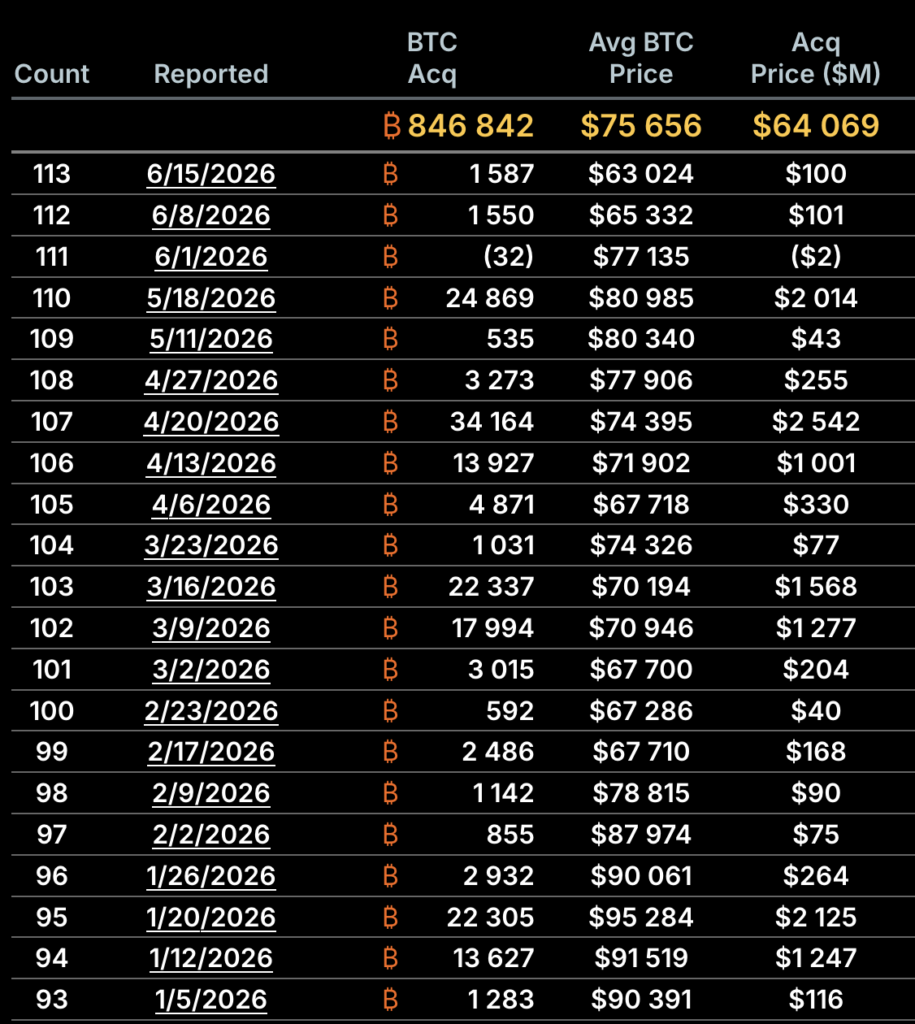
Source: Strategy.com
Led by Executive Chairman Michael Saylor, the company has placed Bitcoin at the center of its corporate strategy for several years. Saylor has long presented Bitcoin as a strategic reserve asset and a hedge against the depreciation of traditional currencies. This approach has become a core part of the company’s identity and clearly sets Strategy apart from most other publicly traded firms.
Despite periods of strong volatility, the company remains committed to its long-term approach and continues to gradually accumulate Bitcoin. The latest purchase once again confirms that Bitcoin remains a key asset for Strategy and one of the main pillars of its business model. At the same time, the company is signaling that it is not changing its strategy even while Bitcoin trades well below its recent highs. Source
Leading cryptographers split over Bitcoin’s quantum dilemma
An advisory board of leading cryptographers has outlined how Bitcoin should prepare for the risk that future quantum computers could steal vulnerable coins. However, it avoids taking a position on the hardest question: what should happen to coins that never migrate.
The group includes Scott Aaronson from the University of Texas at Austin, Stanford’s Dan Boneh and Justin Drake from the Ethereum Foundation. Its report says quantum computers are not an immediate threat to blockchains, but preparation should begin before a clear timeline exists.
Bitcoin has the largest exposure. Around 1.7 million BTC are held in early pay-to-public-key addresses, which reveal public keys directly onchain and could be vulnerable to a future quantum attack. Many are believed to belong to Satoshi Nakamoto or early users who lost their keys. Another estimated 5 million BTC are exposed through address reuse, though much of that may be in active exchange wallets.
Switching to quantum-resistant signatures is the technical solution, but the harder debate is what to do with unmoved coins. Some argue Bitcoin should set a deadline after which current signature schemes are no longer accepted, making unmigrated coins unspendable. They warn that leaving them accessible could hand a future attacker a huge bitcoin stash and damage the network’s credibility.
Others view that as confiscation and a threat to Bitcoin’s principle of strong property rights. They argue it could create a precedent for freezing coins under political or regulatory pressure.
Several proposals try to find a middle ground. Hourglass would limit how many vulnerable coins can be spent per block, BIP-361 would let migrated holders prove ownership after a cutoff, and PACTs would allow users to timestamp a private claim now and move funds later.
The board says these proposals could potentially be combined, but the Bitcoin community must decide how to handle abandoned coins. Its clearest recommendation is to start technical migration work now and communicate clearly with users. Source
Invest with Fumbi Today
Take advantage of the potential of cryptocurrencies easily, safely, and efficiently. Start investing with Fumbi with amounts starting from just €10. The Fumbi Algorithm in the Fumbi Index Portfolio tracks cryptocurrency market movements for you. If you want to create your own crypto portfolios, choose the Advanced Portfolios product, where you’ll have access to over 120 cryptocurrencies and templates created by our team, focusing on different areas of the crypto world.
OPEN PROFILEEncountered a term you don’t understand? No worries! All important crypto-related terms can be found in one place in our new Fumbi Dictionary.

Juraj Ostertag 
Fumbi


