
 3 min •
Juraj Ostertag
3 min •
Juraj Ostertag
Crypto Glossary of Essential Terms for Investors
When reading news from the world of cryptocurrencies, you may come across terms such as blockchain, staking, seed phrase, FOMO, or market cap. For new users, these terms may seem complicated, but most of them have a relatively simple meaning.
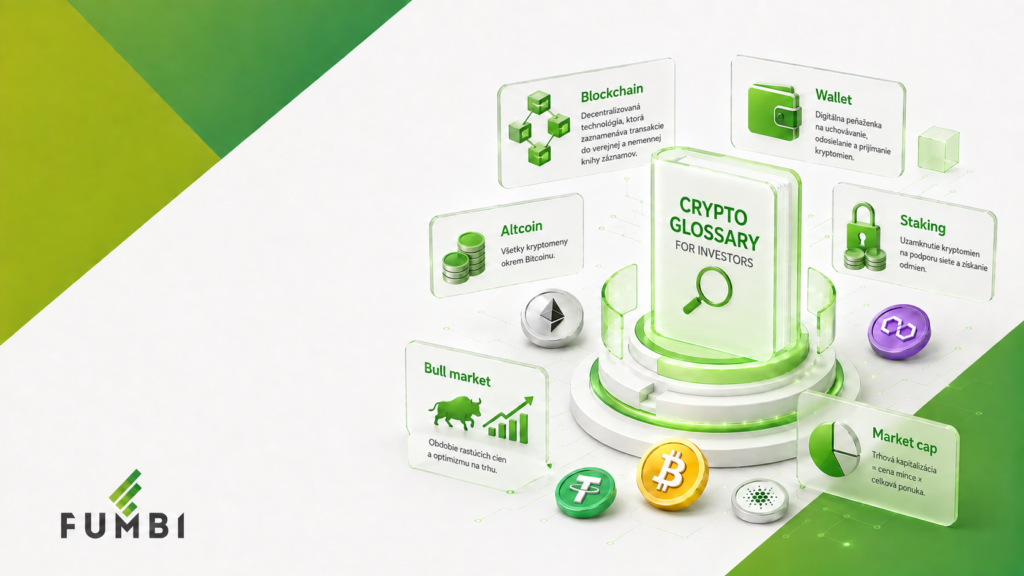
Understanding them will help you navigate the market more easily, understand how cryptocurrencies work, and avoid common mistakes or scams. In the following overview, we explain the most important terms you are likely to encounter in the cryptocurrency environment.
Basic Cryptocurrency Terms
Blockchain
Blockchain is a digital database that records transactions and other information. Its data is stored across multiple computers in a network, which means it cannot be easily changed or controlled by a single person or company.
Transactions are grouped into blocks that are linked together. This is where the name blockchain, or “chain of blocks,” comes from. Blockchain is not used exclusively for cryptocurrencies. It can also be used for ownership records, supply chain tracking, digital documents, or tokenized assets.
Decentralization
Decentralization means that a network is not controlled by a single bank, company, government, or administrator. Transactions are verified and the network is operated by a larger number of independent participants. The more decentralized a network is, the more resistant it tends to be to outages, censorship, or intervention by a single central authority. However, not all cryptocurrencies are decentralized to the same degree.
Cryptocurrency
A cryptocurrency is a digital asset that operates using blockchain technology and is primarily designed to store or transfer value. Unlike traditional currencies, it has no physical form, and transactions take place electronically through a blockchain network.
Many cryptocurrencies operate on their own blockchains. The best-known examples are Bitcoin, which operates on the Bitcoin network, and Ether, which is the native cryptocurrency of the Ethereum network. Cryptocurrencies can be used to send and receive value, pay for goods and services, invest, or use various blockchain applications. Their specific use depends on the characteristics and purpose of the particular cryptocurrency.
Token
A token is a digital asset created on an existing blockchain that uses its infrastructure. Unlike cryptocurrencies that have their own blockchain, a token operates within another blockchain network. For example, many tokens are created on the Ethereum blockchain using the ERC-20 standard.
Tokens can have various uses. They may provide access to a particular service or feature, represent voting rights in a project, digital ownership, a share in a specific asset, or another form of value. Their meaning and use always depend on the particular project that issues them.
Stablecoin
A stablecoin is a cryptoasset designed to maintain a stable value relative to a specific asset, most commonly the US dollar or the euro. Well-known stablecoins include USDC and USDT. Their goal is to reduce the price fluctuations that are common with Bitcoin and other cryptocurrencies. However, stability is not automatically guaranteed. It is important to consider how the stablecoin is backed, who its issuer is, and what risks are associated with it.
Altcoin
Altcoin is a general term for any cryptocurrency other than Bitcoin. This group includes Ethereum, Solana, Cardano, and thousands of other cryptocurrencies. Individual altcoins differ significantly in their purpose, technology, risk, and level of adoption.
Cryptocurrency Wallets and Security
Cryptocurrency Wallet
A cryptocurrency wallet is a tool that allows you to manage your cryptocurrencies, receive and send them, or use decentralized applications. It can take the form of a mobile app, computer program, browser extension, or physical device.
Technically, cryptocurrencies themselves are not stored directly in the wallet. The wallet stores the access credentials that allow you to interact with assets recorded on the blockchain.
Public Address
A public address works similarly to a bank account number. You use it when someone wants to send you cryptocurrency. You can share your public address with other people. Before making a transaction, however, it is important to check that you are using the correct address and the correct blockchain network.
Private Key
A private key is secret information that proves you have the right to control cryptocurrencies associated with a particular address. Anyone who obtains your private key may gain control over your assets. You should therefore never send your private key via email or chat, or enter it on unfamiliar websites.
Seed Phrase or Recovery Phrase
A seed phrase is a list of usually 12 to 24 words that can be used to restore access to a cryptocurrency wallet. It is one of the most sensitive pieces of information in the cryptocurrency environment. If you lose your seed phrase, you may lose access to your assets. If someone else obtains it, they may be able to restore your wallet and transfer your cryptocurrencies.
Never share your seed phrase with anyone!
Hot Wallet
A hot wallet is a wallet connected to the internet. It can be, for example, a mobile app or a browser extension. It is convenient for everyday use and fast transactions. However, because it is connected to the internet, it may be more exposed to phishing, malware, or hacking attacks.
Cold Wallet
A cold wallet is a wallet that stores private keys offline. It is most commonly a physical hardware device. It is mainly used for longer-term cryptocurrency storage. It can provide a higher level of protection against online attacks, but the user must securely protect both the device itself and the backup seed phrase.
Phishing
Phishing is a scam in which an attacker impersonates a trusted platform, exchange, or other service. The goal is to persuade the user to enter login credentials or a seed phrase, or to approve a malicious transaction. Phishing websites can look almost identical to legitimate websites. Before logging in, always check the website address and use only official links.
Rug Pull and Pump and Dump
Rug pulls and pump-and-dump schemes are fraudulent or manipulative practices in which investors can lose a significant portion of their money. In a rug pull, project creators attract users, collect their capital, and then abandon the project or drain its liquidity. This most commonly occurs with new tokens and decentralized finance projects. Warning signs may include an anonymous team, unclear project mechanics, aggressive promotion, or promises of extremely high returns.
In a pump-and-dump scheme, organizers first artificially increase interest in a cryptocurrency and push its price higher. Once additional buyers enter the market, the organizers sell their tokens, which can cause a sharp drop in price and losses for investors who bought later.
Image No. 1: Graphic illustration of a pump and dump formation
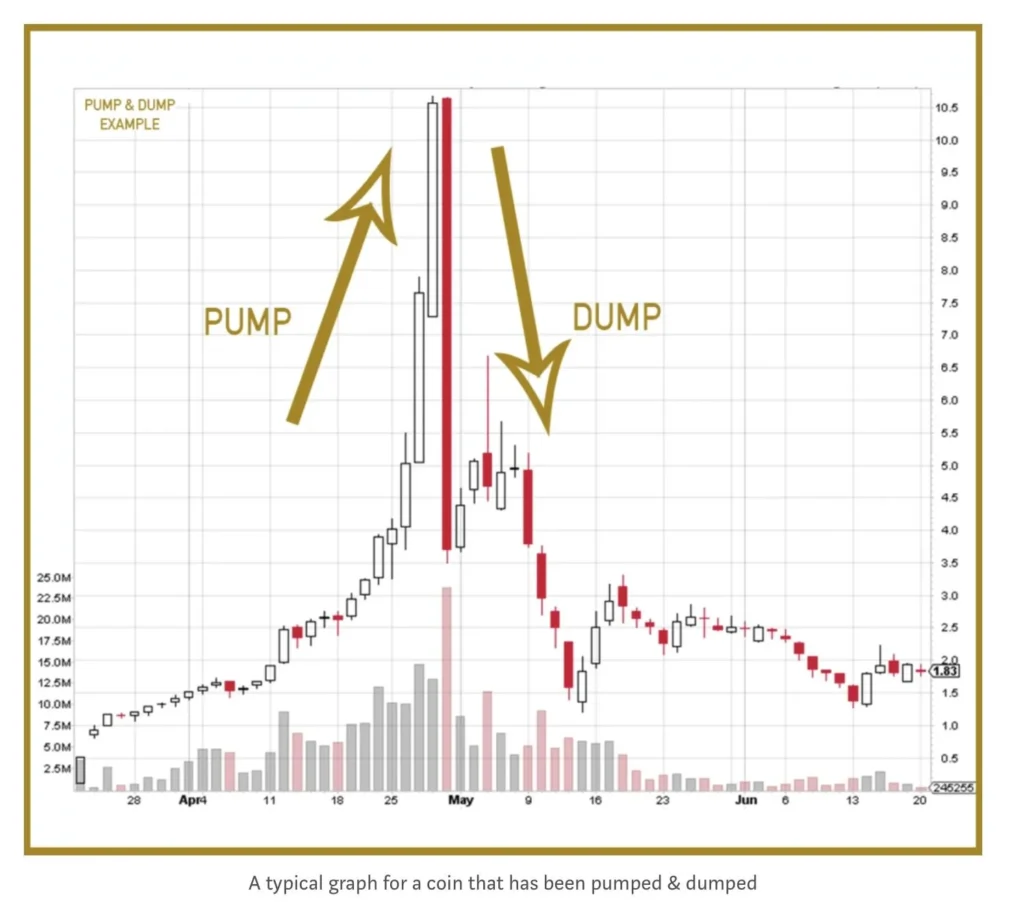
Source: CoinMarketCap
Terms Related to Value and Trading
Market Capitalization
Market capitalization, often referred to as market cap, represents the total market value of a cryptocurrency.
It is calculated as follows:
Market capitalization = current price × number of coins in circulation
If a cryptocurrency is priced at 10 euros and there are 100 million coins in circulation, its market capitalization is one billion euros. The price of a single coin alone therefore does not indicate how large or valuable the entire project is.
Liquidity
Liquidity describes how easily an asset can be bought or sold without significantly affecting its price. A cryptocurrency with high liquidity generally has a large number of buyers and sellers. For assets with low liquidity, even a relatively small transaction may significantly affect the price.
Volatility
Volatility describes how significantly and quickly the price of an asset changes. Cryptocurrencies are known for their high volatility. Their prices can rise or fall considerably over a short period of time. Higher volatility can create opportunities, but it also increases the risk of loss.
Gas Fees
Gas fees are network fees paid to carry out a transaction or execute an operation on a blockchain. The amount of the fee may depend on network congestion, transaction complexity, and current demand for processing. Users most commonly encounter the term gas on the Ethereum network.
ATH
ATH stands for “all-time high” and refers to the highest price a cryptocurrency has ever reached. Breaking an ATH can attract increased market attention. However, it does not automatically mean that the price will continue to rise.
Cryptocurrency Exchanges and Trading Methods
CEX
A CEX (Centralized Exchange) is a centralized cryptocurrency exchange operated by a specific company that manages the platform, processes trades, and protects user accounts. Users typically create an account, complete identity verification, and can then buy, sell, or trade cryptocurrencies. The platform may hold cryptocurrencies on behalf of the user, meaning the user does not have to manage their own private keys.
DEX
A DEX (Decentralized Exchange) is a decentralized exchange that enables token swaps through smart contracts. Users connect to it through their own cryptocurrency wallet and trade without transferring their assets into the custody of a centralized company. A DEX can provide greater control over assets, but it also requires a higher level of knowledge and security awareness from the user.
Technical and More Advanced Terms
Proof of Work
Proof of Work, abbreviated as PoW, is a mechanism used to verify transactions and secure a blockchain network. Network participants use computing power to solve mathematical problems. Bitcoin, for example, uses this mechanism.
Proof of Stake
Proof of Stake, abbreviated as PoS, is a mechanism in which validators with locked cryptocurrencies participate in verifying transactions. The more assets a validator stakes, the greater the role they may have in securing the network. In the event of incorrect or malicious behavior, they may lose part of their stake. Proof of Stake is used by networks such as Ethereum, Cardano, and Avalanche.
Staking
Staking means locking or allocating cryptocurrencies to support the operation of a network that uses the Proof of Stake mechanism. In return for participating in securing the network, a user may receive rewards. However, staking may involve limited access to assets, price fluctuations, or technical risks. Staking rewards should therefore not be considered risk-free or guaranteed returns.
Smart Contract
A smart contract is a program stored on a blockchain that automatically performs a specific operation once predefined conditions are met. It can, for example, facilitate token swaps, provide loans, distribute rewards, or power a decentralized application. Its advantage is automation without the need for a central intermediary. A potential risk is an error in the program code.
DeFi
DeFi stands for “decentralized finance.” It refers to financial services that operate through blockchain technology and smart contracts. These may include trading, lending, providing liquidity, or other services without a traditional bank. DeFi offers new opportunities, but it also brings technical, market, and security risks.
NFT
NFT stands for “non-fungible token.” Each NFT is unique or has distinct characteristics. It can represent digital art, a collectible, an in-game item, a ticket, or ownership rights to specific digital content.
DAO
A DAO is a decentralized autonomous organization whose rules and decision-making processes are partially governed by smart contracts. Members can vote on proposals using tokens. Instead of traditional management, the community may therefore decide the direction of the project. However, the actual degree of decentralization of a DAO depends on the specific project and the distribution of voting rights.
Terms Used by the Crypto Community
HODL
HODL originated as a misspelling of the English word “hold.” Today, it refers to a strategy in which a user holds cryptocurrency for the long term despite short-term price fluctuations. HODLers generally do not try to precisely time the best moment to buy or sell. However, long-term holding alone does not guarantee a profit. Asset selection and risk management are also important.
FOMO
FOMO stands for “fear of missing out.” It occurs, for example, when the price of a cryptocurrency rises sharply and a user feels they must buy immediately because others are already making money. Decisions driven by FOMO often lead to buying after a significant price increase, when the risk of a correction may be higher.
FUD
FUD stands for “fear, uncertainty and doubt.” It refers to negative or misleading information that may influence market sentiment. However, not every negative report is automatically FUD. It is important to verify the source of information and distinguish between unsupported claims and legitimate criticism.
SAFU
SAFU is a term that originated in the crypto community from the phrase “funds are safe.” It later also became associated with a reserve fund created by the Binance exchange to address certain extraordinary security incidents. In the crypto community, the phrase “funds are SAFU” is often used humorously or as reassurance that users’ assets are safe.
How to Navigate Cryptocurrency Terminology
There is no need to learn the entire crypto glossary at once. It is far more important to understand the basic principles behind how cryptocurrencies work. To begin with, you should know what blockchain is, understand the difference between a public address and a private key, and know why a seed phrase is essential for accessing cryptocurrencies in a wallet.
Caution also plays a major role when working with cryptocurrencies. Before every transaction, check the recipient’s address, the selected blockchain network, and the transaction fee. When choosing an exchange, wallet, or investment platform, it is worth paying attention to its track record, security measures, transparency, and regulatory status.
It is also important to understand terms that describe market and investor behavior. When reading news or social media posts, you may frequently encounter expressions such as FOMO or FUD. FOMO may push investors to buy simply because the price is rising sharply and they do not want to “miss the opportunity.” FUD, on the other hand, refers to fear, uncertainty, and doubt that may lead to impulsive decisions. A sharp price increase therefore does not automatically mean that it is a good time to buy, and a single negative report does not necessarily mean the end of a particular project.
The cryptocurrency world is also constantly evolving, and new terms continue to appear alongside new technologies, projects, and ways of using blockchain. There is therefore no need to memorize every term. What matters is understanding what individual terms mean in context and how they may affect your decision-making.
The better you understand basic cryptocurrency terminology, the easier it becomes to evaluate information, compare projects, identify potential risks, and make more informed investment decisions.
Invest with Fumbi Today
Take advantage of the potential of cryptocurrencies easily, safely, and efficiently. Start investing with Fumbi with amounts starting from just €10. The Fumbi Algorithm in the Fumbi Index Portfolio tracks cryptocurrency market movements for you. If you want to create your own crypto portfolios, choose the Advanced Portfolios product, where you’ll have access to over 120 cryptocurrencies and templates created by our team, focusing on different areas of the crypto world.
REGISTEREncountered a term you don’t understand? No worries! All important crypto-related terms can be found in one place in our new Fumbi Dictionary.

Juraj Ostertag 
Fumbi


