
 3 min •
Daniel Mitrovsky
3 min •
Daniel Mitrovsky
Europe Moves Ahead with Its First Blockchain-Based IPO – Market Info
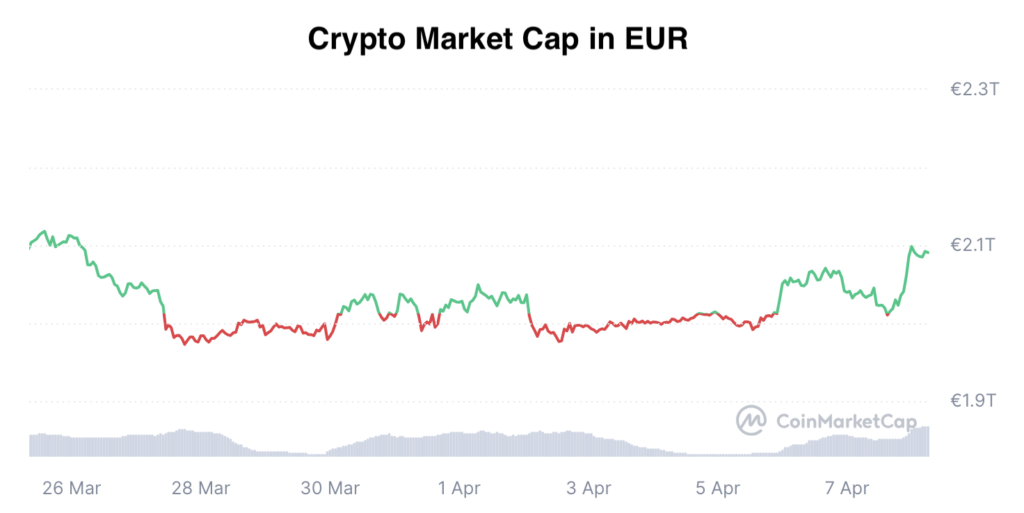
The cryptocurrency market has moved sideways over the past 14 days. The total market capitalization of the market remained unchanged during this period and is currently at €2.10 trillion. Bitcoin also remained unchanged during this time, with its price hovering around €61,400.
The Fear & Greed Index slightly increased over the two weeks from 14 points to 17 points, but it still remains in the extreme fear zone. The Altcoin Season Index slightly decreased from 49 points to 39 points.
Stablecoins on the Brink of Mainstream Adoption in 2026
Stablecoins are moving closer to mainstream finance after U.S. legislation in 2025 (GENIUS Act) clarified their regulatory status. The law defines stablecoins issued by permitted entities as payment instruments rather than securities or commodities, opening the door for broader adoption across traditional and decentralized finance.
The shift is already visible. The two largest stablecoins now have a combined market cap of about $260 billion, roughly triple their value in 2023. Analysts expect stablecoins to represent 3% of all U.S. dollar payments in 2026 and 10% by 2031. Payment processors and major card networks have already begun integrating stablecoin payment and payout options.
Banks are responding by developing their own stablecoin use cases. Some institutions have launched permissioned stablecoins for institutional clients, enabling real-time wholesale settlement instead of traditional interbank transfers that take hours or days. European banks are also exploring euro-backed stablecoins through collaborative initiatives.
Stablecoins could significantly improve cross-border payments, liquidity management, and settlement efficiency. Businesses, fintech firms, online marketplaces, and remittance services can use them to enable faster payments, reduce foreign exchange costs, and improve cash-flow visibility.
They may also support financial inclusion. In the U.S., about 25 million households are unbanked or underbanked, and stablecoins could provide low-cost digital payments and safer ways to store value via mobile devices.
To prepare, organizations should identify the most relevant use cases and work with regulated issuers to test stablecoin pilots within controlled environments. Over time, stablecoins are expected to become embedded in financial infrastructure, enabling programmable, real-time global settlement.
Stablecoins could also play a role in AI-driven commerce, where autonomous agents make purchases on behalf of users. In the long run, they may become a core component of global finance, payments, and digital commerce. Source
Solo bitcoin miner overcomes 1-in-28,000 odds to secure $210,000 block reward
A solo Bitcoin miner with around 230 terahashes per second of computing power successfully validated block 943,411 on Thursday, earning 3.139 BTC roughly $210,000 despite holding such a tiny fraction of the total network hashrate that it effectively rounds to zero on most monitoring dashboards.
The miner was connected to solo.ckpool.org, an anonymous solo mining pool launched in 2014 that allows operators to retain full block rewards minus a 2% fee. CKpool developer Con Kolivas confirmed the victory on X, highlighting that the miner faced roughly a 1-in-28,000 chance of discovering a block on any given day.
At 230 terahashes, the winning rig represents only about 0.00002% of Bitcoin’s estimated total hashrate consistent with a small setup of home-scale ASICs under one roof rather than a large industrial or cloud operation. For comparison, listed miner Riot Platforms alone operates over 30 exahashes, approximately 130,000 times the hashrate of Thursday’s winner.
This block marks the 312th solo win on CKpool since its launch, and the first since Feb. 28, ending a 33-day dry spell. Solo pools have mined just 20 Bitcoin blocks over the past 12 months, totaling 62.96 BTC about one solo block every 18.7 days on average, with the longest gap being 58 days.
The result continues a recurring pattern seen throughout this cycle. In December, a miner with roughly 270 TH/s overcame 1-in-30,000 odds to claim a $284,633 reward. In November, a miner running just 6 TH/s a single old-generation ASIC unlikely to find a block in hundreds of years of continuous mining defied 1-in-180-million odds to earn about $265,000. In late February, a miner converted roughly $75 worth of rented cloud hashrate into a $200,000 reward by directing just 1 petahash at CKpool for a few hours. Source
Charles Schwab Adds Bitcoin and Ethereum Crypto Trading to Brokerage Platform
Charles Schwab is introducing direct trading of Bitcoin and Ethereum to its brokerage clients covering 38.9 million active accounts and $12.22 trillion in assets through a phased rollout starting in Q2 2026.
The new service, called Schwab Crypto, runs via Charles Schwab Premier Bank and represents a clear shift from the firm’s previous crypto strategy, which relied on indirect exposure through ETFs, futures, and crypto-related stocks.
This move goes beyond simply adding a new product. It serves as a real-world test of whether mainstream brokerage clients will adopt direct ownership of digital assets at scale and whether that adoption could influence competition across the retail brokerage industry.
Schwab Crypto will operate separately from standard brokerage accounts. Eligible clients will trade BTC and ETH through a dedicated account linked to Schwab’s banking arm, keeping crypto holdings distinct from traditional assets like stocks, bonds, and ETFs.
At launch, the service will be available in most U.S. states, excluding New York and Louisiana. It will initially support only Bitcoin and Ethereum, with no additional cryptocurrencies announced.
Functionality will also be intentionally limited. Schwab will not support external crypto deposits, withdrawals to self-custody wallets, staking, recurring purchases, or limit orders – features commonly offered by native crypto platforms such as Coinbase. Pricing details have not yet been disclosed. In its initial form, the platform is a simple buy-and-sell interface embedded within one of the largest financial institutions in the U.S.
That simplicity is deliberate. Rather than competing on advanced features, Schwab is testing whether offering direct crypto ownership within a familiar interface trusted by its existing client base can unlock new demand beyond what has already been observed through ETF-driven exposure. Source
Europe Moves Ahead with Its First Blockchain-Based IPO
France’s Lightning Stock Exchange (LISE) is positioning itself to facilitate what could become Europe’s first fully onchain initial public offering (IPO), marking a significant step in integrating tokenization directly into the public listing process.
Based in Paris and authorized last year under the European Union’s Distributed Ledger Technology (DLT) pilot regime, the exchange has announced plans to list French aerospace supplier ST Group on April 9, 2026, according to a recent press release.
ST Group specializes in the production of composite components used across aviation, defense, and space applications. The company reports approximately €59 million in potential program revenue over the next decade and intends to scale its manufacturing capacity in response to growing demand within global aerospace and military supply chains.
Tokenization has been gaining momentum among major financial institutions, which are increasingly leveraging blockchain infrastructure to streamline trade settlement and enhance transparency in asset ownership across instruments such as bonds, funds, and equities. Advocates argue that tokenized markets can deliver meaningful efficiencies, including reduced costs, faster settlement cycles, and improved operational workflows. Leading global exchanges, including Nasdaq and the New York Stock Exchange (NYSE), have also outlined initiatives to support tokenized securities trading.
LISE extends this evolution by bringing the IPO process itself onchain. Its platform is designed with small and mid-sized enterprises in mind—companies that often encounter prohibitive costs and lengthy timelines when accessing traditional capital markets. The exchange is supported by prominent French financial institutions, including BNP Paribas, CACEIS (a subsidiary of Crédit Agricole Group), and Bpifrance.
If successful, ST Group’s listing could establish a viable framework for smaller firms seeking a more efficient and cost-effective route to public markets, while remaining fully aligned with European regulatory standards. Source
Financial markets rally following two-week U.S.–Iran ceasefire agreement
Bitcoin and U.S. stock futures climbed Tuesday evening (7 April 2026), while oil prices plunged after President Donald Trump announced a two-week ceasefire between the United States and Iran in a post on Truth Social.
Bitcoin, the largest cryptocurrency by market capitalization, rallied to an intraday high of $72,699, marking a 5% gain over the past 24 hours, according to data from CoinDesk. At the same time, the price of West Texas Intermediate crude oil fell by more than 10% to around $95 per barrel, with Brent crude oil recording a comparable decline.
The shift toward risk assets followed the announcement of a two-week suspension of a planned large-scale bombing campaign against Iran. “I agree to suspend the bombing and attack of Iran for a period of two weeks,” Trump wrote on Truth Social shortly before his 8 p.m. ET deadline on Tuesday.
“This will be a double-sided ceasefire. We have already met and exceeded all military objectives and are very close to a definitive agreement on long-term peace with Iran and peace in the Middle East,” he added.
Iran later confirmed the ceasefire, stating that if attacks against the country stop, its armed forces will halt defensive operations. The statement also noted that oil tankers would be able to transit the Strait of Hormuz for the next two weeks, subject to coordination with Iran’s military and certain technical constraints.
“Iran also confirms a two-week ceasefire. But the reopening of the Strait of Hormuz remains somewhat unclear, with references to ‘technical limitations’ and the need for ‘coordination’ with the Iranian military. Still, it effectively restores the flow of oil and LNG,” said Javier Blas on X.
For more than a month, uncertainty surrounding the conflict with Iran kept risk assets under pressure. Although bitcoin traded largely sideways, its upside remained limited by surging oil prices and renewed inflation concerns, prompting traders to build bearish positions in crypto futures markets.
The latest surge in prices triggered nearly $600 million in liquidations across leveraged crypto futures positions, with over $400 million coming from short positions betting on falling prices. This suggests strong bullish momentum and a short squeeze, as traders rushed to close losing bets, further amplifying upward pressure on the market. Source
Bitmine Immersion Technologies Speeds Up Ethereum Accumulation Strategy
Bitmine Immersion Technologies significantly increased its cryptocurrency exposure over the past week, acquiring 71,179 ETH as part of an accelerated treasury expansion strategy. This move comes against a backdrop of rising geopolitical tensions and heightened global market volatility.
The company has sustained a steady accumulation strategy over the past month, acquiring approximately 45,000 to 50,000 ETH per week. The latest purchase of 71,179 ETH represents a clear acceleration in buying activity, lifting total Ethereum reserves to around 4.73 million ETH. This increase in acquisition pace underscores Bitmine’s expanding position, placing it among the largest institutional holders of Ethereum.
Chairman Tom Lee characterized the strategic rationale behind the accumulation, describing cryptocurrencies as a “wartime store of value.” He emphasized Ethereum’s resilience during recent market turbulence, noting that the asset outperformed equities by 11.6% while gold declined by more than 7.5% over the same period.
Lee also indicated that the increased allocation reflects management’s view that Ethereum is approaching the end of a “mini crypto winter,” suggesting potential for renewed upward momentum. He further highlighted that periods of extreme negative sentiment have historically aligned with market bottoms, reinforcing the firm’s bullish stance.
In addition to expanding its holdings, Bitmine has advanced its yield-generation strategy through the launch of MAVAN, an institutional-grade staking platform designed to manage its Ethereum treasury. To date, the company has staked approximately 3.14 million ETH- nearly two-thirds of its total holdings- generating an estimated $177 million in annualized revenue at a 2.8% yield.
Overall, Bitmine reports total assets of $10.7 billion, encompassing its cryptocurrency reserves, high-risk “moonshot” investments, and cash holdings. The firm’s growing exposure to Ethereum, combined with its staking operations, underscores a broader institutional trend toward integrating digital assets into treasury management frameworks, particularly as alternative stores of value during periods of geopolitical and economic uncertainty. Source
Invest with Fumbi Today
Take advantage of the potential of cryptocurrencies easily, safely, and efficiently. Start investing with Fumbi with amounts starting from just €50. The Fumbi Algorithm in the Fumbi Index Portfolio tracks cryptocurrency market movements for you. If you want to create your own crypto portfolios, choose the Advanced Portfolios product, where you’ll have access to over 120 cryptocurrencies and templates created by our team, focusing on different areas of the crypto world.
TAKE ADVANTAGE OF CRYPTO’S POTENTIAL
Encountered a term you don’t understand? No worries! All important crypto-related terms can be found in one place in our new Fumbi Dictionary.


Daniel Mitrovsky 
Head of Crypto, Fumbi


Biography
Specializes in cryptocurrency market analysis, investment strategies, and technological trends in the blockchain space. With over 5 years of experience in financial markets, he has been actively involved in cryptocurrencies for more than 8 years. On the Fumbi blog, he brings you the latest news from the world of cryptocurrencies, comments on market developments, and clearly explains various investment approaches – from basics to advanced strategies.