
 3 min •
Juraj Ostertag
3 min •
Juraj Ostertag
Michael Saylor’s Strategy Becomes the Largest Bitcoin Holder – Market Info
Over the past 14 days, the cryptocurrency market has strengthened significantly. The total market capitalization increased over this period and currently stands at €2.22 trillion. Bitcoin also rose, with its price trading around €66,350.
The Fear & Greed Index increased sharply over the two-week period from 17 to 32 points, moving out of the “extreme fear” zone into the “fear” zone. The Altcoin Season Index remained unchanged at 39 points.

Source: Coinmarketcap
Ripple Plans to Make XRP Ledger Quantum-Resistant by 2028
Although quantum computing still represents mostly a theoretical threat to blockchain security, some projects are already preparing for its potential impact. Ripple has introduced a four-phase roadmap to make the XRP Ledgerresistant to quantum attacks, with full implementation targeted by 2028.
The initiative comes shortly after Google warned that future quantum computers might be capable of breaking Bitcoinwith significantly less computational power than previously expected. Some analysts now suggest that a so-called “Q-day” — when quantum threats become practical — could arrive as early as 2029. In response, Bitcoin developers have already begun exploring defensive measures.
According to Ripple, the XRP Ledger — like most blockchain networks — faces three primary risks. First, once a transaction is signed, the public key becomes visible, similar to displaying an address on an envelope. While this poses no issue today, a sufficiently powerful quantum computer could potentially derive the corresponding private key and access funds. Second, long-dormant accounts are at greater risk, as their exposed public keys give attackers more time to attempt such exploits. Finally, transitioning to quantum-resistant systems is not purely a technical challenge; it also requires coordinated adoption across users, developers, and applications within the ecosystem.
Ripple’s strategy is structured into four stages designed to gradually strengthen the network’s defenses.
- Phase 1: Q-Day readiness This initial phase focuses on emergency preparedness in case quantum threats emerge sooner than expected. It includes measures to protect exposed public keys and inactive accounts, potentially enforcing a “hard shift” that would reject traditional cryptographic signatures and require funds to move into quantum-secure wallets. Ripple is also exploring recovery mechanisms based on zero-knowledge proofs, enabling users to verify ownership without revealing private keys — even if security has been compromised.
- Phase 2: Network assessment (target: H1 2026) Already underway, this phase centers on identifying vulnerabilities within the XRP Ledger and testing potential defenses. Ripple is working with Project Eleven to conduct validator-level testing, benchmark development tools, and prototype secure custody solutions.
- Phase 3: Controlled integration (target: H2 2026) In this stage, quantum-resistant cryptographic signatures will be introduced alongside existing ones on a test network. This approach allows developers to experiment with new security methods without affecting live users, helping determine their effectiveness at scale.
- Phase 4: Full deployment (target: 2028) The final phase will transition the technology from testing to full implementation. By rolling out these changes gradually, Ripple aims to ensure a smoother and less disruptive adoption process as the blockchain industry moves closer to a potential quantum era. Source
Coinbase, Bybit Said to Be Working Together on U.S. Stock Tokenization and Custody
Coinbase (COIN) is reportedly in discussions with Bybit, one of the world’s major crypto trading platforms, regarding a potential collaboration focused on the tokenization, custody, and distribution of assets such as publicly traded U.S. equities and pre-IPO shares.
According to a source familiar with the matter, the talks do not include any plans for equity investment or an agreement that would facilitate Bybit’s entry into the U.S. market, contradicting earlier reports. The source, who requested anonymity due to direct involvement, also stated that previous claims about such an investment were inaccurate.
While Bybit does plan to expand into the U.S., it will not do so in partnership with Coinbase. Instead, the company intends to establish a separate entity led by former co-CEO Helen Liu. Under this structure, a domestic partner would handle regulatory licensing and compliance, while Bybit would provide technology, products, and liquidity.
The discussions between Coinbase and Bybit are reportedly centered on international opportunities, particularly leveraging Bybit’s strong presence in regions such as Asia, where demand for tokenized U.S. financial assets is growing. The firms are exploring potential collaboration in custody solutions and the global distribution of these products.
The source noted that while U.S. financial assets are highly attractive globally, Coinbase’s operations remain primarily domestic, whereas Bybit has a broader international reach. A partnership could therefore help bridge this gap and potentially expand access to U.S.-based investments for global users. Over time, tokenization could enable a wide range of assets to be accessed worldwide through a single platform.
“Even if Coinbase evolves into a dominant app within the U.S., its reach would still be geographically limited,” the source said.
This potential collaboration reflects a broader industry trend, as major financial and crypto players increasingly explore tokenized assets. For example, Intercontinental Exchange (ICE), which owns the New York Stock Exchange, recently announced an investment in crypto exchange OKX. Similarly, Deutsche Börse disclosed a $200 million strategic investment in Kraken.
Both Coinbase and Bybit declined to comment on the matter. Source
The $292 Million Kelp Exploit: How It Happened, and What It Means for Defi
A roughly $292 million exploit over the weekend has sent shockwaves through the crypto industry, exposing vulnerabilities in decentralized finance (DeFi) infrastructure and raising concerns about broader contagion risks across lending protocols.
The attack centered on Kelp’s rsETH token — a yield-bearing form of ether (ETH) — and the cross-chain infrastructure used to transfer assets between blockchains. The attacker appears to have exploited this system to mint large quantities of unbacked tokens, which were then rapidly used as collateral to borrow and drain real assets from lending markets, primarily from Aave, the largest decentralized crypto lending platform. The perpetrator is widely suspected to be linked to the North Korean state-backed Lazarus Group.
The exploit targeted a LayerZero bridge component, infrastructure designed to enable asset transfers across blockchains. Such bridges typically function by locking assets on one chain while issuing equivalent tokens on another, relying on trusted validators or oracles to confirm deposits.
In this case, Kelp reportedly acted as the verifying entity. According to security researchers, the system relied on a single-signer configuration, meaning one party had the authority to approve transactions.
This design flaw allegedly allowed the attacker to sign a message that enabled the minting of large amounts of rsETH without corresponding locked collateral on the source chain. Once created, these tokens were quickly deployed as collateral in lending protocols, predominantly Aave, to borrow real ETH.
What began as a targeted exploit quickly escalated into a systemic risk for DeFi markets. Lending platforms are now left holding collateral that may be difficult to recover or liquidate, while high-quality liquid assets have already been drained.
As a result, Aave and other protocols may be exposed to hundreds of millions of dollars in questionable collateral and potential bad debt, fueling concerns of a liquidity crunch or “bank run”-like dynamic as users rush to withdraw funds.
On Monday, the Arbitrum Security Council froze 30,766 ETH — worth approximately $71 million — linked to the exploit, moving the assets into a governance-controlled wallet. The emergency action, taken in coordination with law enforcement and without disrupting other users or applications, prevents the attacker from accessing roughly 25% of the stolen funds.
Since the incident, Aave has reportedly seen about $6 billion in outflows as users withdrew assets in response to the exploit. The protocol’s native token also fell around 15% within the first 24 hours of trading following the event.
Despite the turmoil, some industry figures see a long-term upside. “Crypto is a harsh environment that no bank would have survived — yet we are working with it,” said Egorov. “I think DeFi will learn from this incident and become stronger than before.” Source
Strategy Overtakes BlackRock’s Bitcoin Holdings
Michael Saylor announced on Monday that Strategy had executed yet another substantial Bitcoin purchase. The multi-billion-dollar acquisition did not come as a surprise to the market, as the company had already been steadily raising additional capital in preparation for further BTC accumulation in the days leading up to the announcement. What stands out more, however, is the sheer scale of its current Bitcoin position and what it now implies when compared with other major institutional holders in the market.
With its latest purchase of 34,164 BTC, the company has now pushed its total Bitcoin holdings past the 800,000 BTC milestone for the first time. According to the announcement, this latest acquisition cost approximately $2.54 billion, executed at an average price of $74,395 per Bitcoin, reflecting continued aggressive accumulation despite elevated market levels.
This brings Strategy’s total Bitcoin holdings to 815,061 BTC, with cumulative spending reaching $61.56 billion to date. The latest purchase also helped reduce its overall average acquisition price slightly to $75,527 per Bitcoin, marginally improving its blended entry point across all holdings.
With its position now exceeding 815,000 BTC, Strategy has effectively overtaken BlackRock in total Bitcoin exposure. BlackRock previously dominated institutional rankings, particularly as spot Bitcoin ETFs gained rapid traction and attracted strong inflows, causing its holdings to expand at a fast pace.
MSTR vs IBIT (BITBO and Strategy)
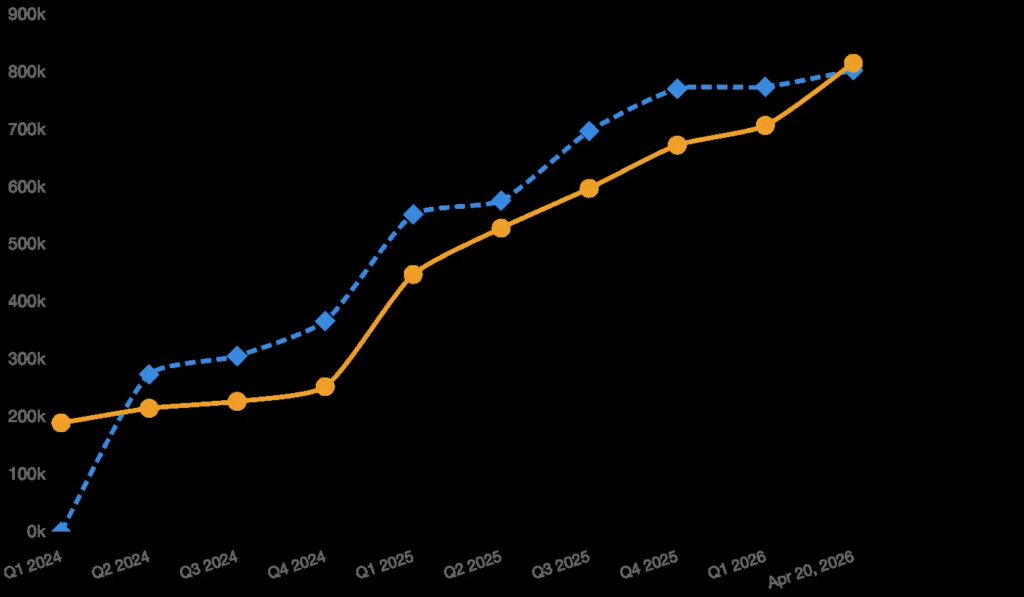
Source: Coindesk
However, at the time of writing, BlackRock’s IBIT ETF holds 798,062 BTC, according to data from Bitbo. While the difference remains relatively narrow, it underscores how Strategy’s continued accumulation has steadily accelerated, allowing it to go head-to-head with one of the world’s largest asset managers overseeing more than $12 trillion in assets. The comparison highlights a growing competition between corporate treasury accumulation and ETF-driven demand in shaping Bitcoin’s institutional landscape. Source
France’s Finance Minister Calls for More Euro Stablecoins
Europe needs a greater supply of euro-denominated stablecoins, and banks across European Union (EU) member states should actively explore tokenized deposits, French Finance Minister Roland Lescure said on Friday, according to Reuters.
His remarks suggest a possible softening in the French government’s and central bank’s previously cautious stance on privately issued digital money. Lescure voiced strong support for Qivalis, a consortium of 12 European banks — including BBVA, ING, UniCredit and BNP Paribas — which plan to launch a euro-pegged stablecoin in the second half of 2026. The initiative is seen as an attempt to strengthen Europe’s position in digital payments and reduce reliance on U.S.-dominated stablecoin infrastructure.
“That is what we need and that is what we want,” Lescure said, adding that banks should further accelerate their exploration of tokenised deposits as part of broader financial modernization. He also noted that the current disparity between euro-pegged and dollar-pegged stablecoins is “not satisfactory,” highlighting Europe’s relatively weak position in the global stablecoin market.
The renewed political interest marks a notable shift from earlier regulatory skepticism. Former Finance Minister Bruno Le Maire previously led a strict stance against privately issued fiat-pegged cryptocurrencies, arguing that they “had no place on European soil” and posed a threat to “the sovereignty of nations.” In 2023, Le Maire was also linked to an EU policy draft suggesting the European Commission was considering measures to prevent stablecoins from becoming widely used as substitutes for traditional fiat currencies.
More recently, tensions around the issue resurfaced during a public exchange between Brian Armstrong and European policymakers. Bank of France Governor François Villeroy de Galhau warned that stablecoins and tokenised private money could accelerate what he described as a growing political risk. “The first threat is privatization of money, and loss of monetary sovereignty,” he said, reinforcing concerns among parts of Europe’s central banking community about the long-term implications of privately issued digital currencies.
Overall, the debate reflects a broader strategic push within Europe: balancing innovation in digital assets with concerns over financial sovereignty, while attempting to catch up to the rapid expansion of U.S. dollar-backed stablecoins dominating global crypto markets. Source
Crypto Holdings Found in Portfolio of Next Fed Chair Candidate
Kevin Warsh, the nominee of U.S. President Donald Trump to lead the Federal Reserve, has submitted a 69-page financial disclosure to the U.S. Office of Government Ethics, clearing a key procedural step ahead of his confirmation hearing, which is now expected next week. The filing discloses that Warsh and his wife hold at least $192 million in combined assets. However, the most notable details for the crypto industry are embedded within his digital asset-related investments.
Through a network of venture capital fund structures, Warsh holds equity stakes in more than a dozen blockchain and crypto-focused companies spanning decentralized finance lending, derivatives, Layer 1 and Layer 2 scaling networks, prediction markets, and Bitcoin payment infrastructure. He has also committed to divesting the majority of these holdings. The individual who would oversee U.S. stablecoin regulation, bank crypto custody frameworks, and potential central bank digital currency (CBDC) policy has, until now, maintained indirect personal exposure to the crypto ecosystem — although the precise scale of many positions remains unclear.
Most of these holdings are embedded within fund vehicles where individual line items are reported without specific valuations. Under U.S. Office of Government Ethics rules, this typically indicates each position is valued at under $1,000, suggesting they are small venture-style bets rather than concentrated investments.
However, larger and more opaque holdings likely contain meaningful exposure. Warsh holds more than $100 million in Juggernaut Fund LP, whose underlying portfolio remains undisclosed due to confidentiality agreements. He also has multiple positions in THSDFS LLC, some individually valued between $1 million and $5 million, which are similarly non-transparent. All of these will be subject to full divestiture requirements.
For the crypto sector, the disclosure sends a mixed signal. On one hand, a potential Federal Reserve chair with prior exposure to DeFi and blockchain infrastructure could bring a more informed perspective on digital assets. On the other hand, mandatory divestment and strict recusal rules may significantly limit his ability to act on any perceived affinity for the industry, particularly in the early phase of his tenure. Source
Invest with Fumbi Today
Take advantage of the potential of cryptocurrencies easily, safely, and efficiently. Start investing with Fumbi with amounts starting from just €50. The Fumbi Algorithm in the Fumbi Index Portfolio tracks cryptocurrency market movements for you. If you want to create your own crypto portfolios, choose the Advanced Portfolios product, where you’ll have access to over 120 cryptocurrencies and templates created by our team, focusing on different areas of the crypto world.
TAKE ADVANTAGE OF CRYPTO’S POTENTIAL
Encountered a term you don’t understand? No worries! All important crypto-related terms can be found in one place in our new Fumbi Dictionary.

Juraj Ostertag 
Fumbi


