
 3 min •
Juraj Ostertag
The World’s Largest Banks Are Preparing a Joint Stablecoin – Market Info
The cryptocurrency market grew slightly over the past 14 days. The total market capitalization increased from €2.27 trillion to €2.31 trillion during this period. The price of Bitcoin remained almost unchanged at €67,647.
The Fear & Greed Index rose slightly over the past 14 days, from 65 to 69 points. This value still falls within the “Greed” category. The Altcoin Season Index increased from 39 to 43 points.
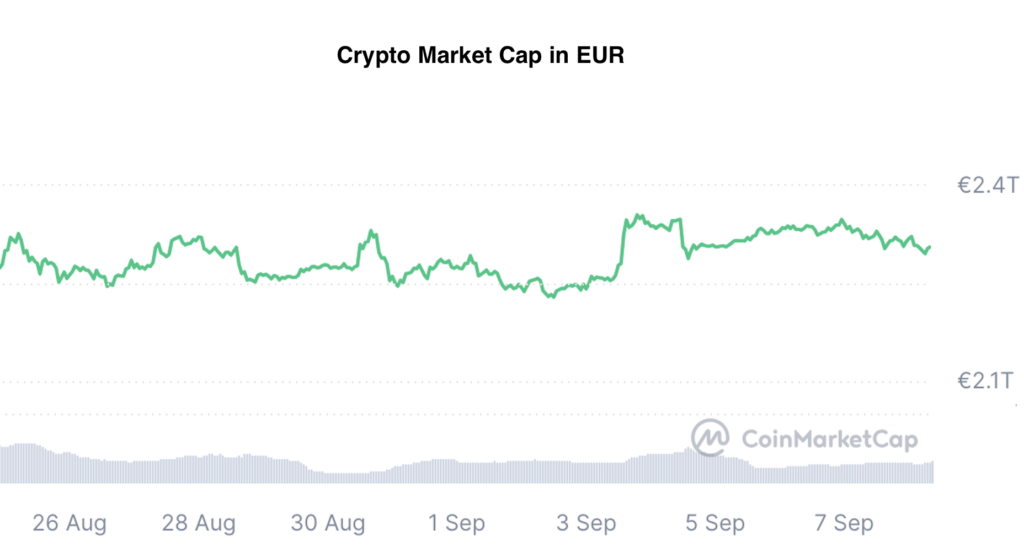
Source: CoinMarketCap
The World’s Largest Banks Are Preparing a Joint Stablecoin
Stablecoins are no longer just a tool for crypto exchanges and investors. A group of 21 major banks and asset managers, including Citibank, Goldman Sachs, Bank of America and UBS, plans to create a joint stablecoin pegged to the US dollar. The project shows that blockchain infrastructure is gradually becoming part of the plans of the world’s largest financial institutions and that the line between traditional finance and cryptocurrencies continues to narrow.
Financial companies from North America, Europe, Asia, the Middle East and Africa have joined the initiative. In addition to Citibank, Goldman Sachs, Bank of America and UBS, the group includes companies such as Wells Fargo, Deutsche Bank, Santander, Fidelity Investments and MUFG Bank. A new company that will oversee the entire project is expected to be established in the second half of 2026, with its first product set to be a stablecoin pegged to the US dollar. It is expected to launch in the first half of 2027, while the group later plans to expand its offering to stablecoins pegged to other G7 currencies, including the euro.
The interest from the world’s largest banks is no coincidence. The total value of the stablecoin market increased from around $200 billion at the beginning of 2025 to more than $300 billion at the beginning of September 2026, with USDT from Tether and USDC from Circle continuing to dominate the market. However, stablecoins are gradually moving far beyond cryptocurrency trading itself. Banks and other financial companies are exploring their use in cross-border payments, tokenized assets and the settlement of financial transactions. In this respect, the entry of major banks could provide a significant boost to the broader adoption of cryptocurrencies and blockchain technology. Millions of clients do not necessarily need to start using Bitcoin or Ethereum directly to come into contact with blockchain. They may gradually begin using it in the background through banks, investment companies or payment systems they already know.
The project is also further evidence of how significantly the traditional financial sector’s attitude towards cryptocurrencies is changing. When the initiative was first introduced in October 2025, it consisted of ten banks, but in less than a year the number of participating companies more than doubled. The stablecoin is also expected to comply with the requirements of the US GENIUS Act and the European MiCA regulation.
A similar trend can also be seen in crypto custody, the tokenization of traditional assets and the development of blockchain payment infrastructure. The new stablecoin does not yet have a name and its success will largely depend on real-world adoption, but the fact that 21 major financial companies have joined forces already suggests that technologies originally associated primarily with the cryptocurrency market are gradually moving into the mainstream. Broader crypto adoption therefore does not necessarily mean only an increase in the number of people buying Bitcoin. It can also happen less visibly, through the gradual migration of payments, assets and financial services onto blockchain infrastructure. Source
Memecoins Take Over Robinhood Chain as Network Activity Surges
Robinhood launched its own blockchain with the ambition of connecting traditional finance with the world of cryptocurrencies, but its biggest growth driver so far has come from a completely different area – memecoins. Pons, an application that allows users to create and trade new tokens, generated approximately $5.95 million in fees within 24 hours. This placed it fourth in the ranking of services tracked by DefiLlama, behind Tether, Uniswap and Circle, while on that day it surpassed competitors such as the memecoin project Pump and the trading platform Hyperliquid. Activity was also remarkable from the perspective of Robinhood Chain itself. On 2 September, nearly 25,000 new tokens were created through Pons and daily trading volume reached approximately $544 million. Since the platform launched in July, around 646,000 tokens have already been created through it.
Chart: Fee comparison from 2 September 2026

Source: CoinDesk
The sharp increase is particularly interesting because Robinhood Chain was originally created with a very different vision. The blockchain, launched on 1 July, is built as an Ethereum Layer 2 network using Arbitrum technology, and its main use case was intended to be tokenized real-world assets, such as stocks. Through blockchain technology, Robinhood wants to gradually connect traditional investing with decentralized finance and allow traditional assets to be used directly within a blockchain environment.
The first few months, however, show that the development of blockchain networks does not always follow the original plans of their creators. Memecoins and applications built by independent developers have become one of the largest sources of activity on the network. During the day in question, Robinhood Chain generated approximately $4 million in network fees, representing roughly one-fifth of all fees the network had generated since its July launch. Robinhood has emphasized that its network is open to external developers who can build their own financial applications on it – and Pons demonstrates how quickly a single application can significantly increase usage across the entire network.
The current growth should not automatically be seen as proof of the long-term success of memecoins. They remain a highly speculative part of the crypto market, and a large share of current activity could disappear just as quickly as it emerged. From the perspective of broader blockchain adoption, the more important point is that a new network can attract millions of transactions and a large number of external applications in a short period of time. At the end of August, Robinhood Chain processed a record 5.52 million transactions in a single day, while trading volume on decentralized exchanges reached approximately $875 million. For Robinhood, the current memecoin wave may therefore represent the first major test of infrastructure that it eventually wants to use for tokenized stocks and other traditional financial assets.
As with other blockchains, speculation may bring the initial attention, while more sustainable use cases are built gradually over time. If Robinhood succeeds in turning this activity into a broader ecosystem of financial services, its blockchain could become another example of how the line between traditional investing and cryptocurrencies continues to narrow. Source
Authorities Shut Down Russian Malware After Eight Years of Stealing Cryptocurrencies
Cybersecurity company CrowdStrike, together with US federal authorities and international partners, disrupted the Sality botnet, which was one of the longest-running malicious networks on the internet. The malware had been active since 2003 and, over the past eight years, had also been used to secretly steal Bitcoin and Ethereum.
The attackers did not need to compromise the blockchain itself or break into a crypto wallet. Sality monitored the clipboard of infected computers, and when a user copied a Bitcoin or Ethereum wallet address, the malicious program automatically replaced it with an address controlled by the attacker. The user could then confirm the transaction without noticing that the cryptocurrency was being sent to a completely different destination. According to CrowdStrike, at least approximately $150,000 worth of cryptocurrency was stolen in this way over eight years. Since a large portion of the stolen assets remained untouched and cryptocurrency prices later increased, the value of this portfolio had risen to around $1.35 million by the beginning of 2025.
Sality was able to operate for so long mainly because of its decentralized architecture. Instead of relying on a single central server that authorities could simply shut down, infected computers communicated directly with each other and formed a peer-to-peer botnet. The malicious software could spread through network drives and USB devices, while its operators were also able to distribute additional malware through the network. Sality was capable of delivering malicious files to more than 33,000 infected devices around the world.
However, the way the network operated ultimately also made it possible to disrupt it. Security experts exploited a weakness in the communication between infected devices and began replacing the network’s original contacts with infrastructure under their own control. This allowed them to directly cut off more than 15,000 infected computers from the operator and gradually isolate additional devices. The operation was carried out in cooperation between CrowdStrike, the US Department of Justice, the FBI, other US authorities and European partners. Domains and other parts of the infrastructure used by Sality to distribute malicious software were also taken offline.
The case highlights that the blockchain itself does not necessarily have to be the weakest point when it comes to cryptocurrencies. Attackers often target users directly, their computers or the way they interact with digital assets. This issue is even more significant with blockchain transactions because, once confirmed, they generally cannot simply be cancelled or reversed. In this case, all it took was a subtle change to a long crypto wallet address that the user might not notice when copying and pasting. Sality was able to use this technique for years without the need for complex attacks on exchanges or blockchain protocols. As the number of people and companies using digital assets grows, the importance of device security and safe handling of cryptocurrencies increases as well. The disruption of Sality also shows that even a decentralized malicious network operating for more than two decades can be significantly weakened when cybersecurity companies and authorities from multiple countries cooperate. Source
Hackers Return 3,400 Bitcoin to Liquid Network After $320 Million Incident
Liquid Network recovered most of the Bitcoin taken during one of the largest cryptocurrency security incidents of the year. A group of hackers described as “white hat”, or ethical hackers, returned 3,400 of the approximately 4,000 Bitcoin they had withdrawn from the network’s reserve wallet over the weekend. Based on the price of Bitcoin at the time of the incident, the total amount involved was approximately $320 million. Around 598 BTC worth roughly $47 million still remain outside the network, and Blockstream continues to communicate with the hackers regarding their return.
Liquid Network is a Bitcoin sidechain created by Blockstream that enables faster and more private transfers of digital assets between exchanges, traders and other market participants. The network uses the L-BTC token, with each L-BTC intended to be backed by one actual Bitcoin held in a shared reserve wallet. The hackers drained around 4,000 of the total 4,200 BTC from this reserve, temporarily putting almost the entire backing of L-BTC at risk. It was therefore an extremely serious incident, as the loss of most of the reserves could have significantly undermined confidence in both the token’s backing mechanism and the functioning of the network.
According to findings so far, the incident did not involve compromised private keys or a traditional wallet hack, but rather a vulnerability in Elements, the software on which Liquid Network operates. The funds were withdrawn through SideSwap, a platform authorized to process such transactions, which meant that from the system’s perspective they initially appeared legitimate. After the issue was discovered, Liquid immediately suspended new transactions and network operators began analyzing the extent of the incident and preparing a fix.
The hackers later communicated directly with developers through messages embedded in Bitcoin transactions and claimed that their goal was not to steal the funds, but to draw attention to a critical security flaw. They also stated that they would return the Bitcoin once the vulnerability had been fixed. After the first patches were deployed, they did in fact return 3,400 BTC, or around 85% of the withdrawn Bitcoin. Negotiations over the remaining approximately 598 BTC are ongoing, and it is still unclear whether they will be returned in full or whether the hackers will retain a portion as a reward for discovering the vulnerability. The network also remains restricted, as operators continue working on further security improvements, resolving issues that arose during the shutdown and restoring full backing for L-BTC. Other assets issued on Liquid Network, including the USDT stablecoin, were not directly affected by the incident according to available information.
The case is unusual mainly because a large portion of the withdrawn cryptocurrency was returned within a short period of time. In typical hacking incidents, attackers generally try to move stolen assets as quickly as possible, split them across numerous addresses or obscure their origin. White-hat hackers, by contrast, exploit a security flaw in order to highlight a vulnerability and may return the funds once it has been fixed, sometimes in exchange for a reward. Even in this case, however, it has not yet been fully confirmed what will happen to the remaining Bitcoin.
The incident once again shows that security risks within the cryptocurrency ecosystem are not limited to Bitcoin or Ethereum themselves, but also affect additional layers, bridges, protocols and applications built on top of them. Even if the underlying blockchain is secure, a vulnerability in connected software can put hundreds of millions of dollars at risk. Before fully restoring operations, Liquid Network will therefore need to demonstrate that the vulnerability has been fixed, the system is stable and L-BTC is once again fully backed by Bitcoin. The return of 3,400 BTC significantly reduced the immediate impact of the incident, but further developments will depend on the return of the remaining funds and how quickly user confidence in the network’s security can be restored. Source
Ethereum Will Allow Users to Pay Fees Without Having to Hold ETH
Ethereum is preparing one of the most significant changes to the network’s user experience in recent years. In the future, users may no longer need to own ETH simply to pay a transaction fee, known as gas. At present, a fairly impractical situation can occur: a user may have hundreds of dollars worth of stablecoins such as USDC or USDT in their wallet, but without a small amount of ETH they cannot send them or use them in a decentralized application. Ethereum wants to solve this problem through proposal EIP-8141, known as Frame Transactions, which developers added at the end of August to the planned components of the Hegotá upgrade expected in 2027. The new system will separate the user carrying out the transaction from the party paying the fee. Gas could therefore be paid on behalf of the user by a crypto wallet, an application or another account. Alternatively, the user could pay the fee using a stablecoin or another token, while the service would provide the required ETH in the background. The Ethereum network itself would continue to receive transaction fees in ETH, but the user would no longer need to own ETH directly or deal with buying it before every transaction.
For an ordinary user, this could represent a significant improvement. One of the long-term barriers to broader crypto adoption is the more complicated user experience compared with traditional financial applications. If someone wants to use a token on Ethereum today, they often need to first obtain ETH, send it to the correct wallet and keep enough in reserve for future fees. Frame Transactions are part of Ethereum’s broader move towards so-called account abstraction, which aims to make blockchain applications function more like modern financial apps and reduce the number of technical steps users need to manage.
For example, an application could fully sponsor fees for its users or automatically deduct them in a currency the user already holds. Ethereum already supports some similar options today through specialized services and smart contracts, but the new proposal aims to integrate them directly into the network’s standard functionality without the need for an external intermediary. The proposal also includes the possibility of combining multiple steps into a single transaction. When swapping tokens today, for example, users often need to first give an application permission to access a token and only then execute the swap itself. Under the new system, these steps could be combined so that either all of them are completed or, if an error occurs, all of them are automatically cancelled.
The change is also expected to introduce additional security options. Current Ethereum accounts are closely linked to a specific private key, and losing that key can mean losing access to the assets. The new architecture is expected to enable more flexible authorization rules, key replacement and, in the future, an easier transition to cryptographic methods resistant to quantum computers without requiring users to move all their assets to a new address. EIP-8141 is still only a proposal and its technical details may change before implementation, so this feature cannot yet be used normally on the main network. However, its significance goes beyond fee payments alone. Ethereum has long been working to remove technical barriers that make blockchain difficult for ordinary users, and the ability to use stablecoins, tokenized assets or decentralized applications without first needing to buy ETH could be another step towards making blockchain services feel as simple to use as a conventional payment or banking application. Source
Hunter Biden’s New Memecoin Sparks Controversy Before Launch
Hunter Biden is preparing his own memecoin called LAPTOP, but the project has already faced significant criticism from the crypto community before its official launch. The token is scheduled to launch on 9 September on the Base network, with a total supply of one billion tokens. Its name refers to Hunter Biden’s laptop, which became the subject of extensive political and media attention ahead of the 2020 US presidential election and later became the source of numerous internet memes. Biden is now attempting to turn that notoriety into a cryptocurrency project.
The founders, including Biden himself, are expected to receive 30% of the total token supply. These assets will be locked for the first six months and then gradually released over more than two years. Another 20% of the supply is expected to be distributed through two airdrops, meaning free token distributions to selected users. Among the first recipients are, somewhat paradoxically, expected to be wallets belonging to investors who suffered losses on the TRUMP memecoin launched by Donald Trump at the beginning of 2025. A portion of the tokens is also expected to go to subscribers to Biden’s Substack, an online platform through which authors can publish articles, newsletters, podcasts or videos and send them directly to subscribers, as well as to other selected groups.
The reaction from the crypto community has been strongly negative. Several well-known traders and developers have publicly criticized the growing connection between political figures and highly speculative memecoins. The criticism has also affected companies associated with the project. Crypto exchange Kraken removed a promotional post about the token following a wave of negative reactions, although it has not announced that it would cancel any potential listing. Video journalist Andrew Callaghan also distanced himself from the project after his subscribers were listed among the groups eligible to receive a portion of the tokens. According to Callaghan, neither he nor his Channel 5 project has anything to do with the cryptocurrency. Representatives of Base responded in a similar way after some users began directly linking the launch of LAPTOP with Coinbase. Base is an open blockchain network where practically anyone can create a token without prior approval. Network representatives therefore emphasized that no partnership exists between Base and the LAPTOP project and that the Base team deliberately chose not to participate in the design or promotion of the token.
LAPTOP arrives at a time when the crypto market has already had several experiences with political and celebrity memecoins whose prices often dropped sharply after an initial wave of interest. One of the most prominent examples is TRUMP, which briefly reached a market value of approximately $15 billion after launch but later lost 97% from its peak. Experiences with similar tokens may help explain why the crypto community is skeptical even before trading begins. Memecoins generally do not have economic utility comparable to blockchain networks, stablecoins or tokenized assets, and their value is often based primarily on attention, community interest and short-term speculation. Despite the criticism, interest has not disappeared completely. Even before the official launch, unofficial tokens with the same or similar names appeared on the market in an attempt to capitalize on the attention surrounding the project. The real test will therefore come with the launch on 9 September, which will show whether the negative reactions discourage traders or whether the controversy itself becomes another source of interest in the new memecoin. Source
Invest with Fumbi Today
Take advantage of the potential of cryptocurrencies easily, safely, and efficiently. Start investing with Fumbi with amounts starting from just €10. The Fumbi Algorithm in the Fumbi Index Portfolio tracks cryptocurrency market movements for you. If you want to create your own crypto portfolios, choose the Advanced Portfolios product, where you’ll have access to over 120 cryptocurrencies and templates created by our team, focusing on different areas of the crypto world.
OPEN PROFILEEncountered a term you don’t understand? No worries! All important crypto-related terms can be found in one place in our new Fumbi Dictionary.

Juraj Ostertag 
Fumbi


