
 3 min •
Juraj Ostertag
3 min •
Juraj Ostertag
Debate on the Key CLARITY Act Crypto Bill Delayed Due to the U.S. Senate’s Packed Schedule – Market Info
The cryptocurrency market traded mostly sideways over the past 14 days. During this period, the total market capitalisation declined slightly from €1.95 trillion to €1.93 trillion. The price of bitcoin fell by approximately 0.1% and is currently trading at around €56,430.
Over the past 14 days, the Fear & Greed Index increased from 25 to 29 points, moving out of the “extreme fear” zone and into the “fear” zone. The Altcoin Season Index rose from 51 to 59 points.
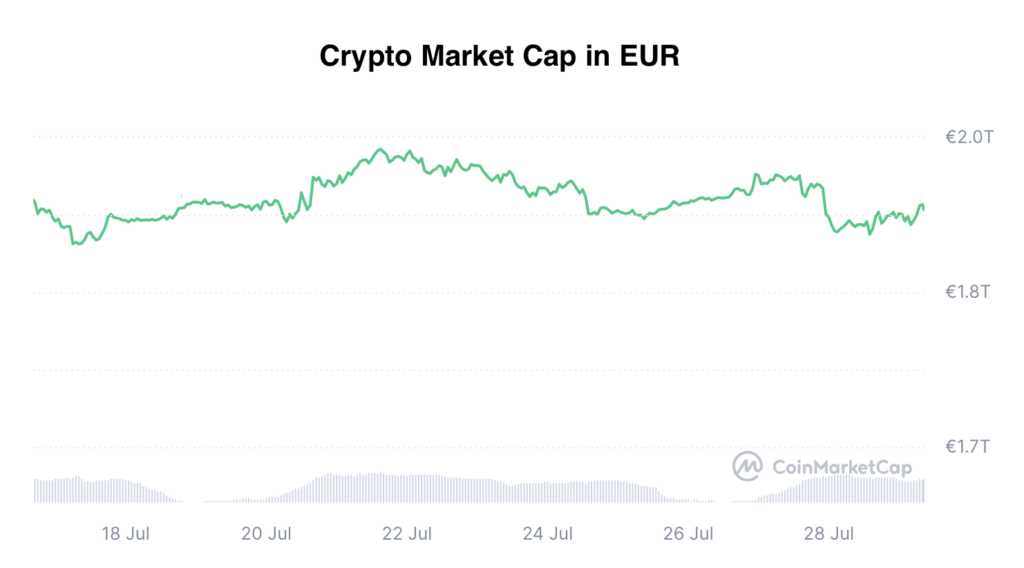
Source: CoinMarketCap
Debate on the Key CLARITY Act Crypto Bill Delayed Due to the U.S. Senate’s Packed Schedule
The U.S. Senate has temporarily postponed discussions on the Digital Asset Market Clarity Act, known as the CLARITY Act. Instead of focusing on this key piece of legislation for the cryptocurrency sector, lawmakers are concentrating on approving federal nominations and a proposal for new sanctions against Russia.
The delay further reduces the amount of time available to the Senate to pass one of the most important legislative proposals concerning the regulation of digital assets in the United States. The legislative agenda is extremely busy ahead of the summer recess, and the CLARITY Act still lacks sufficient political support to proceed smoothly to a final vote.
Senate Republican Majority Leader John Thune has shifted his attention to a sanctions bill targeting Russia, which bears the name of the late Senator Lindsey Graham. The proposal includes sanctions against Russian officials and other entities supporting the war in Ukraine. It would also allow tariffs to be imposed on countries that purchase large quantities of Russian energy commodities. On 28 July, the Senate voted 86–12 to advance the proposal to the next stage of the legislative process.
The Senate can generally devote its full attention to only one controversial legislative proposal at a time. Until the process involving sanctions, nominations and other priorities has been completed, lawmakers are therefore unlikely to begin considering the CLARITY Act.
The CLARITY Act is unlikely to be put to a vote before the final days leading up to the summer recess, which will begin on 10 August and continue until 11 September. This leaves the Senate with only a very limited number of legislative days. John Thune stated that the Senate might attempt to vote on the CLARITY Act before the recess. However, he also acknowledged that the leadership must first determine whether the proposal has enough votes to continue through the legislative process. Support from at least 60 senators is generally required to overcome procedural obstacles.
The lack of time is not the only problem. The parties are still attempting to reach a compromise on one of the bill’s most controversial provisions, which is intended to restrict the involvement of senior government officials, including President Donald Trump, in cryptocurrency projects.
The White House claims that Donald Trump has agreed to restrictions on his cryptocurrency activities. Democrats, however, argue that the proposed rules are not strict enough and would not effectively address potential conflicts of interest connected to his digital asset businesses. Despite their differences, both parties have expressed an interest in continuing the negotiations. However, every additional delay reduces the likelihood that the bill will be passed in 2026.
The cryptocurrency sector’s greatest hope is that the Senate leadership will at least begin the initial procedural steps towards a vote before lawmakers leave for the summer recess. This could allow the process to continue after they return.
The available time nevertheless remains extremely limited. After the Senate returns in September, lawmakers will increasingly focus on the November elections. These will be followed by the so-called “lame-duck” period, during which politicians who lost their elections or decided to leave office remain in their positions until their terms officially end.
Such a period may result in rapid legislative agreements, but it can also bring political uncertainty. The future of the CLARITY Act will therefore depend not only on the remaining time, but primarily on whether Republicans and Democrats can reach a compromise on ethical rules and secure enough votes for its approval. Source
BitMEX and BitMart Suffer as Cryptocurrency Trading Activity Slows
The cryptocurrency market is going through a period of significantly weaker trading activity. Trading volumes on the largest centralised exchanges have fallen to their lowest level in more than two years, and the first platforms are already beginning to feel the consequences. Among the most notable cases are BitMEX and BitMart, both of which have announced that they will discontinue their services.
BitMEX, one of the oldest cryptocurrency derivatives exchanges, plans to permanently cease operations in September. The platform played an important role in the development of cryptocurrency trading and became particularly well known for popularising perpetual futures contracts—derivatives without an expiry date.
However, the closure of BitMEX is unlikely to be an isolated case. Within a single week, several other companies in the cryptocurrency sector also announced that they were shutting down or filing for bankruptcy. These included BitMart, which informed users that they had approximately 30 days to close their trading positions and six months to withdraw all funds from the platform.
BitMart did not provide a detailed explanation for its decision. Following the announcement, users also expressed concerns about delays in the processing of fund withdrawals.
According to analysts, the main cause of the exchanges’ difficulties is a significant decline in interest among retail investors. Spot trading volume on major centralised platforms fell to approximately $1.05 trillion in April 2026. This represented the lowest monthly volume recorded in 25 months.
An even sharper decline was recorded in South Korea, where trading volume on the country’s five largest cryptocurrency exchanges reportedly fell by as much as 88%. According to analyst Jason Fernandes, there are no longer enough retail traders or sufficient trading volume to support such a large number of exchanges. The decline in interest is also visible in cryptocurrency communities and discussion groups, which were considerably more active during previous growth cycles.
Weaker trading activity is not the only problem. Cryptocurrency platforms are also facing increasing regulatory and operating costs. New regulatory frameworks, such as the European Union’s Markets in Crypto-Assets Regulation, impose considerably higher requirements on cryptocurrency service providers. Exchanges must invest in obtaining licences, protecting clients, implementing internal controls, increasing transparency and introducing anti-money laundering measures. According to analyst Michaël van de Poppe, it is primarily the largest platforms that are currently capable of meeting all regulatory requirements. Smaller exchanges essentially have two options: leave the market or be acquired by a larger company.
Erald Ghoos, CEO of OKX Europe, previously estimated that a significant proportion of the more than 3,000 registered virtual asset service providers would not survive the regulatory changes in Europe. According to him, the reason is not only MiCA itself, but also the overall scope and complexity of European regulatory rules. These developments indicate that the period when brand popularity and high levels of retail trading activity were sufficient for exchanges to succeed is coming to an end. To survive, they will need sufficient scale, regulatory preparedness, credible reserves and a broader range of services for both retail and institutional clients. Source
Strict Regulation Could Trigger a New Wave of Crypto Company Consolidation in Europe
The European cryptocurrency sector is entering another stage of its development. Following a period during which companies focused primarily on obtaining licences under the MiCA regulation, attention is now shifting towards their long-term operation in a strictly regulated environment.
Obtaining authorisation is only the first step. Cryptocurrency companies must subsequently demonstrate on a regular basis that they comply with requirements concerning capital, client protection, risk management, digital asset custody, cybersecurity and the prevention of money laundering.
For large companies with sufficient capital and established teams, this may not represent a major challenge. Smaller cryptocurrency businesses, however, may struggle to bear the high costs associated with long-term regulatory compliance. The European market could therefore experience an increase in mergers, acquisitions and strategic partnerships in the coming years.
The trend towards stricter regulation is not limited to the European Union. The United Kingdom is preparing its own framework for cryptocurrency companies, which is expected to be comparable to MiCA rules in many areas. The British Financial Conduct Authority plans to incorporate cryptocurrency activities into the existing financial services regime. Cryptocurrency companies would therefore not operate under a completely separate system, but would be subject to rules similar to those applying to traditional investment firms.
This means they would have to comply with requirements concerning capital, internal governance, operational risks and the protection of client assets. Obtaining authorisation from the British regulator is therefore unlikely to be easy, despite efforts to promote competition and facilitate the entry of new companies into the market. A major part of the British rules is expected to be the strict separation of clients’ cryptocurrencies from the company’s own assets. Companies would also be required to introduce precise procedures for managing private keys, verifying balances and regularly reconciling internal records with the actual amount of assets held. These requirements are intended to improve client security and reduce the risk that a company could use client assets to finance its own operations or be unable to return them in the event of financial difficulties.
The consolidation of the cryptocurrency market may take place at the same time as traditional banks begin showing greater interest in digital assets. Currently, fewer than one-fifth of European banks offer cryptocurrency services, indicating that this market remains largely untapped. One of the main reasons for the banks’ cautious approach has been prolonged regulatory uncertainty. MiCA, however, has introduced clearer rules and established a legal framework that allows financial institutions to plan their future development.
Banks may therefore gradually expand their services to include digital asset custody, cryptocurrency trading, staking and the tokenisation of traditional financial instruments. They do not necessarily have to develop all the required technologies independently. A more likely solution is cooperation with specialised cryptocurrency companies that can provide banks with technological infrastructure, custody services or access to trading services. Banks have clients, distribution networks and regulatory experience, while cryptocurrency companies possess the required technologies and blockchain expertise. Source
Hyperliquid Is Preparing Prediction Markets for All Users
The decentralised trading platform Hyperliquid has announced that its HIP-4 upgrade, which introduced a new event-outcome-based method of trading, should eventually allow prediction markets to be created without requiring specific permission from the platform.
Once this functionality has been fully launched, virtually anyone will be able to create their own prediction market on Hyperliquid. Individual markets will, however, have to be based on standardised templates approved in advance by network validators. Hyperliquid published the information through Telegram. Until then, the creation and administration of these contracts will remain under the control of validators.
Prediction markets allow users to trade based on the expected outcome of specific events. Participants can, for example, speculate on central bank interest-rate decisions, election results, sporting events or which performer will appear in the Super Bowl halftime show.
This market segment is currently dominated by platforms such as Polymarket and Kalshi. Major political, economic and sporting events attract particularly strong public interest. According to the reported data, bets and prediction positions related to the FIFA World Cup reached a value of more than $50 billion.
The increasing popularity of prediction markets has also attracted the attention of major centralised trading platforms. Companies such as Coinbase and Robinhood are gradually expanding their services to include this type of trading. Their objective is to create a single destination where customers can trade not only traditional financial instruments and cryptocurrencies, but also the outcomes of future events.
The HIP-4 upgrade was launched on the Hyperliquid mainnet in May. However, the markets currently continue to operate under the supervision of validators. Once the open system has been introduced, users will be able to create their own markets without requiring direct approval for each individual market.
Validator-operated markets will continue to exist after the open version is launched, although Hyperliquid expects their number to be very low. The new functionality will initially be made available on the testnet. It will be deployed on the mainnet only after thorough testing and evaluation, at which point it will become available to all users of the platform.
To prevent the creation of unclear, misleading or low-quality prediction markets, their operators will be required to provide collateral amounting to 500,000 HYPE tokens. This collateral may be partially or completely seized if validators vote that a market was not defined precisely enough or that its outcome was evaluated incorrectly. The mechanism is intended to encourage market creators to establish unambiguous rules, clearly define the conditions for settlement and minimise the risk of disputes between participants.
Operators of successful prediction markets will, on the other hand, be able to receive up to 50% of the revenue generated from trading fees. Hyperliquid therefore intends to create an economic incentive for the development of new markets while ensuring that their creators remain responsible for their quality and proper settlement.
Opening prediction markets represents another step in Hyperliquid’s efforts to expand its services beyond conventional cryptocurrency and derivatives trading. Should the system prove successful, the platform could become a major competitor to the current leaders of the prediction market sector, including Polymarket and Kalshi. Source
Morgan Stanley Expands Its Offering With New Cryptocurrency Funds
“Digital assets are becoming an increasingly important part of diversified investment portfolios,” said Amy Oldenburg, Head of Digital Asset Strategy at Morgan Stanley. According to her, clients are showing growing interest in products that allow them to combine traditional financial instruments with decentralised asset classes. Morgan Stanley is therefore focusing on expanding its range of cryptocurrency solutions, which are intended to provide investors with new diversification opportunities while meeting the company’s internal standards for governance, technological infrastructure, security and risk management.
Morgan Stanley also plans to stake a portion of the ether and SOL tokens held by the funds. In staking, digital assets are used to support the operation and security of the relevant blockchain networks, in exchange for which their holders receive rewards. The staking returns will be credited to the funds’ investors. The products will therefore provide investors not only with exposure to movements in the prices of ether and solana, but potentially also with additional returns from staking rewards.
The new funds follow the launch of the Morgan Stanley Bitcoin Trust, which the company introduced at the beginning of the year. As of 16 July, the fund managed assets worth more than $381 million, indicating growing client interest in regulated cryptocurrency-linked products. The Bitcoin fund tracks the price of bitcoin through the CoinDesk Bitcoin Benchmark Rate, which is used to determine the value of the digital asset transparently.
By expanding its offering to include products focused on ether and solana, Morgan Stanley is seeking to attract investors who do not want to limit their cryptocurrency exposure exclusively to bitcoin. Ether is the second-largest cryptocurrency and the native asset of the Ethereum network, while Solana is one of the leading blockchain platforms focused on decentralised applications, tokenisation and high-speed transaction processing.
Morgan Stanley is entering this market at a time when major financial companies are significantly expanding their range of digital asset-linked products. BlackRock, which operates the largest spot Bitcoin ETF on the market, recently introduced its first cryptocurrency ETF focused on generating regular income. The company is responding to growing interest among investors who are no longer seeking only gains resulting from an increase in the price of bitcoin, but also want to generate ongoing income from their long-term cryptocurrency positions.
One of Morgan Stanley’s major advantages is its extensive distribution network and strong position in the wealth management sector. Its wealth management division includes approximately 16,000 financial advisers overseeing more than $9 trillion in client assets. These advisers can offer the new products to clients who already use the bank’s services and are looking for a simpler way to include digital assets in their portfolios.
Through its ownership of the E*TRADE platform, Morgan Stanley also has direct access to millions of individual investors who manage their portfolios independently. The company can therefore reach not only wealthier clients who use financial advisory services, but also a broader group of retail investors. The combination of low fees, staking returns and an extensive distribution network could help Morgan Stanley establish a significant position in the growing market for regulated cryptocurrency products. Source
South Korea Tests a Digital Won With Commercial Banks
South Korea is continuing its preparations for the introduction of a central bank digital currency. The Bank of Korea plans to launch the next stage of its pilot project in September, with nine commercial banks participating. The testing will be expanded to include real payments and transfers made using tokenised bank deposits.
The objective of the project is to create infrastructure that will allow the digital won to be used regardless of the specific bank, time or location of the transaction. The central bank will provide the underlying blockchain infrastructure and settlement asset, while individual banks will issue their own digital deposit tokens and use them in their services.
During the second stage, the number of participating banks will increase from seven to nine. The existing participants will be joined by the regional banks Gyeongnam Bank and iM Bank. Major South Korean financial groups KB Kookmin, Shinhan, Hana and Woori will also participate in the testing.
Tokenised deposits will be recorded and transferred through blockchain infrastructure, potentially enabling faster settlement, transaction automation and easier integration of financial services between individual banks.
The Bank of Korea stated that the new stage is intended to establish the foundations for the future commercial use of the technology. However, it does not yet represent the full introduction of a digital won for all residents of the country. The project remains a controlled test through which the central bank intends to evaluate the system’s technical operation, security and usability in real payment scenarios.
The testing will also focus on new ways of using digital money. One possible use case is the distribution of government benefits through tokenised deposits. The digital money could be programmed so that recipients are able to use it only for a specified purpose or with approved merchants.
Such a system could accelerate the distribution of public funds while increasing transparency regarding how they are used. However, questions remain about user privacy and the extent of control that banks or government institutions would have over individual transactions.
The digital won project is being developed at a time when South Korean banks are also preparing infrastructure for won-backed stablecoins. The Bank of Korea supports a gradual model under which these stablecoins would initially be issued primarily by regulated commercial banks. The banks are already building systems for issuing tokens, digital wallets, payment settlement and anti-money laundering controls. Their actual launch, however, will depend on forthcoming legislation.
While a CBDC is issued by a central bank, stablecoins are issued by private companies or commercial banks. The South Korean model seeks to connect both approaches by having the central bank provide the underlying infrastructure and commercial banks provide digital tokens to their clients.
South Korea is not the only country experimenting with a central bank digital currency. According to Atlantic Council data, 41 CBDC pilot projects are currently under way around the world. The Bahamas, Nigeria and Jamaica have already introduced fully operational central bank digital currencies, although their adoption in these countries continues to be affected by slow uptake and technical challenges.
The September testing will therefore represent an important step in assessing whether a tokenised won could become part of the standard payment system. The project’s success will depend not only on the technology used, but also on its security, privacy protection and consumers’ willingness to use digital money in practice. Source
Invest with Fumbi Today
Take advantage of the potential of cryptocurrencies easily, safely, and efficiently. Start investing with Fumbi with amounts starting from just €10. The Fumbi Algorithm in the Fumbi Index Portfolio tracks cryptocurrency market movements for you. If you want to create your own crypto portfolios, choose the Advanced Portfolios product, where you’ll have access to over 120 cryptocurrencies and templates created by our team, focusing on different areas of the crypto world.
QUICK REGISTRATIONEncountered a term you don’t understand? No worries! All important crypto-related terms can be found in one place in our new Fumbi Dictionary.

Juraj Ostertag 
Fumbi


