
 3 min •
Juraj Ostertag
3 min •
Juraj Ostertag
Banca Sella enters the crypto services sector as the first regulated bank in Italy – Market info
The cryptocurrency market has experienced a sharp sell-off over the past 14 days. Total market capitalization declined by approximately 10% during this period and currently stands at €2 trillion. Bitcoin dropped by around 12.8%, with its price hovering around €57,776.
The Fear & Greed Index continued to decline over the past 14 days, falling from 27 points to 11 points. This range falls under the classification of “extreme fear”. The Altcoin Season Index, on the other hand, increased from 29 points to 49 points.

Strategy Sells $2.5M in Bitcoin for Dividend Obligations
Michael Saylor’s Strategy has sold a small amount of bitcoin for the first time in several years, using the proceeds to help cover dividend payments tied to its perpetual preferred stock, STRC, also known as Stretch.
The company sold 32 BTC between May 26 and May 31 for a total of about $2.5 million, at an average price of $77,135 per bitcoin. Despite the sale, Strategy remains the largest publicly traded corporate holder of bitcoin, with more than 843,700 BTC on its balance sheet. The transaction represented only a tiny fraction of its total holdings.
The move attracted attention across the crypto market, although it was not entirely unexpected. Earlier this year, during Strategy’s first-quarter earnings call, Saylor indicated that the company might sell some bitcoin to fund dividend payments and signal to the market that it was willing to do so. The comment stood out because Saylor has long been known for promoting a buy-and-hold approach to bitcoin.
After that earnings call, Saylor later discussed several possible ways Strategy could meet its dividend obligations and support its balance sheet, including the sale of bitcoin. He said management evaluates such decisions based on their impact on bitcoin per share, with a focus on actions that benefit shareholders.
The latest sale appears to be Saylor’s first disclosed standalone bitcoin divestment. Strategy did sell bitcoin in December 2022, but that transaction was paired with a much larger bitcoin purchase, resulting in a net increase in its holdings and serving mainly as a tax-loss harvesting strategy.
This time, the transaction appears to mark a net reduction in Strategy’s bitcoin position and does not seem to be tied to tax-loss harvesting. It also stands out as the first bitcoin sale Strategy has publicly disclosed on its website.
During the same week, Strategy also raised $128.3 million through its at-the-market common stock program. A small portion of those proceeds was used to increase the company’s U.S. dollar cash reserve from $871 million to $900 million. The company had recently used $1.5 billion to repurchase its 2029 convertible notes. Source
Bitcoin’s slide to $66,000 as a downtrend continues
Bitcoin has fallen by around 12% over the past week, dropping below the $66,000 level and dragging the wider cryptocurrency market down with it. At the same time, Bitcoin’s dominance, which measures its share of the total crypto market, has slipped to 58.5%. This marks a reversal from April and early May, when its dominance climbed as high as 61.2%.
Traders on prediction markets are increasingly betting that Bitcoin’s downturn may continue. The cryptocurrency moved closer to $65,000 this week as pressure from ETF outflows and weaker institutional demand weighed on market sentiment.
On Kalshi, traders currently see a 66% probability that Bitcoin will fall below $55,000 at some point this year. They also assign a 50% probability to Bitcoin dropping under $50,000, while the chance of a decline below $40,000 stands at 31%.
A similar outlook can be seen on Polymarket. Contracts on the platform suggest an approximately 67% probability that Bitcoin will trade below $55,000 this year, along with a more than 50% chance of a move under $50,000.
Bitcoin ETF Net Flows in USD
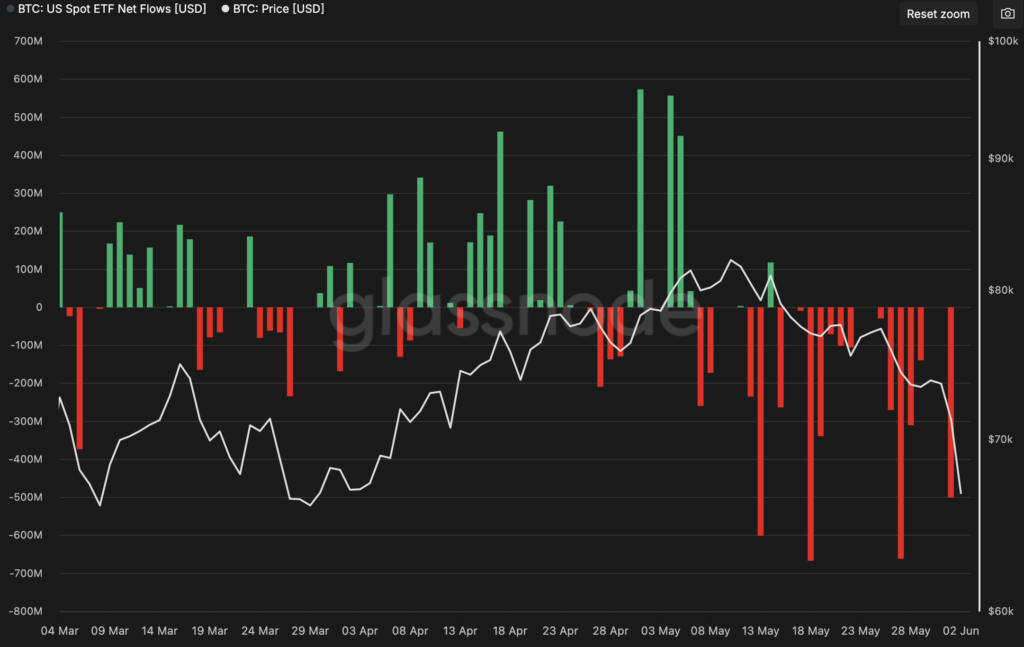
Source: Glassnode
Meanwhile, Tether (USDT), the largest dollar-backed stablecoin, has seen its market dominance rise to 8.30%, the highest level since late February. USD Coin (USDC) has also recovered to levels last recorded in early April.
Although USDT and USDC together still account for only about 11% of the total crypto market, their growing share points to a clear shift toward dollar-linked liquidity within the sector. This trend is becoming increasingly visible as Bitcoin continues to lose momentum.
A similar pattern appeared during previous market sell-offs, including the sharp decline from above $90,000 to around $60,000 in January and February.
Bitcoin is not the only major asset under pressure. Ether (ETH), XRP, and Solana (SOL) have each declined by around 8% to 11% over the past week. Other cryptocurrencies, including BCH, SUI, and RAO, have fallen by nearly 20%. These moves appear to be strengthening the broader rotation into dollar-equivalent assets.
Interestingly, the same flight to the dollar is not visible in traditional financial markets. The Nasdaq and S&P 500 are trading near record highs, while the U.S. Dollar Index, which tracks the dollar against a basket of major currencies, remains confined to a narrow range between 98.50 and 99.50. Source
The $1 Trillion Potential Behind Crypto-Backed Loans
Crypto lending company Ledn believes the market for consumer loans backed by bitcoin could grow dramatically over the next decade, potentially reaching $1 trillion. The company says interest in borrowing against digital assets is already strong, but actual usage remains relatively low.
The estimate was published alongside research by consumer insights firm Protocol Theory, which surveyed 1,244 crypto holders in the United States and Australia between February and March. The study found that 88% of respondents would consider using a crypto-backed loan or credit product, while only 14% currently use one.
Ledn estimates the consumer bitcoin-backed lending market at around $3 billion. For comparison, Galaxy Research previously estimated that the wider crypto lending sector reached a record $73.6 billion in the third quarter of 2025.
Despite the growth potential, the sector is still recovering from the 2022 crypto credit crisis, when companies such as Celsius Network, Voyager Digital and BlockFi collapsed or entered restructuring after falling crypto prices and liquidity pressures exposed weaknesses in centralized lending models. The failures caused major customer losses, damaged trust and led to stronger regulatory scrutiny.
Ledn says demand for these products already exists, but the industry still needs stronger trust mechanisms before adoption can grow. The report also argues that crypto-backed lending remains small compared with the broader scale of digital asset ownership.
The main barriers to wider adoption are linked less to awareness and more to confidence. Non-users cited concerns around crypto price volatility, liquidation risk and regulatory uncertainty. When choosing a lender, respondents said platform reputation, clear loan terms, custody safeguards and risk management mattered more than rates or product features. Source
How Bermuda Plans to Become a Crypto Economy
Speaking at the Digital Money Summit in London, Swan, CEO of the Bermuda Monetary Authority, outlined Bermuda’s goal of becoming a leading blockchain-based economy.
He said the country had already tested digital asset adoption through a public education event, where residents learned how to create crypto wallets and received £100 in stablecoins. Participants were shown how to use the funds for payments, transfers, conversions and withdrawals into traditional currency.
The initiative introduced both citizens and local businesses to digital payments. A temporary marketplace allowed attendees to spend their stablecoins immediately, while payment providers such as MoneyGram enabled quick conversion back into cash.
Bermuda is now expanding this infrastructure beyond the pilot stage. The country has updated its laws to allow digital assets to be used for certain public tax payments and has announced plans to build what it describes as the world’s first fully on-chain national economy.
Rather than developing the technology itself, Bermuda plans to rely on regulated private-sector financial institutions. It has also partnered with Stellar to support the launch of the Bermuda digital dollar, a government-backed stablecoin planned for the Stellar network.
Swan said moving an economy onto blockchain requires more than modernizing payments, including updates to legal concepts such as property rights. Bermuda also recently completed a pilot focused on embedding compliance into smart contracts, showing that transactions could be paused or blocked if they failed reserve, AML or sanctions requirements.
While larger economies may face slower regulatory processes, Bermuda’s small size could help it move faster and serve as a testing ground for national blockchain adoption. Source
Base Connects ChatGPT to Crypto Wallets and DeFi Apps
Base has introduced a new tool designed to let AI agents work directly with crypto wallets and DeFi applications through simple text instructions. The launch highlights the growing overlap between artificial intelligence and blockchain infrastructure.
The tool, called Base MCP, links a user’s Base Account with AI platforms such as ChatGPT, Claude and Cursor. Once connected, users can ask an AI agent to perform actions such as sending funds, swapping tokens, checking balances, reviewing transaction history or using DeFi apps on Base, without needing to move through traditional crypto interfaces manually.
Base said the goal is to make the on-chain economy easier to access through AI. Instead of requiring users to switch between different apps, understand complex protocol layouts or know each step in advance, the tool allows an agent to guide them through the ecosystem in a more personalized and user-friendly way.
The release comes as more crypto companies explore agent-based systems that can carry out blockchain transactions and interact with decentralized applications. Supporters of this trend believe AI agents could make crypto easier for new users by reducing the complexity of wallet management and DeFi navigation.
At launch, Base MCP supports several DeFi protocols on Base, including Morpho, Moonwell, Uniswap and Avantis.
Base described the product as part of a wider shift toward AI-native internet experiences. The company believes chat-based agents could become an important way for users to discover and access on-chain applications as more people begin using AI assistants as their main interface for the internet. Source
Banca Sella Secures MiCA Approval for Crypto Services in Italy
Banca Sella has become the first Italian bank to receive authorization to offer crypto-related services under the European Union’s Markets in Crypto-Assets regulation, known as MiCA.
The bank plans to introduce digital asset custody, transfer, and receiving services for selected groups of clients in 2026. The approval follows the completion of the authorization process under MiCA, the EU-wide regulatory framework designed to oversee the crypto-asset market.
According to Banca Sella, the initial offer will mainly focus on the safekeeping and movement of digital assets. With this authorization, the bank becomes the first banking institution in Italy officially permitted to operate in the crypto-services sector under the new European rules.
The move is part of a broader strategy that Banca Sella has been developing for several years. In 2022, the bank joined the Fintech Milano Hub experimental program promoted by the Bank of Italy, where it explored applications of distributed ledger technology.
Since then, Banca Sella has built a dedicated team focused on digital assets and DLT. It has also become one of the founding members of the Qivalis consortium and has participated in Eurosystem initiatives connected to deposit tokenization and digital payments.
Qivalis currently includes 37 European banks and is working on the launch of a euro-denominated stablecoin, expected by the end of 2026.
Andrea Tessera, Managing Director of Digital Banking at Banca Sella, said that instant, interoperable, and programmable payments are gradually changing the foundations of Europe’s financial system. He noted that the bank’s investments in digital assets and DLT are intended to support safer, more efficient financial services that comply with European regulatory standards.
Banca Sella also said that its upcoming crypto services form part of a wider shift in the European financial sector, shaped by asset tokenization and the growing use of digital payment infrastructure. Source
Invest with Fumbi Today
Take advantage of the potential of cryptocurrencies easily, safely, and efficiently. Start investing with Fumbi with amounts starting from just €10. The Fumbi Algorithm in the Fumbi Index Portfolio tracks cryptocurrency market movements for you. If you want to create your own crypto portfolios, choose the Advanced Portfolios product, where you’ll have access to over 120 cryptocurrencies and templates created by our team, focusing on different areas of the crypto world.
REGISTEREncountered a term you don’t understand? No worries! All important crypto-related terms can be found in one place in our new Fumbi Dictionary.

Juraj Ostertag 
Fumbi


