
 3 min •
Juraj Ostertag
3 min •
Juraj Ostertag
What is Asset Tokenization and How It Could Transform the Financial World
The financial world has undergone a significant transformation in recent years. Technologies based on blockchain are bringing new possibilities for investing, trading, and owning assets. One of the most significant trends is asset tokenization, which has the potential to change how traditional financial markets operate.
Tokenization is transforming ownership by converting real-world and digital assets like stocks, real estate, and money market funds into blockchain-based tokens, enabling greater liquidity, transparency, and worldwide access.
What is asset tokenization?
Asset tokenization refers to the creation of a digital token that represents ownership of a real-world asset. This can apply to a wide range of assets, including financial instruments such as stocks, bonds, and funds; tangible assets like real estate and commodities; as well as unique items such as art and collectibles.
The concept is already gaining traction in today’s financial markets. A clear example is the growing use of stablecoins (digital tokens pegged to fiat currencies at a 1:1 ratio) which are increasingly used for cross-border payments and other financial activities.
By converting ownership into digital form, tokenization makes assets easier to buy, sell, transfer, lend, and use as collateral. While this shift introduces both advantages and trade-offs for investors, intermediaries, and issuers, its overall impact could significantly change how value is exchanged across the financial system.
Foundational principles of asset tokenization
Blockchain and distributed ledger technology (DLT) form the backbone of asset tokenization, serving as the systems where tokenized assets are created, stored, and tracked.
What makes these ledgers particularly powerful are two key features. First, important data about an asset (such as details needed for valuation, accounting, and trading) can be embedded directly into the token itself. Second, the ledger is shared and synchronized across multiple participants, which enhances security and trust even without a single central authority controlling it.
Together, these capabilities can significantly streamline transaction processes. Settlement can happen almost instantly, transactions can occur directly between assets without relying on traditional cash exchanges, and many steps can be automated. Compared to existing financial infrastructure, this represents a substantial leap in efficiency.
While the mechanics behind tokenization can be complex, the outcome is simple: assets become more fluid and easier to use. In their tokenized form, they can be traded, transferred, lent, or borrowed with greater ease—making this shift potentially transformative for the broader economy.
How asset tokenization works
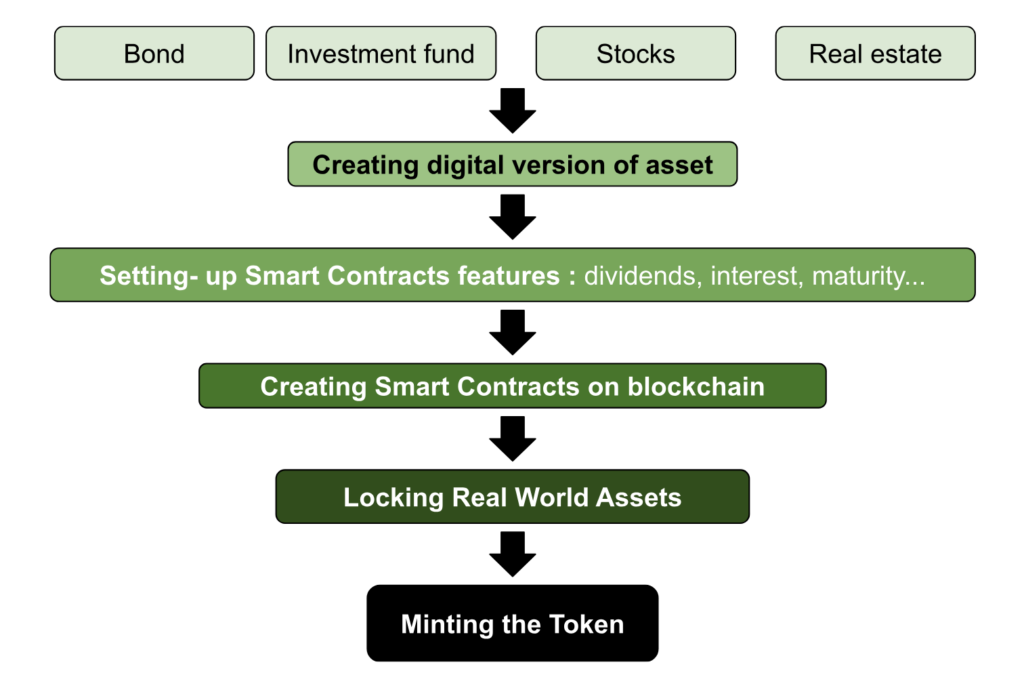
The process typically unfolds in several key steps:
First, the asset is identified. This could be anything from a bond or investment fund to a piece of real estate.
Next, a digital version of that asset is created on a blockchain or distributed ledger. The token’s code contains essential details, including information about the asset itself (such as its type, issuer, and identifiers), the rights attached to it (like voting or income entitlements), and any regulatory or compliance requirements that govern how it can be traded or owned. It can also include ownership records, any associated claims or restrictions, and a history of transactions that builds over time, along with additional control mechanisms.
Smart contracts are then integrated. These allow certain actions -like distributing dividends or releasing financial reports- to happen automatically when predefined conditions are met, such as specific dates or events.
In many cases, the underlying real-world asset is effectively “locked” or set aside, while investors interact with its digital counterpart. They can trade, hold, or transfer the token, and in some cases redeem it for the original asset. For purely financial instruments like shares or bonds, it is also possible to issue them directly on the blockchain without a traditional backing asset—this is known as on-chain issuance, though it is still at an early stage of development.
Finally, the tokens are created (minted) and distributed according to the chosen structure. From that point on, they behave in line with the underlying asset’s lifecycle, they can be traded, generate income such as interest or dividends, and eventually mature or be redeemed if applicable.
Table 1 – Creation of Tokenized Asset
Source: Fumbi
Take stablecoins as an example. When a fiat currency such as the US dollar is tokenized, it gains new functionality. Stablecoins operate on public blockchains, making them accessible to anyone with an internet connection. They can be transferred globally without relying on traditional correspondent banking networks, which are often slow and complex. Transaction fees for moving stablecoins between wallets are typically much lower than those for conventional wire transfers, making them especially appealing for remittances and other cross-border payments.
The benefits of tokenization
1. Greater liquidity for traditionally illiquid assets
A major limitation of traditional markets is the difficulty of trading illiquid assets such as real estate, commodities, or fine art. Tokenization addresses this by enabling these assets to be traded continuously on global blockchain networks.
By breaking assets into smaller digital units, ownership can be divided into fractions, making it easier for investors to buy and sell portions rather than entire assets. This flexibility lowers barriers to entry and broadens participation, allowing more investors to access markets that were previously out of reach.
In addition, tokenized assets are not restricted by the fixed hours of traditional exchanges, meaning they can be traded at any time. The decentralized nature of blockchain-based trading also reduces dependence on intermediaries, helping streamline processes and accelerate transactions.
2. Fractional ownership
Tokenization enables assets to be divided into smaller digital units, allowing multiple investors to own portions rather than requiring a single buyer to purchase the entire asset. This is especially beneficial for high-value assets such as real estate, artwork, or luxury goods, where full ownership is often out of reach for most individuals.
For instance, instead of buying an entire property, an investor can acquire a partial stake through tokenized shares. This lowers the entry barrier and makes investing more accessible to a wider audience. It also supports better portfolio diversification, as investors can spread their capital across fractions of different assets, industries, and regions rather than concentrating it in a single investment.
3. Global accessibility
Tokenizing real-world assets (RWAs) expands access to investment opportunities by removing many of the traditional barriers. In conventional markets, assets like real estate or venture capital are often limited to accredited investors or restricted by geographic boundaries. With tokenization, these assets can be accessed by anyone with an internet connection, regardless of location or financial background.
Because blockchain operates in a decentralized manner, tokenized assets can be traded across borders without relying on intermediaries such as banks or brokers. This opens markets to a much broader, global investor base and allows participation in opportunities that were previously difficult or impossible to access.
In addition, tokenization simplifies cross-border investing by reducing the complexity and cost typically associated with international transactions. For example, an investor in Asia can gain exposure to tokenized real estate in Europe without navigating the usual administrative and regulatory hurdles.
4. Improved transparency and security
When real-world assets are tokenized on a blockchain, every transaction is recorded on a shared and tamper-resistant ledger. This increases transparency around ownership, transfers, and pricing, while also allowing investors to track an asset’s history and activity in real time.
Because the system is decentralized, it reduces reliance on centralized record-keeping institutions, lowering the risk of fraud or data manipulation. Security is further reinforced through cryptographic methods (such as digital signatures and hashing) which help protect the accuracy and integrity of transaction data. As a result, ownership records and transactions become more reliable, verifiable, and easier to audit.
Smart contracts add another layer of protection and efficiency. These self-executing programs automatically carry out agreed terms once specific conditions are met, minimizing the potential for human error and ensuring that transactions are completed exactly as intended, without requiring intermediaries.
5. Easier transfer of ownership
In traditional markets, transferring ownership of assets like real estate or shares is often slow and complex, involving multiple intermediaries, legal paperwork, and regulatory approvals. These steps can create delays and increase costs.
Tokenization simplifies this process by enabling ownership to be transferred digitally on a blockchain. Asset tokens can move quickly and securely between parties, with full transparency and without the need for extensive intermediary involvement. This is especially valuable for cross-border transactions, where legal and administrative hurdles typically slow things down.
Smart contracts further streamline the process by automating transfers once predefined conditions are met, reducing the likelihood of errors, disputes, or unnecessary delays.
6. Faster transactions and settlement
Traditional asset transactions—especially across borders—often involve multiple intermediaries, compliance checks, and manual processes that can slow settlement and increase costs.
Tokenization streamlines this by enabling assets to be transferred on blockchain networks almost instantly or within minutes. This significantly reduces settlement times and improves overall transaction efficiency, making financial interactions faster, more seamless, and less dependent on complex infrastructure.
7. Portfolio diversification
Tokenized assets make it easier for investors to build more diversified portfolios by opening access to a wider range of asset classes. Barriers such as high minimum investments or geographic limitations are reduced, allowing exposure to assets like real estate, fine art, commodities, and other alternatives.
For instance, an investor can spread capital across tokenized assets such as gold, property, or even intellectual property. This approach helps balance risk and potentially enhance returns, even with a relatively modest investment.
8. Innovation in financial products
Tokenization of real-world assets is enabling the development of entirely new types of financial products. By digitizing assets, they can be bundled into structures such as tokenized funds, asset-backed instruments, tokenized bonds, or real estate investment vehicles. These offerings give investors exposure to diversified pools of assets, increasing the attractiveness of tokenized markets.
At the same time, blockchain technology provides the flexibility to design new kinds of financial instruments. This includes solutions like tokenized insurance, peer-to-peer lending systems, and a wide range of decentralized finance (DeFi) applications, all of which expand how capital can be created, managed, and distributed.
Regulation and risk management
Distributed ledgers introduce a fundamental challenge: finding the right balance between transparency and privacy. Any institution exploring tokenization must carefully address this by deciding what transaction data is shared, with whom, and how it is accessed.
On one hand, these systems can deliver a high level of transparency. A shared, synchronized record of transactions creates a single source of truth, which can simplify processes like transaction validation, regulatory reporting, and monitoring for suspicious activity. This can improve efficiency for both financial institutions and regulators.
On the other hand, increased transparency can raise concerns around privacy. Early blockchain systems demonstrated this trade-off—while transactions were fully visible on the network, the identities behind them were not directly disclosed. Even so, the level of openness may not meet the expectations of investors.
For tokenization to gain wider adoption, stronger privacy protections will likely be necessary. Investors typically want to safeguard sensitive information, including transaction details and positions, especially from competitors or unauthorized parties. As a result, designing systems that balance openness with confidentiality is essential for building trust and encouraging participation.
High-quality regulatory frameworks are generally designed to:
- Protect investors from fraud and market manipulation
- Promote transparency and accurate disclosures
- Deter illicit activities such as money laundering and terrorism financing
- Clarify how digital assets are taxed
- Encourage innovation in blockchain technology while maintaining financial stability
- Reduce systemic risk by subjecting crypto firms to oversight
Nowadays there have been several regulatory frameworks across the world which are developing robust infrastructure concerning cryptocurrency
Europe:
The EU adopted its first unified crypto regulation, the Markets in Crypto-Assets (MiCA) regulation, in 2023, although most provisions didn’t take effect until 2024. MiCA sets common rules for issuers of stablecoins, crypto asset service providers, and trading platforms across all member states. The framework emphasizes investor protection, financial stability, and cross-border regulatory consistency.
USA:
Cryptocurrency regulation in the United States has historically been fragmented, with federal agencies applying different interpretations based on the nature and use of each asset. That splintered approach began to change in 2025, when Congress passed legislation to establish a clearer framework for stablecoins and digital asset markets.
GENIUS Act: Regulates the issuance of payment stablecoins, requiring full reserve backing, monthly audits, and anti–money laundering compliance. Only approved issuers may create stablecoins pegged to the U.S. dollar.
CLARITY Act: Defines how digital assets are treated under federal securities and commodities laws. It also aims to reduce regulatory overlap and increase transparency for both businesses and investors.
Anti-CBDC Surveillance State Act: Seeks to block the Federal Reserve from creating a central bank digital currency (CBDC) for public use without congressional approval.
China:
China began restricting cryptocurrency in 2017 by banning exchanges and initial coin offerings (ICOs), followed by a sweeping 2021 crackdown that outlawed crypto mining and most crypto transactions. At the same time, the government developed its own CBDC, the digital yuan, which entered pilot testing in late 2019 and has since expanded to more cities and applications.
Key challenges in the adoption of tokenization
The rollout of any transformative technology is rarely straightforward, and tokenization is no exception. As the space evolves, several important challenges continue to shape its development.
New investment considerations
Tokenized assets introduce unique factors that investors must account for. Many of these relate to the connection between the digital token and its underlying asset—such as dependence on third-party verification, legal protections in case of insolvency, and the mechanics of redemption. From an operational standpoint, risks also increase, particularly in areas like cybersecurity. Flexible custody models, while innovative, can expose investors to threats such as hacking or loss of private keys. In essence, although tokenized assets may mirror traditional instruments structurally, their real-world use brings added complexity.
Regulatory fragmentation
Despite growing momentum at the policy level, regulation of digital assets remains uneven across regions. The global framework is still fragmented, with some jurisdictions further ahead than others. While certain markets have made meaningful progress, a fully harmonized regulatory environment has yet to emerge. This lack of consistency creates uncertainty for market participants, especially those operating internationally.
Technology and integration challenges
There is also a divide between the open, public blockchain systems commonly associated with crypto and the private, permissioned networks favored by traditional financial institutions. Although private networks can be large and sophisticated, the assets within them often remain isolated. Bridging these separate systems—while maintaining standards for privacy, security, and compliance—is both a technical and organizational challenge. Successfully connecting them could unlock significant network effects and broader market efficiency.
The outlook and future for tokenization
Tokenization marks the early stages of a fundamental shift in how the financial system functions. Compared to traditional infrastructure, digital systems offer clear advantages in areas such as trade settlement, ownership tracking, and asset servicing, and the underlying technology has already proven its reliability.
Overall, tokenization is expected to deliver net benefits for both financial markets and investors. However, it also presents strategic challenges for intermediaries, who must adapt to remain relevant in an evolving landscape. At the same time, regulators face the task of balancing innovation with the need to manage systemic risks.
As a result, the transition will not happen instantly. Instead, tokenization is likely to expand gradually, becoming an increasingly integral part of financial markets over time.
There are currently several projects in the cryptocurrency market that focus on the tokenization of real-world assets. These include, for example, Ondo (ONDO), Centrifuge (CFG), and Quant (QNT). These projects aim to build infrastructure that enables a more efficient connection between traditional financial assets and blockchain. For instance, Ondo focuses on tokenized financial products linked to U.S. Treasury bonds, while Centrifuge enables the financing of real-world assets through decentralized protocols. The growing interest of major financial institutions in tokenization indicates that this segment may play an important role in the future digitalization of capital markets.
REGISTER
Juraj Ostertag 
Fumbi


