
 3 min •
Juraj Ostertag
3 min •
Juraj Ostertag
Bitcoin Price Surpassed $80,000 – Market Info
The cryptocurrency market rose sharply over the past 14 days. Total market capitalization increased from €1.89 trillion to €2.27 trillion during this period. The price of Bitcoin rose by a substantial 22.5%, from €55,231 to €67,646.
The Fear & Greed Index increased from 27 to 65 points over the past 14 days. This means that the market moved out of the “fear” zone and is currently in the “greed” zone. As a result of Bitcoin’s sharp rise, the Altcoin Season Index fell from 55 points to 39 points.

Source: CoinMarketCap
Bitcoin Price Surpassed $80,000
Bitcoin has once again moved into the spotlight in recent days after the U.S. Treasury Department announced an expansion of its long-term government bond buyback program. Treasury Secretary Scott Bessent’s move was originally aimed at stabilizing the bond market and easing pressure from high yields. Markets, however, reacted differently – instead of a significant decline in yields, Bitcoin and other cryptocurrencies surged.
On August 19, Bessent announced an increase in the maximum volume of buybacks of 10-, 20-, and 30-year U.S. Treasury bonds from $2 billion to at least $4 billion per operation. The announcement came at a time when long-term U.S. Treasury yields were trading at their highest levels since 2007. Bitcoin reacted with a sharp rise and successfully broke through the $80,000 level. The broader crypto market also moved higher, while the strong upward move triggered liquidations of short positions worth several billion dollars. Gold also rose, suggesting that investors began shifting toward assets with limited supply following the announcement.
For Bitcoin, the signal sent by the Treasury Department’s decision is particularly important. The buybacks themselves do not represent money printing or traditional quantitative easing by the Federal Reserve. However, the market may interpret the move as evidence that the high cost of financing U.S. debt is becoming an increasingly serious problem and that the government is prepared to intervene more actively in the functioning of the bond market.
This situation supports a narrative that has historically been favorable for Bitcoin. If investors expect the government to introduce additional measures to reduce debt-financing costs or support liquidity, concerns about currency debasement may increase. In such an environment, Bitcoin is increasingly viewed in a similar way to gold – as a scarce asset that is independent of decisions made by central banks and governments.
Interestingly, bond yields remained high despite the announcement. The yield on the 30-year U.S. Treasury bond stayed at around 5.25%, only slightly below the 5.33% peak reached on August 18. This suggests that the buybacks have so far failed to resolve the main issue – investor concerns over high U.S. debt, further fiscal deficits, and inflation. U.S. federal debt has already reached approximately $40 trillion, while continued budget deficits mean that the government needs to issue additional Treasury bonds. A higher supply of bonds can push their prices lower and yields higher. A buyback program worth several billion dollars may therefore not be large enough to significantly reverse this broader trend.
This creates an unusual situation for the crypto market. Under normal circumstances, high U.S. Treasury yields are not particularly supportive of Bitcoin, because investors can earn attractive returns on relatively safe government assets. This time, however, high yields are also signaling growing concerns over debt, inflation, and U.S. fiscal sustainability. These factors may, in turn, support demand for Bitcoin as an alternative store of value.
For BTC’s further development, it will therefore be crucial to watch what happens to U.S. Treasury yields and whether Washington introduces additional measures. If yields remain high and pressure on U.S. debt financing continues, investors may begin to expect more aggressive interventions aimed at supporting liquidity. Bitcoin is therefore currently benefiting not only from developments directly within the crypto market. The broader macroeconomic environment, rising U.S. debt, and the question of how the United States will attempt to keep its financing costs under control are playing an increasingly important role. Developments in the bond market could therefore become one of the most important factors influencing Bitcoin’s next price move. Source
The White House Opens the Door to Crypto: The U.S. Wants to Become a Global Crypto Powerhouse
Cryptocurrencies in the United States are definitively moving from the margins of the financial system into the center of economic and technological policy. The latest meeting between President Donald Trump and representatives of the crypto industry at the White House showed that his administration no longer sees digital assets merely as a new segment of the financial market, but as part of a broader strategy to strengthen the technological and economic position of the United States.
On Wednesday, August 19, a crypto summit was held at the White House, where Donald Trump met with representatives of some of the largest U.S. crypto companies, financial institutions, and regulatory bodies. Participants included representatives of Coinbase, Kraken, Robinhood, Nasdaq, and Intercontinental Exchange, together with the leadership of the SEC and CFTC. The main topic of discussion was the future direction of cryptocurrency regulation in the United States, particularly the adoption of the CLARITY Act, a clearer division of responsibilities between the SEC and CFTC, and the creation of a more favorable environment for the crypto industry.
The Trump administration views the growing digital asset sector as an issue of geopolitical competitiveness. If the United States fails to create suitable conditions for the development of cryptocurrencies and blockchain technologies, China or other competitors could take the lead. The focus is therefore not only on Bitcoin or cryptocurrency trading, but on the entire ecosystem – from exchanges and stablecoins to the tokenization of traditional assets and new financial infrastructure.
The goal is for companies to build these technologies directly in the United States, raise capital there, and at the same time create jobs and generate tax revenues. Crypto is therefore gradually becoming part of Trump’s broader strategy to support industries that could be crucial to the country’s technological and economic position over the next decade.
One of the most important topics of the meeting was the CLARITY Act, legislation aimed at creating a clearer structure for the U.S. digital asset market. One of the crypto industry’s long-standing problems in the United States has been uncertainty over which cryptocurrencies fall under SEC supervision as securities and which are more appropriately regulated by the CFTC as commodities. The unclear division of responsibilities created uncertainty not only for crypto exchanges, but also for token issuers, investors, and other financial companies. The CLARITY Act is intended to clarify the boundaries between the powers of individual regulators and establish more stable rules for the market. For crypto companies, however, it is not only the current administration’s more favorable stance that matters. They need rules that will work over the long term and will not change fundamentally after every presidential transition. Coinbase CEO Brian Armstrong therefore described the legislation as a step that could anchor the current changes for the long term.
The tone of U.S. regulatory authorities is also changing significantly. The previous period was often criticized by the crypto industry for so-called “regulation by enforcement,” where boundaries were established through lawsuits and individual enforcement actions rather than through clearly defined rules. The new administration wants to change this model. Under the new approach, the SEC and CFTC are expected to provide clearer rules and create legal pathways through which crypto companies can raise capital and offer their services in the United States. Companies that only recently viewed U.S. regulators mainly as a source of legal risk are now discussing directly at the White House what the future regulatory framework should look like.
Although discussions about U.S. crypto policy are often associated primarily with Bitcoin, stablecoins and tokenized financial assets may be even more strategically important. Dollar-backed stablecoins make it possible to use a digital form of the U.S. currency virtually anywhere in the world, while their reserves can also generate additional demand for U.S. Treasury securities. The tokenization of stocks, bonds, and other financial products could, in turn, extend the reach of U.S. capital markets far beyond traditional Wall Street. For the White House, the development of crypto infrastructure therefore does not necessarily mean weakening the traditional financial system. On the contrary, as long as the U.S. dollar remains at the center of the digital economy, Washington may view blockchain technologies as another way to strengthen its global importance.
The White House meeting therefore sent a relatively clear signal to the crypto market. An industry that was viewed with considerable skepticism in Washington only a few years ago is gradually becoming part of U.S. economic strategy. The biggest question, however, remains whether political support will also translate into long-term legislation. A more favorable stance from the administration itself can improve conditions for crypto companies, but legal certainty will be decisive for the sector’s further development. If Washington succeeds in creating a stable regulatory framework while attracting capital, companies, and new financial infrastructure, the United States could further strengthen its position as one of the most important centers of the global crypto industry. And based on the outcome of the latest White House meeting, this is precisely what the Trump administration is trying to achieve. Source
Strategy Holds Billions in Cash and Its Bitcoin Position Is Back in Profit
Michael Saylor’s Strategy is significantly strengthening its cash position. Over the past week, the company raised approximately $2 billion through the sale of new MSTR shares while also creating a new cash pool that could be used for additional Bitcoin purchases in the future. The company already owns more than 840,000 BTC, and at current prices its Bitcoin position is once again in profit.
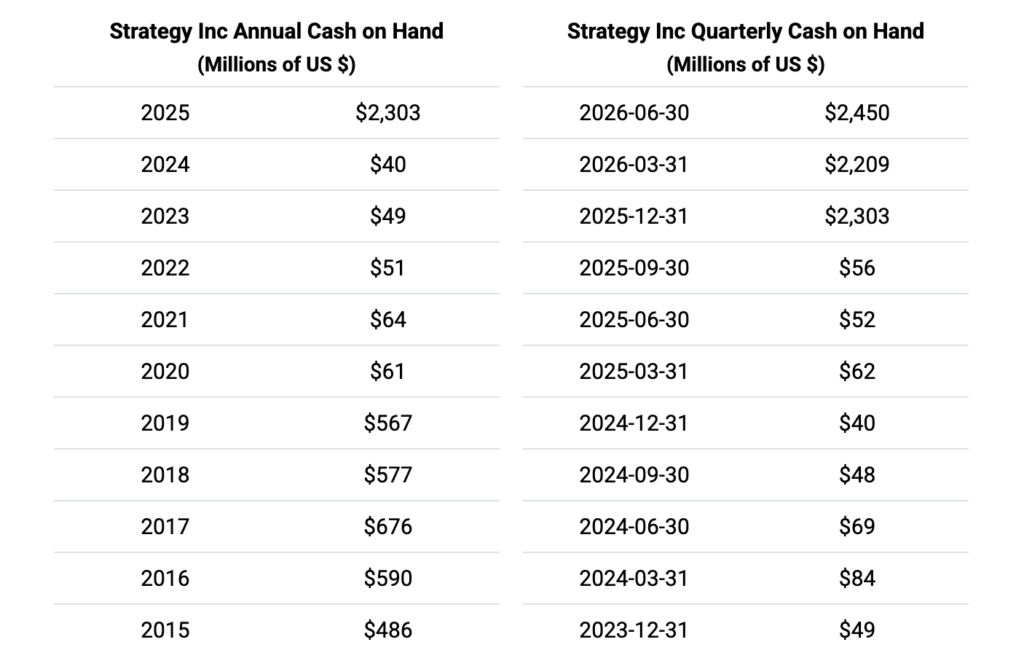
Between August 17 and 23, Strategy sold approximately 18.26 million MSTR shares, raising net proceeds of $2.01 billion. Of this amount, $300 million was transferred to its existing U.S. dollar reserve, while another $136.4 million was used to repurchase approximately 1.43 million STRC preferred shares. The remaining capital was directed into a new fund referred to as “USD Cash.” As of August 23, Strategy therefore held a U.S. dollar reserve of $5.1 billion and an additional $1.59 billion in the new USD Cash pool. The company’s total dollar liquidity thus reached approximately $6.69 billion. The original reserve is mainly intended to finance preferred-share dividends and interest payments on debt, while the new fund gives management significantly greater flexibility.
Table: Strategy’s Total Cash Reserves
Source: Macrotrends.net
Strategy can use the funds in USD Cash to purchase additional Bitcoin, repurchase its own MSTR or preferred shares, repay convertible bonds, or further strengthen its U.S. dollar reserve. The company stated that the new cash position will allow it to respond more quickly to significant movements in the price of Bitcoin or its own securities. For the company’s Bitcoin strategy, this represents an important change. For years, Strategy was known primarily for converting newly raised capital into Bitcoin almost immediately. This time, however, it is keeping part of the funds in cash. This gives the company a reserve that it can use, for example, during a sharp decline in the price of BTC without first having to raise new capital or sell its existing Bitcoin holdings.
During the week, Strategy did not buy or sell any Bitcoin. Its holdings therefore remained at 840,447 BTC, representing approximately 4% of the maximum number of Bitcoins that can ever be created. The total cost of acquiring them amounts to approximately $63.36 billion, with an average purchase price of $75,385 per BTC. With Bitcoin trading above $78,000, the holdings were worth approximately $65.6 billion. This means Strategy’s Bitcoin position was at that point in an unrealized profit of approximately $2.2 billion, or around 3.5% above its acquisition cost. If Bitcoin’s price were to continue rising, the company’s unrealized profit would increase very quickly due to the enormous amount of BTC it holds – every $1,000 increase in Bitcoin’s price adds approximately $840 million to the market value of its holdings.
Interestingly, Strategy is also continuing to repurchase STRC preferred shares. Under its $1 billion program, it has already repurchased approximately $483.4 million worth of preferred shares, leaving another $516.6 million available. A separate $1 billion program for repurchasing common MSTR shares has not yet been used. The new approach also shows that Strategy is trying to build a more stable financial structure around its Bitcoin reserves. Holding nearly $6.7 billion in U.S. dollar liquidity reduces the need to sell Bitcoin at an unfavorable time while keeping capital available for potential purchases during market downturns.
On the other hand, raising capital through the sale of new MSTR shares means further dilution for existing shareholders. Strategy therefore has to continuously balance the benefits of new capital against its impact on shareholders. However, as long as the company can raise capital on favorable terms and Bitcoin remains above its average purchase price, its basic model continues to work in its favor. Strategy is gradually evolving from a company that simply accumulates Bitcoin into a business with a broader financing system built around BTC. With more than 840,000 Bitcoins and nearly $6.7 billion in available dollar liquidity, it now has significantly more room to respond to further developments in the crypto market – whether that means another rise in Bitcoin or an opportunity to buy during the next major downturn. Source
Citibank Opens the Door to Bitcoin and Will Offer Its Own Custody Service to Institutions
One of the largest U.S. banks is planning another significant step toward cryptocurrencies. Citibank wants to launch a Bitcoin custody service for institutional clients later this year, allowing them to hold BTC through the same banking infrastructure they use for traditional assets such as stocks and bonds. The new service will be part of the Custody+ platform, which Citibank introduced on August 18. It is a broader suite of services focused on asset custody, transaction settlement, cash management, and foreign exchange operations. The platform is intended to gradually connect traditional financial assets with digital assets within a single system. Bitcoin will be the first cryptocurrency supported, although the bank has not yet announced an exact launch date.
For institutional investors, this could represent a relatively significant change. Investment funds, asset managers, and other large clients often rely on specialized crypto custodians. The new service will allow them to hold BTC directly through a major traditional bank alongside their other assets. This could reduce operational complexity while removing one of the barriers that still complicates the entry of some traditional financial institutions into the crypto market. Citibank’s scale shows why this step could have a broader impact. The bank serves clients in more than 100 markets and operates its own custody network in 62 of them. This gives it established relationships with institutional investors, to whom it can gradually expand its offering to include digital assets.
Custody+ is part of a broader infrastructure modernization initiative. Citibank is upgrading its infrastructure so that it can process most operations in real time. The goal is to prepare the bank for faster financial markets and the continuous operation of digital assets. Bitcoin fits naturally into this strategy. The crypto market operates 24 hours a day, seven days a week, and transactions settle much faster than in many traditional financial markets. Changes in the U.S. regulatory environment also play an important role. In 2025, the U.S. SEC withdrew the SAB 121 accounting guidance, which had made it significantly more difficult and expensive for banks to provide crypto custody services. Following its removal, traditional banks gained more room to build their own digital asset infrastructure.
For Bitcoin, Citibank’s entry could be important particularly from a long-term perspective. This is not about the bank itself purchasing BTC, but rather about building infrastructure that could make it easier for other large investors to hold it. Following the launch of spot Bitcoin ETFs, institutions gained easier access to price exposure to Bitcoin. The expansion of bank custody services now addresses another part of the equation – the safe and regulatory-compliant custody of the underlying asset itself.
Citibank is also sending another signal that Bitcoin is gradually becoming a standard part of financial infrastructure. Services that only a few years ago were provided mainly by specialized crypto companies are increasingly being offered by the world’s largest banks. If the service launches as planned later this year, institutional clients will be able to manage Bitcoin, stocks, bonds, and cash within a single financial ecosystem. Source
Client Migration After MiCA Implementation Attracts Scammers
New European cryptocurrency rules are intended to increase investor protection and remove providers from the market that do not meet regulatory requirements. However, the large-scale migration of clients between platforms has also created a new opportunity for scammers. The transitional period under the Markets in Crypto-Assets Regulation (MiCA) ended on July 1, 2026. Crypto-asset service providers without the required authorization must cease their activities in the EU, stop accepting new clients, and inform existing users about the next steps.
The change affected more than 1,700 unlicensed crypto platforms, while approximately 323 companies held valid MiCA authorization when the transitional period ended. Millions of users across Europe therefore had to deal with changing providers. Scammers have begun exploiting precisely the situation in which users expect an email or notification about the termination of services, cryptocurrency withdrawals, or account migration. Fraudulent communication can look very similar to a legitimate announcement from a crypto exchange. A user may, for example, be told that their platform can no longer provide services in the EU and that they must move their cryptocurrencies to a “licensed” provider. However, the link may lead to a fraudulent website designed to steal login credentials or persuade the user to transfer assets to an address controlled by the attacker.
Scammers are not only abusing the names of crypto exchanges. ESMA has warned about cases involving the misuse of its name, identity, and logo, including fake documents intended to convince victims that their funds were at risk. The French regulator Autorité des marchés financiers (AMF) recorded cases in which scammers impersonated its employees. They told victims that they could help recover lost funds, but first demanded payment of an administrative fee. The Dutch regulator AFM also warned that the migration of users from unregulated platforms itself creates favorable conditions for scammers. Investors who are currently looking for a new provider are a natural target for fraudulent offers and messages.
The problem of social engineering existed even before the introduction of the new rules. According to data from crypto exchange WhiteBIT, incidents involving fraudulent investment offers or impersonation accounted for approximately 41% of recorded crypto-security incidents in 2025. European regulators therefore recommend verifying whether a particular company genuinely holds MiCA authorization before transferring cryptocurrencies. It is important to check the specific legal entity providing the service, not merely the name or brand of the broader corporate group. The fact that one company within a group has obtained an EU license does not automatically mean that the same authorization applies to all of its subsidiaries or services.
Users should pay particular attention to unsolicited messages urging them to quickly transfer cryptocurrencies or funds. Regulators also warn that they do not normally contact investors through private messages requesting money transfers. Regulation itself is not the cause of scams, but the transition to the new licensing regime has created opportunities for new forms of social engineering and impersonation of regulated companies or public authorities. Users should therefore always verify providers through official registers and proceed with caution when receiving unexpected instructions to transfer cryptocurrencies or money. Source
The U.S. Tightens Rules for Stablecoin Issuers Through the GENIUS Act
The U.S. Treasury Department has introduced a new proposal for rules intended to clarify how stablecoins will operate under the GENIUS Act. The proposal focuses mainly on who will be allowed to issue stablecoins in the United States and under what conditions both domestic and foreign companies will be able to offer them to U.S. users. The GENIUS Act was adopted in July 2025 and created the first comprehensive federal framework for regulating payment stablecoins in the United States. However, the law left several practical questions to regulators. The Treasury Department is therefore now proposing more precise definitions of what it means to “issue a stablecoin in the United States” and when a stablecoin is considered to be offered or sold to a person located in the United States.
From January 18, 2027, when the main provisions of the law are expected to take effect, payment stablecoins generally should not be issued in the United States without the appropriate federal or state license. The rules are not intended to apply only to U.S. issuers. The GENIUS Act also includes restrictions for stablecoins issued outside the United States. Foreign stablecoins will be available to U.S. users only under certain conditions. Among other requirements, their issuers will need to have the ability to respond to lawful orders from U.S. authorities and comply with any relevant agreements between the United States and the country in which they are based. From July 18, 2028, the rules will become even stricter, and digital service providers generally will not be allowed to offer U.S. users stablecoins that do not meet the law’s requirements.
The treatment of foreign issuers could become one of the most important parts of the upcoming regulation. Market attention is focused, for example, on Tether and its USDT stablecoin, as Tether is one of the world’s largest stablecoin issuers but its main company is based outside the United States. The final wording of the rules could therefore significantly influence which foreign stablecoins remain available on U.S. crypto platforms. When drafting the proposal, the Treasury Department also drew on experience from existing regulation of securities and other financial instruments. At the same time, it emphasized that stablecoins are primarily intended to serve as a means of payment and settlement, including cross-border transactions, and therefore traditional investment rules cannot simply be applied to them directly.
The proposal is not yet final. The Treasury Department opened a 60-day public consultation period during which stablecoin companies, financial institutions, and other market participants can comment on the rules. The department will then evaluate the feedback and prepare the final version of the regulation. Implementation of the GENIUS Act is nevertheless progressing more slowly than originally anticipated by the law. The one-year deadline for creating the necessary rules has already passed, and it remains uncertain whether all regulatory provisions will be completed by January 2027. In addition to the Treasury Department, other banking and financial regulators must also prepare their own rules.
Despite this, the new proposal represents another important step toward creating a unified U.S. framework for stablecoins. Its final form could determine not only which companies will be allowed to issue stablecoins in the United States, but also which foreign stablecoins will remain available to U.S. users and crypto exchanges. Washington also views stablecoins as a tool that could support the international use of the U.S. dollar and strengthen its position in the global financial system. Source
Invest with Fumbi Today
Take advantage of the potential of cryptocurrencies easily, safely, and efficiently. Start investing with Fumbi with amounts starting from just €10. The Fumbi Algorithm in the Fumbi Index Portfolio tracks cryptocurrency market movements for you. If you want to create your own crypto portfolios, choose the Advanced Portfolios product, where you’ll have access to over 120 cryptocurrencies and templates created by our team, focusing on different areas of the crypto world.
REGISTEREncountered a term you don’t understand? No worries! All important crypto-related terms can be found in one place in our new Fumbi Dictionary.

Juraj Ostertag 
Fumbi


