
 3 min •
Juraj Ostertag
3 min •
Juraj Ostertag
Spot Bitcoin ETFs Post Strongest Week Since April – Market info
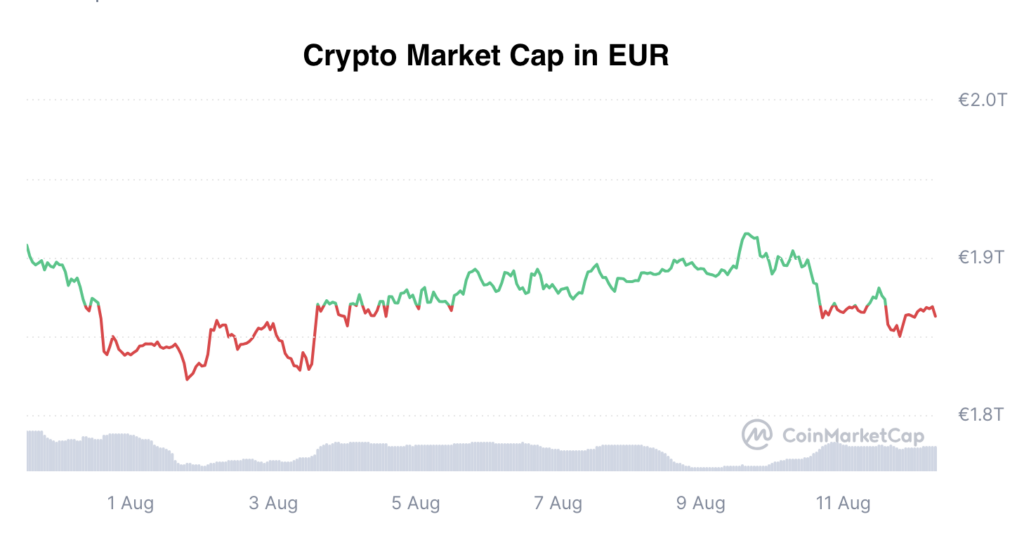
The cryptocurrency market declined slightly over the past 14 days. Total market capitalization decreased from €1.93 trillion to €1.89 trillion during this period. The price of Bitcoin fell by approximately 3% from €56,430 to €55,231.
The Fear & Greed Index fell from 29 to 27 points over the past 14 days. This level still falls within the “fear” category. The Altcoin Season Index decreased from 59 points to 55 points.
Source: Coinmarketcap
Spot Bitcoin ETFs Post Strongest Week Since April
U.S. spot Bitcoin ETFs recorded net capital inflows of more than $853 million last week, marking their strongest weekly result since mid-April. The increased interest comes at a time when a security incident involving Coldcard hardware wallets has once again raised concerns about the risks of crypto self-custody. According to data from SoSoValue, Bitcoin ETFs recorded inflows for five consecutive trading days. The highest daily inflow reached approximately $244.4 million last Wednesday, while investors added another $211.5 million the previous day.
Over the entire five-day streak, approximately $853.5 million flowed into spot Bitcoin ETFs. Total cumulative net inflows into these funds increased to approximately $52.18 billion. The increased interest in regulated investment products came shortly after a security incident involving Coldcard hardware wallets. The exploited vulnerability reportedly led to Bitcoin being stolen from thousands of addresses, with the total value of the stolen assets estimated at approximately $120 million. According to experts, such incidents may encourage some investors to choose exposure through regulated ETFs rather than holding Bitcoin directly. Markus Levin, co-founder of the XYO project, noted that the security incident could persuade some investors to prefer ETFs over crypto self-custody. At the same time, he pointed out that using a custodian means giving up direct control over Bitcoin and relying on a third party to safeguard the assets.
U.S. spot Ethereum ETFs also recorded positive developments. They attracted approximately $245 million during the week, with net inflows recorded for four consecutive trading days. According to Matt Mena, Senior Crypto Research Strategist at 21Shares, Ethereum has recently shown relatively strong performance and is attempting to reclaim the important $2,000 price level. Ethereum gained approximately 18.5% in July, marking its best monthly result since August 2025. It also outperformed major U.S. stock indexes during the month. Ethereum’s performance is often viewed as an indicator of the broader health of the altcoin market. If the ETH-to-Bitcoin ratio has stabilized after approximately a year of decline, the third quarter could also be more favorable for other cryptocurrencies, according to Matt Mena.
Despite rising ETF inflows, Bitcoin remains approximately 50% below its all-time high from October. Since June, its price has mostly traded within a range of approximately $60,000 to $67,000. Strong inflows into Bitcoin and Ethereum ETFs nevertheless suggest that investor interest in regulated crypto-linked products remains high. Security incidents associated with self-custody may also further increase the appeal of solutions where assets are held by a regulated custodian. Source
Bitcoin-Backed Loans Are Attracting More and More Institutions
Institutional investor demand for Bitcoin-backed loans is growing. Lenders are also offering larger credit facilities, longer maturities and more customized terms tailored to the needs of large clients. One of the clearest examples is MARA Holdings, which used 18,750 BTC as collateral in early August to secure $600 million in financing. The financing was obtained through two term loans from Coinbase Credit and Two Prime Lending.
The pledged Bitcoin represented approximately 53% of MARA’s total Bitcoin holdings at the time. When the transactions closed on August 4, the collateral was valued at approximately $1.2 billion. MARA said the proceeds could be used for general corporate purposes, including its planned acquisition of Long Ridge Energy & Power. The company operates a gas-fired power plant in Ohio that could potentially provide energy not only for Bitcoin mining but also for infrastructure related to artificial intelligence.
This type of financing reflects a shift in the behavior of companies that hold Bitcoin on their balance sheets. Instead of selling BTC when they need cash, they are increasingly using it as collateral to raise capital. According to Two Prime CEO Alexander Blume, Bitcoin-secured loans are gradually developing into a full-fledged financial product. Lenders are increasingly able to offer longer maturities, customized terms and financial structures similar to those commonly used in traditional finance. The loan provided by Two Prime to MARA, for example, carries a fixed interest rate of 7.65% and matures in August 2028.
Blume also noted that demand for this type of financing has increased in recent months. Institutions are using their Bitcoin holdings to finance capital expenditures while retaining exposure to potential further appreciation in the price of Bitcoin. The structure of loan agreements is also gradually changing. Regulatory filings show increasingly detailed provisions covering areas such as additional collateral requirements when collateral values decline, asset custody and potential liquidation conditions.
The range of available loans and maturities is also expanding. Additional companies, including Ledn and Kraken, are entering the segment and developing financing through structures linked to Bitcoin collateral. This trend may not remain limited to Bitcoin. As traditional financial assets become increasingly tokenized, similar mechanisms could also be used for other assets operating on blockchain-based infrastructure. One possibility is tokenized equities, which could potentially serve as collateral for various forms of financing in the future. As more publicly traded companies add Bitcoin to their balance sheets, the importance of being able to use these assets efficiently without selling them is also increasing. Bitcoin-backed loans are therefore gradually becoming another tool in corporate finance. They allow companies to raise capital for further investments or operational needs while retaining their Bitcoin holdings. Source
$116 Million Coldcard Hack Shakes Hardware Wallet Security
A security flaw in the firmware of the Coldcard hardware wallet allowed attackers to steal approximately 1,816 BTC worth around $116 million beginning in late July 2026. The incident affected more than 5,200 Bitcoin addresses and, according to available data, ranks as the third-largest crypto hack of 2026. The problem dates back to March 2021, when firmware version 4.0.1 was released. A configuration error caused some devices to use a weaker software-based random number generator instead of a sufficiently strong hardware source of randomness when generating seeds.
The result was a significant weakening of the security of the generated private keys. According to the analysis, their effective strength may in some cases have fallen from the intended 128 bits to approximately 40 bits. Keys weakened to this level could be brute-forced using computing power without requiring physical access to the hardware wallet itself. The first movements of stolen Bitcoin were detected on July 30, 2026. Within approximately 25 minutes, around 594 BTC, worth nearly $38 million at the time, was transferred from approximately 500 wallets.
However, this was not a one-off attack. Additional waves of withdrawals followed over the next four days. According to preliminary data from Galaxy Research, approximately 1,816 BTC was stolen from more than 5,200 addresses in total. The final scale of the incident may not yet be fully known. Some users may only discover the loss of their funds later, while part of the financial flows is still being analyzed. The current figures should therefore be considered preliminary. Differences in the way the individual waves of the attack were carried out also suggest that more than one attacker may have been involved. The attack has therefore not been attributed to any specific group.
The Coldcard incident ranks among the largest cryptocurrency attacks of 2026 according to available data. It is approximately the third-largest hack of the year so far. Total losses caused by crypto hacks in 2026 have now exceeded $1.2 billion, with approximately 276 security incidents recorded. Unlike many previous attacks on exchanges or DeFi protocols, this time the issue involved a hardware wallet, which is generally considered one of the safer options for crypto self-custody. Coldcard has already fixed the firmware issue. However, the update only addresses the creation of new wallets and cannot retroactively improve the security of seeds generated while the vulnerability was present. Users who generated a seed on an affected version of the device between March 2021 and the release of the patch should therefore consider it potentially compromised according to security recommendations. In such a case, a new seed should be generated on an updated device and the assets transferred to a new wallet.
The Coldcard hack also highlights a broader issue with crypto self-custody. While self-custody removes reliance on a centralized exchange or custodian, it does not automatically eliminate all security risks. Wallet security depends not only on the protection of the device itself, but also on how the seed was generated, the quality of randomness generation, the firmware and the overall development process of the device. Open-source code and security audits therefore do not provide an absolute guarantee. The Coldcard incident shows that regular review of firmware and the mechanisms used to generate private keys is also a critical part of hardware wallet security. For larger crypto holdings, additional protection may be provided by a multisignature setup using independent devices and separately generated keys. Such an approach reduces reliance on a single device or implementation. Source
BitMine Continues Buying Ethereum and Expands Its Share Buyback
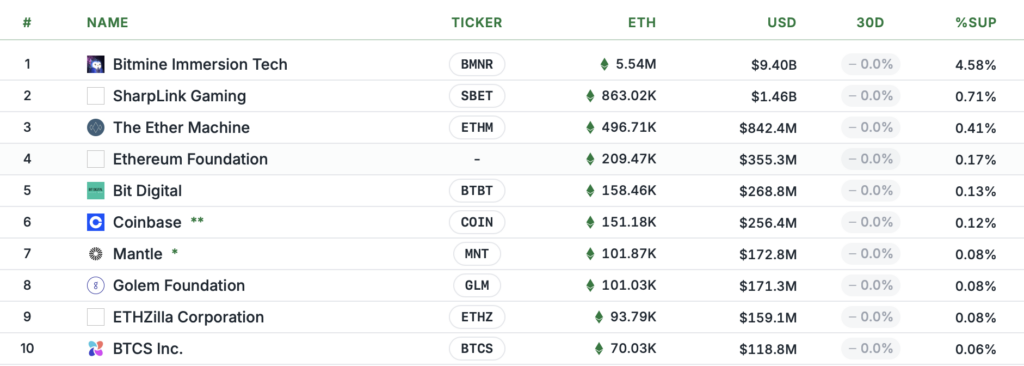
BitMine Immersion Technologies (BMNR) continues to aggressively build its Ethereum reserves. During the week ending August 2, it purchased another 10,399 ETH, increasing its total holdings to almost 5.8 million ETH. The purchase itself was worth approximately $19 million. BitMine also repurchased 4.5 million of its own shares, continuing its combination of Ethereum accumulation and share buybacks. The latest purchase followed the previous week’s acquisition of another 9,946 ETH. According to the company, BitMine has been buying Ethereum every week since launching its ETH treasury strategy in June 2025. As of August 2, it held 5,797,813 ETH, representing approximately 4.8% of the total supply of 120.7 million ETH. The company had therefore reached approximately 96% of its long-term goal, referred to as the “Alchemy of 5%” — an effort to own approximately 5% of Ethereum’s total supply.
10 largest corporate Ethereum holders:
Source: strategicethreserve.xyz
An important part of BitMine’s strategy is not simply holding the cryptocurrency. Of its approximately 5.8 million ETH, the company had more than 4.9 million ETH staked as of August 2, representing approximately 85% of its reserves. At the prevailing staking yield, the company estimated its annual staking revenue at approximately $247 million. If it were eventually able to stake practically its entire ETH portfolio through the MAVAN platform and other partners, the company estimated potential annual staking rewards at approximately $291 million. Staking is one of the main differences between BitMine’s strategy and Strategy’s Bitcoin treasury model. Bitcoin held on a corporate balance sheet does not itself generate yield, while Ethereum can be used to secure the network and generate staking rewards. BitMine therefore aims not only to profit from potential ETH price appreciation, but also to use its reserves as a yield-generating asset.
BitMine Chairman Tom Lee also links further purchases to Ethereum’s relative performance. In July, ETH outperformed the Nasdaq 100 by approximately 2,500 basis points, or 25 percentage points, according to company data. This was its strongest monthly outperformance since July 2025. The company also continued repurchasing its own shares. It bought back 4.5 million shares during the week, bringing the total number of shares repurchased since the beginning of July to approximately 16.1 million. The buyback is part of a previously approved share repurchase program worth up to $4 billion. Management explains the move by saying that it considers BitMine shares attractive relative to the company’s value and its ETH reserves.
The total value of BitMine’s cryptocurrencies, cash, marketable securities and other investments stood at approximately $11.3 billion as of August 2. In addition to Ethereum, the company held 209 BTC, $173 million in cash and marketable securities, and investments in Beast Industries and Eightco Holdings. Source
Strategy Sells Bitcoin and the STRC Model Comes to Solana
Strategy (MSTR) continues to change the way it manages its Bitcoin reserves. During the previous week, it sold 1,638 BTC for approximately $104.7 million and raised an additional $290.6 million through the sale of 3.01 million MSTR common shares. The company used part of the capital to repurchase its preferred STRC shares. Strategy repurchased approximately 912,000 STRC shares for $81.2 million. The Bitcoin sale reduced its holdings at the time to 842,138 BTC, acquired for a total purchase price of approximately $63.5 billion. The average purchase price therefore stood at approximately $75,419 per BTC. The company also increased its cash reserve by $250 million to a total of $4 billion.
Strategy subsequently continued with a similar approach this week. On Monday, it announced the sale of another approximately 1,690 BTC for $108.6 million and repurchased more than 1.15 million STRC shares for the same amount. Its Bitcoin holdings consequently fell further to approximately 840,447 BTC. STRC, also known as Stretch, is Strategy’s variable-rate perpetual preferred stock. It currently offers a 12% annual cash dividend paid twice a month. However, the dividend rate is not guaranteed, as it can be adjusted by the company’s board. Strategy said it does not currently plan to reduce the 12% dividend rate until STRC trades more consistently near its stated value of $100 per share.
Interest in STRC is also extending beyond traditional financial markets. Solstice Finance introduced a new product on the Solana blockchain called strcUSX, which allows decentralized finance users to gain economic exposure to STRC’s dividend income and price risk. However, this does not involve tokenized Strategy shares, and holders of strcUSX do not gain ownership of the underlying STRC shares. Instead, users deposit the stablecoin settlement token USX into a vault holding a portfolio linked to STRC. They can then choose between two levels of risk and potential return.
The product is divided into a senior and junior tranche. The senior token SR-strcUSX has priority in income distribution and targets an annual yield of approximately 7%. The junior token JR-strcUSX receives the remaining income after the senior portion has been paid and targets a yield exceeding 20% APY. The higher potential return of the junior tranche is also associated with higher risk. If the value of STRC declines, losses are first absorbed by the junior portion. The senior tranche is therefore intended to be partially protected from STRC price fluctuations. Solstice says this is the first STRC-linked product available in the Solana ecosystem. Users can withdraw their funds after a seven-day unlock period or immediately for an additional fee. Yield accrues through the token’s increasing exchange rate rather than being paid as a separate dividend distribution.
The integration of STRC with DeFi shows how financial products created by Strategy are gradually moving into blockchain-based markets. While Strategy is selling part of its Bitcoin reserves and using capital to repurchase STRC, new products are simultaneously bringing the economics of these preferred shares directly into decentralized finance. Source
Grayscale Drops Plans for Cardano, Polkadot and Hedera ETFs
Grayscale Investments has withdrawn its plans to launch exchange-traded funds linked to Cardano (ADA), Polkadot (DOT) and Hedera (HBAR). The asset manager submitted three separate requests to the U.S. Securities and Exchange Commission (SEC) to withdraw the registration statements. In the filings, Grayscale said it no longer intends to proceed with the planned distribution of shares of the respective trusts. Importantly, these were not rejections by the SEC. The decision to discontinue all three proposed products was made by Grayscale itself.
Grayscale first introduced plans for a Cardano ETF in February 2025, while the proposal for a Polkadot-linked product followed later that month. Registration statements for ADA and DOT were subsequently filed on August 29, while the Hedera registration was submitted on September 9. The proposed funds were designed as passive investment products tracking the value of the respective cryptocurrencies after fees and expenses. However, none of the funds became effective and, according to Grayscale, no securities were sold or issued under the registrations. The decision comes during a period of weaker performance for all three cryptocurrencies. Since the beginning of the year, ADA has fallen by more than 41%, Polkadot has lost approximately 54% and Hedera approximately 35% of its value. The decline is even more pronounced compared with the period when Grayscale began preparing the ETF proposals. Since late February 2025, Cardano has recorded a decline of approximately 70%, Polkadot approximately 80% and HBAR more than 70%. Although the company did not provide a specific reason for abandoning the plans, the withdrawal of all three registrations within a short period suggests that Grayscale reassessed the economic or strategic importance of these products.
The cancellation of plans for ADA, DOT and HBAR also reduces the number of proposed single-token products in Grayscale’s pipeline. However, Grayscale remains a significant player in the cryptocurrency ETF market and currently lists 17 exchange-traded products on its website. These include the Bitcoin Mini Trust ETF, Ethereum Staking Mini ETF and Hyperliquid Staking ETF. The company therefore continues to expand its offering of digital asset products, although it appears to be taking a more selective approach when choosing new ETFs for individual cryptocurrencies. The withdrawal of the proposed funds also shows that simply filing for a cryptocurrency ETF does not automatically mean that the product will eventually enter the market. Asset managers may change their plans depending on market developments, expected investor demand, the regulatory environment or their own product strategy. In the case of altcoin ETFs, sufficient liquidity in the underlying asset and expectations of whether there will be real demand for the product after launch may also be important factors.
Grayscale’s decision therefore does not necessarily represent the definitive end of ETF products linked to Cardano, Polkadot or Hedera. If market conditions improve or investor demand increases, the company may return to similar products in the future. At the same time, the move suggests that after a period of rapid expansion in the cryptocurrency ETF market, asset managers may increasingly focus on products where they see the highest likelihood of sufficient demand and long-term viability. Source
Invest with Fumbi Today
Take advantage of the potential of cryptocurrencies easily, safely, and efficiently. Start investing with Fumbi with amounts starting from just €10. The Fumbi Algorithm in the Fumbi Index Portfolio tracks cryptocurrency market movements for you. If you want to create your own crypto portfolios, choose the Advanced Portfolios product, where you’ll have access to over 120 cryptocurrencies and templates created by our team, focusing on different areas of the crypto world.
OPEN PROFILEEncountered a term you don’t understand? No worries! All important crypto-related terms can be found in one place in our new Fumbi Dictionary.

Juraj Ostertag 
Fumbi


