
 3 min •
Juraj Ostertag
3 min •
Juraj Ostertag
What Is the CLARITY Act in the United States and Why Is It Important for the Future of Crypto?
The CLARITY Act, officially known as the Digital Asset Market Clarity Act, is one of the most important cryptocurrency-related legislative proposals in the United States. It has been under consideration in Congress since 2025 and aims to establish a clearer legal framework for the issuance, trading, and regulation of digital assets in the US.
Despite the significant legislative progress the proposal has already made, its future remains uncertain. The main question is whether it can be passed before the end of 2026. The uncertainty is largely driven by controversial issues such as stablecoin yields, DeFi regulation, investor protection, and potential conflicts of interest. In this blog, we will explain what the CLARITY Act is, how it classifies different types of assets, and what impact it could have on investors.
What Is the CLARITY Act?
The main objective of the CLARITY Act is to bring greater legal certainty to a market that operated for many years in the United States without a unified and clearly defined regulatory framework. Unlike laws that focus on only one specific area, the CLARITY Act addresses the broader functioning of the digital asset market as a whole.
US crypto companies have long faced uncertainty over whether certain tokens should be treated as securities, commodities, or an entirely different category of assets. Ambiguous rules make it more difficult for the entire market to operate, affecting token issuers, exchanges, brokers, asset custodians, and investors themselves.
This problem was particularly visible during Gary Gensler’s tenure as Chair of the US Securities and Exchange Commission, or SEC, from 2021 to 2025. During this period, the SEC took a number of legal actions against crypto companies and applied existing securities regulations to their activities. Meanwhile, the Commodity Futures Trading Commission, or CFTC, primarily supervised commodity derivatives and certain parts of the cryptocurrency market.
As a result, many companies were unsure which rules actually applied to them. A company seeking to launch a token, list a cryptocurrency on an exchange, or offer digital asset trading often faced legal risks even when it attempted to operate responsibly.
The proposal therefore aims to replace this uncertainty with a clearer legal framework designed specifically for blockchain-based assets. It is frequently discussed alongside the GENIUS Act, although the two pieces of legislation serve different purposes. The GENIUS Act primarily focuses on payment stablecoins and establishes rules governing their issuance, reserves, and consumer protection.
By contrast, the CLARITY Act has a broader scope. It addresses the functioning of the digital asset market as a whole, including digital commodities, trading platforms, brokers, asset custodians, and the division of responsibilities between the SEC and the CFTC. Although it also covers certain aspects of stablecoins, they are not its primary focus.
What Does the Act Mainly Focus On?
The Act addresses several long-standing problems in the US cryptocurrency market.
The first problem is the overlap between the responsibilities of different regulators. Both the SEC and the CFTC oversee parts of the cryptocurrency market, but each institution has a different role. Without clear rules, companies often do not know whether they are required to register with one regulator, both regulators, or neither of them.
The second problem is the unclear classification of tokens. A digital asset may function as a commodity in one situation, while the way it is sold may resemble a securities offering. The CLARITY Act therefore seeks to distinguish the asset itself from the way in which it was offered or sold.
The third problem is uncertainty regarding compliance. Crypto exchanges, brokers, and asset custodians need to know what type of asset they are dealing with so they can determine which rules apply to them. Without a clear framework, even companies that are attempting to comply with the law may face significant legal risks.
The fourth problem is investor protection. Clearer rules could improve market safety and transparency, as investors would have a better understanding of the assets they are purchasing, the entities behind them, and the regulations that apply. At the same time, clearer rules would reduce the scope for conflicting interpretations of existing regulations.
How Does the CLARITY Act Classify Digital Assets?
One of the key elements of the Act is its attempt to classify digital assets according to how they operate, how they are used within the market, and how they were initially sold.
One important category is digital commodities. These are blockchain-based assets that should not be treated as shares, bonds, or other traditional securities. Bitcoin, Ethereum, and XRP are frequently mentioned in this context. Bitcoin is generally regarded as a digital commodity. For Ethereum and certain other assets, such as XRP, the CLARITY Act establishes a mechanism through which they could be classified as digital commodities if specific conditions are met.
Another important category is stablecoins. These are digital assets whose value is linked to a stable underlying asset, most commonly the US dollar. This area is also addressed by the separate GENIUS Act, which primarily focuses on the regulation of payment stablecoins, including their issuance, reserves, and user protection.
The Act also addresses the concept of tokenized securities. These are traditional financial instruments, such as shares or bonds, that are recorded on a blockchain. Because the underlying asset remains a security, it should continue to be subject to securities regulations.
One of the key questions is when a blockchain network can be considered sufficiently decentralized. This distinction is particularly important because a token may initially be sold in a way that resembles an investment offering. Over time, however, the project may develop, the network may become less dependent on a single team or company, and the token itself may no longer have the same characteristics as a security.
The CLARITY Act therefore seeks to establish clearer rules for determining whether a digital asset should fall under securities regulation or be treated as a digital commodity.
What Would the Act Mean for Companies?
For crypto companies, the CLARITY Act could significantly change the way the US market operates.
For exchanges, the Act would introduce a clearer framework for listing and trading digital commodities. It would also reduce uncertainty over which regulator supervises their activities—the SEC or the CFTC. For brokers, the Act would more clearly define their obligations when facilitating transactions and handling client assets. In the area of asset custody, the rules would focus primarily on secure custody, the segregation of client assets from company assets, risk management, and the prevention of conflicts of interest.
Stablecoin issuers would primarily be affected by restrictions concerning passive yields on stablecoin balances. This issue is one of the most heavily debated elements of the proposal. Crypto projects would benefit from more predictable rules for determining the legal status of their tokens, raising capital, and gradually transitioning from a more centralized model to a decentralized network.
A clearer division of responsibilities between the SEC and the CFTC could also benefit traditional financial institutions. It would reduce regulatory uncertainty and make it easier for them to enter the digital asset sector.
What Impact Would the Act Have on Investors?
For investors, the CLARITY Act could introduce clearer rules, greater access to information, and broader access to investment opportunities involving digital assets.
One area that could change is initial coin offerings, commonly known as ICOs. These have often been difficult for US investors to access, primarily because of the unclear regulatory environment. A clearer legal framework could allow certain projects to raise capital in a more transparent and regulated manner.
However, this is also one of the most heavily criticised aspects of the Act. Opponents warn that if a larger proportion of cryptoassets falls outside the SEC’s direct supervision, retail investors may receive less information and benefit from a lower level of protection than investors in traditional securities. The key question therefore remains whether the Act would establish a balanced regulatory framework or give the crypto sector too much freedom to operate without sufficient oversight.
CLARITY Act Timeline
The CLARITY Act has been under consideration in Congress since 2025 and has gradually passed through several important legislative stages.
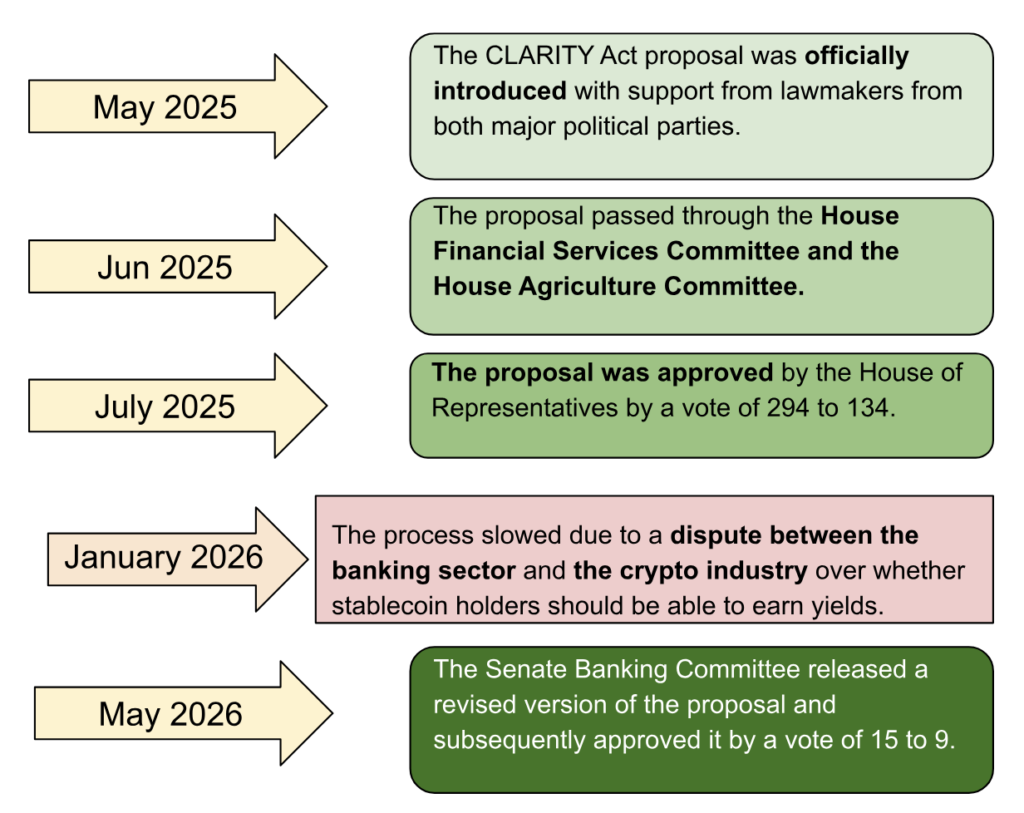
The proposal is currently moving through the Senate legislative process, although no exact date for a vote has yet been set. Even if the Senate approves its version, it will still need to be reconciled with the version passed by the House of Representatives. Only then could the legislation be presented to the president for signature. The final form of the Act therefore remains uncertain.
Criticism and Controversial Issues
Despite strong support from many lawmakers and the crypto industry, the CLARITY Act remains controversial.
One of the main issues concerns stablecoin yields. Banking groups warn that if stablecoin issuers were allowed to pay interest or passive returns, some deposits could move from traditional banks into stablecoins. The crypto industry, by contrast, argues that these concerns are exaggerated. Lawmakers therefore revised the proposal to prohibit passive yields paid by stablecoin issuers and certain third parties. However, some forms of rewards based on user activity could remain permitted.
Another issue involves conflicts of interest. Some Democrats supported amendments that would restrict federal officials from profiting from crypto projects. The debate was also connected to concerns about politicians’ links to digital assets. The proposal was viewed as a response to President Trump’s extensive cryptocurrency activities, which critics claim generated millions of dollars in profits for his family. However, the proposed amendment did not pass in committee.
Retail investor protection is also being debated. Critics argue that if many digital assets are moved outside the scope of securities regulation, investors may receive less information and weaker legal protection.
DeFi regulation remains another major issue. The current version of the CLARITY Act generally treats decentralized protocols as infrastructure rather than intermediaries that would be required to register in a similar way to traditional financial institutions. Supporters argue that this approach is important for protecting developers and technologies that allow users to manage their own cryptoassets. Critics, however, warn that it could leave large parts of the market without sufficient oversight.
Conclusion
The CLARITY Act is one of the most important attempts to establish clear rules for digital assets in the United States. Its primary objective is to determine which cryptoassets fall under securities laws, which should be treated as commodities, and which regulator should oversee each part of the market.
If passed, the Act could provide long-awaited certainty for crypto companies, traditional financial institutions, and investors. It could also make the United States more attractive as a location for digital asset innovation and development.
However, the legislation remains politically sensitive. Issues such as stablecoin yields, DeFi regulation, investor protection, and conflicts of interest continue to divide lawmakers. Until the Senate completes its work and a final version of the legislation is agreed upon, the future of the CLARITY Act remains uncertain.
Nevertheless, it is already clear that the CLARITY Act has significantly shaped the debate over cryptocurrency regulation in the United States. Regardless of whether it ultimately becomes law, it demonstrates that the country is gradually moving towards clearer and more systematic oversight of the digital asset market.
Invest with Fumbi Today
Take advantage of the potential of cryptocurrencies easily, safely, and efficiently. Start investing with Fumbi with amounts starting from just €10. The Fumbi Algorithm in the Fumbi Index Portfolio tracks cryptocurrency market movements for you. If you want to create your own crypto portfolios, choose the Advanced Portfolios product, where you’ll have access to over 120 cryptocurrencies and templates created by our team, focusing on different areas of the crypto world.
FREE REGISTRATIONEncountered a term you don’t understand? No worries! All important crypto-related terms can be found in one place in our new Fumbi Dictionary.

Juraj Ostertag 
Fumbi


